Step by step
What not to do
- Don't ask 'Do you want to...?' This invites a 'no' because it requires them to initiate and evaluate.
- Don't correct or criticize how they do the activity. The goal is engagement, not perfection.
- Don't leave them alone with an activity expecting them to continue. Your presence and modeling are part of what makes it work.
- Don't quiz or test their memory during the activity. Asking 'Do you remember this?' turns a pleasant moment into an exam.
Key points
- A person with dementia says "no" not because they don’t want to, but because they can’t initiate or feel the task is too hard.
- Start the activity yourself and invite them to join, don’t ask a yes/no question.
- Match the activity to their current ability level, not their past self. Simplify as needed.
- Focus on the process (the doing together), not the finished product.
- Use their past interests and roles to choose meaningful activities.
- End the activity before frustration sets in, and always have a backup plan.
Videos
 How Do You Keep A Dementia Person Busy?This video offers practical, real-world ideas for keeping a person with dementia engaged, including the rummage box technique and how to use parallel tasks.
 How to increase activity for someone with dementiaThis video explains the common reasons for refusal and gives step-by-step troubleshooting tips to increase activity participation.
 Dementia Friendly Activities To Do At Home With Your Loved OneA great resource for free, low-prep activities you can do indoors, regardless of ability level. Includes ideas for sorting, art, and sensory play.
 How To Entertain Someone With Dementia At Home?Focuses on how to use everyday objects and routines to create engaging activities, with tips for reducing caregiver stress.
2 more videos
 How to keep a dementia patient busyThis video covers the importance of routine and how to adapt activities as the disease progresses, with specific examples for each stage.
 How To Stop A 'Frustrating' Dementia BehaviorHelps you understand that challenging behaviors often stem from unmet needs or activity mismatch, and gives strategies to redirect without confrontation.
Background
Why They Say No: It’s Not Refusal, It’s a Skill Problem
When your loved one says "no" to an activity, it’s rarely because they don’t want to do it. More often, they cannot figure out how to start. Dementia damages the brain’s ability to initiate, the internal "volitional switch" that helps us begin a task. They may also feel the activity is beyond their current abilities, even if it was easy before. This is why a direct question like "Do you want to do a puzzle?" often gets a quick "no." The request feels like a test they might fail, so they decline to protect themselves from frustration or embarrassment.
The Activity Must Match Their Current Ability: Not Their Past Self
Dementia is an ever-changing disease, so an activity that worked last month may be too hard today. The key is to continually adjust to their current skill level. If the task is too difficult, they will feel anxious and shut down. If it’s too simple, they may feel bored or insulted. The goal is to find the "just right" challenge, something that feels meaningful and achievable. For example, instead of folding a full load of laundry, they might simply match socks or fold a single towel. The activity must also feel purposeful to them, not just busywork. A task that connects to their past roles, like wiping a counter if they were a homemaker, or sorting screws if they were a handyman, will feel more natural and engaging.
Engagement Is About the Process, Not the Outcome
Many caregivers focus on the finished product, the completed puzzle, the folded laundry, the painted picture. But for a person with dementia, the value is in the doing. The process of being together, feeling useful, and experiencing sensory stimulation is what matters. If they only sort three socks or stir the batter for two minutes, that is a success. Let go of your own expectations about what "done" looks like. When you shift your focus to the shared moment, you both feel less pressure and more connection.
Practical tools
4
The Rummage Box
A container filled with safe objects like fabric swatches, wooden spoons, large keys, or a small photo album. Place it on the table and explore it yourself to draw them in without a verbal request.
The 'Just Right' Challenge Checklist
Before offering an activity, ask:
If any answer is no, simplify until all answers are yes.
The Activity Journal
A notebook to record what worked, what didn't, time of day, mood, and energy. Over weeks, patterns emerge to guide planning.
A Personalized Music Playlist
A short playlist of songs from their teenage and young adult years on a simple speaker. Familiar music soothes agitation and can draw out engagement.
Different situations
Early-stage dementia (mild cognitive changes)
In early stages, the person may still be able to initiate activities but may feel anxious about failure. Use open-ended invitations like, "I’m going to work on this crossword, want to help with the clues?" They can still do many of their usual hobbies with slight modifications, like using a large-print book or playing simpler card games. Encourage them to continue social activities but in smaller groups to reduce overwhelm.
Middle-stage dementia (moderate cognitive decline)
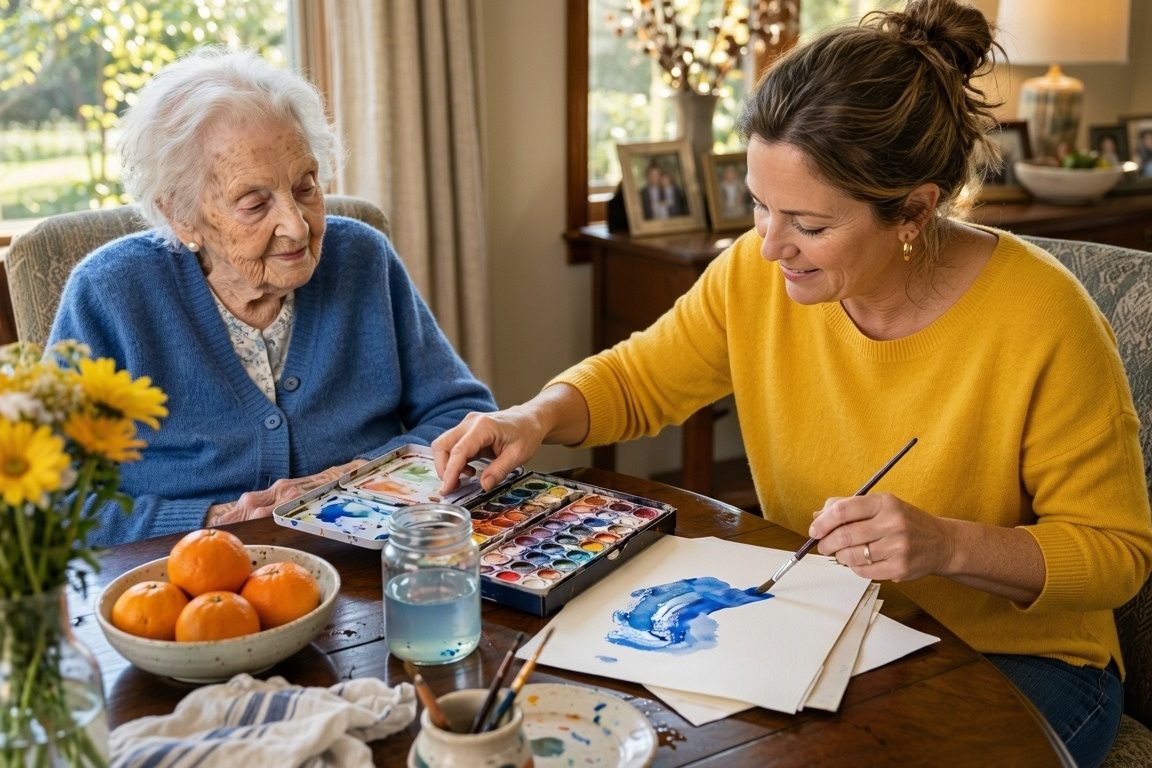
At this stage, they need more hands-on guidance. Use the "parallel task" approach frequently. Activities should be repetitive and sensory, folding towels, sorting objects, or doing simple art like painting with watercolors. Avoid anything that requires sequencing (like following a recipe). Focus on the process, not the product. They may also enjoy music from their youth, sing along or play an instrument together.
Late-stage dementia (severe cognitive decline)
In late stages, the person may be bed-bound or have limited mobility. Activities should focus on sensory stimulation: gentle hand massage with lotion, listening to familiar music, looking at a photo album, or feeling different textures (soft fabric, a smooth stone). Use simple, one-step instructions like, "Hold this," or "Feel this." The goal is comfort and connection, not task completion. Always monitor for signs of distress.
Lewy body dementia (fluctuating cognition, visual hallucinations)
People with Lewy body dementia often have unpredictable good days and bad days. On good days, they may enjoy activities like sorting or simple crafts. On bad days, they may be too confused or have visual hallucinations that make activities frightening. On those days, stick to calming, familiar activities like listening to music or sitting quietly together. Avoid activities with complex patterns or bright lights, which can trigger hallucinations. Always have a backup plan for when cognition suddenly drops.
Frontotemporal dementia (behavioral changes, loss of empathy)
This type often affects behavior and personality first. The person may lose interest in activities they once loved or show inappropriate behaviors. Focus on activities that provide sensory input or physical movement, like walking, sorting objects, or listening to music. Avoid activities that require social skills or empathy, like board games. Use redirection gently if they become fixated on a repetitive behavior, offer a different object to hold or a new task to do.
Common questions
14
How do I choose activities matching past interests and current abilities and start them without forcing?
Begin the activity yourself with a simple, familiar step, like folding a towel or humming a favorite song, and invite them to join you with a warm smile and no yes/no question.
How can I help a person with dementia maintain independence in daily tasks like toothbrushing?
For toothbrushing, hand them their toothbrush already with toothpaste and start brushing your own teeth alongside them, mirroring the steps without giving commands.
What categories of activities should fill a day for a person with dementia and caregiver?
Fill the day with a gentle rhythm of meaningful categories: morning self-care, a simple chore or sensory activity, a social or music moment, and a calm, restful period to prevent fatigue.
How can I use creative distractions to prevent my loved one from getting upset?
If they start to get upset, shift focus to a soothing object or topic they love, like a soft cloth to fold or asking about a childhood memory, without explaining the distraction.
How can I help my spouse with dementia have better days by adding meaning to daily activities?
Weave purpose into daily tasks by linking them to their past role, such as asking them to 'help set the table for our guests' or 'fold these towels for the family' instead of just tidying up.
How do I engage late-stage residents without high-functioning activities?
For late-stage residents, focus on gentle, sensory-based engagement, like holding a soft brush while you stroke their hand, or playing a familiar song and softly singing along, without expecting any active participation.
How can I get my loved one to start an activity without forcing them?
Instead of asking 'Do you want to...?', simply begin the first step yourself, like picking up a gardening trowel and touching soil, and invite them with a gesture and a kind 'Come help me with this.'
How can I package activity so it feels natural and not like exercise?
Package activity as a natural part of the day, like saying 'Let's sort these socks together while we chat' instead of labeling it exercise or occupational therapy.
How can I get my loved one with dementia to be active when they don't want to do anything?
When they resist, drop the original plan and start a very simple activity yourself, like wiping a counter or watering a plant, then gently invite them to 'just hand me that cloth' so they feel helpful, not pressured.
How can I engage a person with dementia by using their established interests?
Use their established interests by, for example, if they loved baking, set out a bowl and spoon and stir some dry ingredients together with them, focusing on the familiar motions rather than the recipe.
4 more questions
How can offering choices promote engagement during care tasks?
During care tasks like dressing, offer two simple, visible choices, 'Do you want the blue shirt or the red one?', and hold each up, giving them control without overwhelming them.
How do I create meaningful social activities for an isolated person with dementia?
Create meaningful social activity by inviting one calm friend over for a specific, short shared task, like looking at a photo album together for 10 minutes, rather than open-ended visiting.
How do I get my loved one to be active when they refuse?
When they refuse, put the activity aside and invite them to join you in something you've already started for yourself, like 'I'm just collecting the mail, come walk with me' without making it about exercise.
How do I get a person with dementia to start an activity on their own?
A person with dementia cannot start an activity on their own due to the disease, you must take the first step yourself, like placing a familiar object in their hand and beginning the motion for them.
For the doctor
4
- Before starting any new physical activity (like chair yoga or tai chi), ask your loved one’s doctor or physical therapist if it is safe given their current health and mobility.
- If your loved one shows sudden resistance to activities they previously enjoyed, discuss with their doctor, this could be a sign of an underlying medical issue like pain, infection, or depression.
- If you are considering using any calming supplements or medications to help with agitation during activities, always consult their prescribing clinician first. Never give over-the-counter sleep aids or anxiety medications without medical guidance.
- If your loved one has a history of falls, ask their doctor or occupational therapist for specific activity modifications to reduce fall risk (e.g., seated activities only).