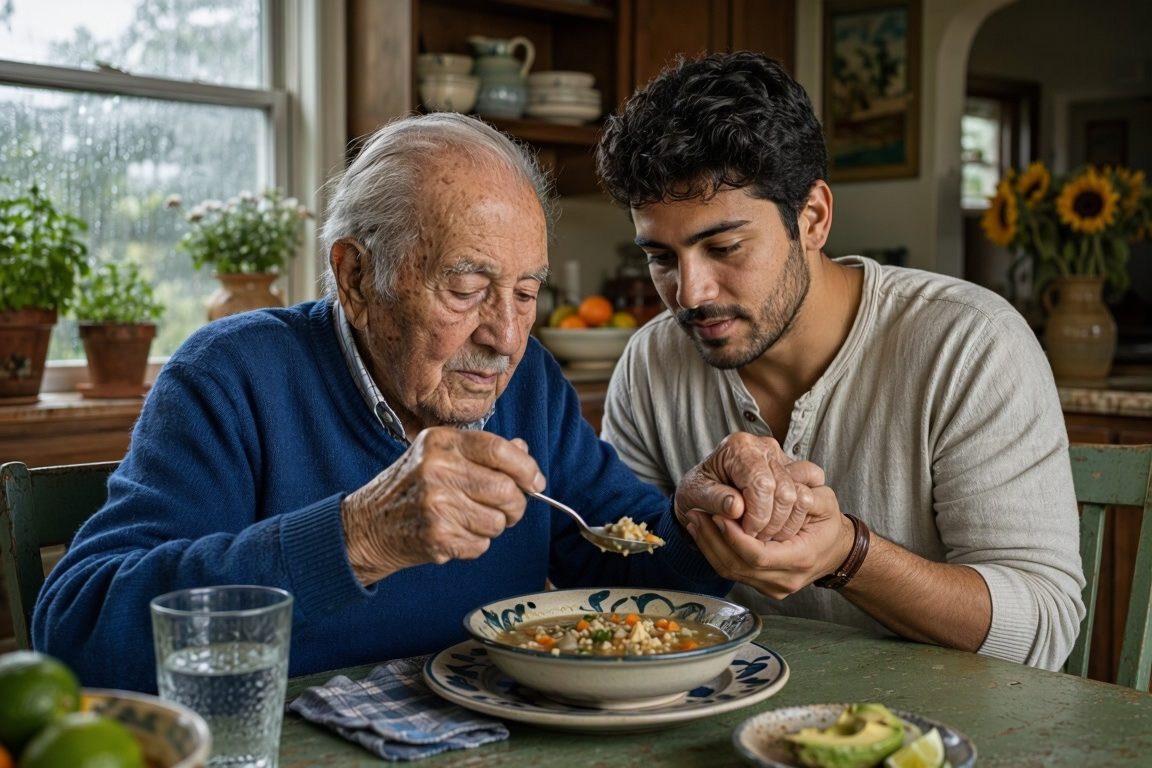
Step by step
What not to do
- Do not place your hand on top of theirs to guide, this removes control and can trigger refusal.
- Do not serve a full plate of food, large portions are visually overwhelming and increase pressure.
- Do not ask 'Do you want to eat?', they may refuse automatically due to confusion; assume the activity.
- Do not force food into their mouth or rush them, this risks choking, aspiration, and loss of trust.
- Do not ignore physical discomfort (sore gums, ill-fitting dentures, hand/shoulder pain), address with a dentist or doctor first.
- Do not serve dry, crumbly, or hard foods, offer soft, moist foods as swallowing becomes harder.
Key points
- Hand-under-hand means placing your hand under the person's hand to guide the utensil, not on top of it. This preserves their sense of control and dignity.
- Refusal to eat is often due to brain changes (visual agnosia, loss of hunger cues), physical discomfort, or overwhelm, not stubbornness.
- Use small portions on a contrasting-color plate to reduce visual confusion and pressure.
- Finger foods and smoothies are excellent alternatives when utensils become too difficult.
- Create a calm, distraction-free environment with a consistent routine to reduce anxiety at mealtime.
- If the person refuses, stop and try again later. Forcing food can damage trust and lead to choking or aspiration.
Videos
 Ep. 264: Dinner is ServedThis video demonstrates the hand-under-hand technique in real-time during a meal, showing how to guide a person with dementia to eat while maintaining their dignity.
 Dementia Caregiving: How to Get Them to EatOffers practical tips for motivating a person with dementia to eat, including the use of finger foods and small portions, which complement the hand-under-hand approach.
 SUP! How This Team Sparked SuccessShows how a care team can work together to support eating, including using hand-under-hand and other gentle cues, especially useful for facility settings.
 Time with Teepa - What is Autotopagnosia?Explains how the brain can misinterpret body parts and objects, which is directly relevant to why a person with dementia might not recognize a spoon or their own hand during eating.
2 more videos
 Why Meal Refusal Happens with Dementia (And How to Tackle It Without a Fight)Provides a deep dive into the reasons behind meal refusal and offers non-confrontational strategies, including hand-under-hand, to address it.
 The Baffled Brain Demystifying Dementia Episode 30 June 26 2021Covers the cognitive changes that affect eating, such as agnosia and apraxia, and how to adapt your approach accordingly.
Background
Why Refusal Happens: It's Not About Being Difficult
A person with mid-to-late stage dementia may refuse food for reasons that have nothing to do with being stubborn. Their brain may no longer register hunger or thirst cues (source 5). The visual system can also play tricks: a pile of mashed potatoes might look like a dirty puddle, and spaghetti might appear as a tangle of wires (source 13). This is called visual agnosia, and it's a real neurological problem, not a choice. Additionally, the person may have physical discomfort, sore gums, ill-fitting dentures, arthritis in their hands, or pain from a shoulder injury, that makes eating painful, but they may not be able to communicate this (source 11). Fatigue also plays a role; by the time a meal is served, they may already be exhausted from the effort of the day (source 9).
The Loss of Independence and the Power of Control
For a person with dementia, eating may be one of the last activities they can still do on their own. When a caregiver reaches over and places a hand on top of theirs to guide the spoon, it can feel like a loss of control, a reminder of what they can no longer do (source 3). This can trigger frustration, anger, or a complete shutdown. The hand-under-hand technique flips this dynamic. By placing your hand under theirs, you become a support rather than a director. You are doing with them, not to them. This preserves their dignity and sense of agency, which is crucial for cooperation and emotional well-being.
The Mechanics of Eating: More Complex Than You Think
Eating involves a series of complex motor skills: picking up a utensil, scooping food, bringing it to the mouth, and then chewing and swallowing. With dementia, these skills can deteriorate unevenly. A person may still have good mouth skills but poor hand skills, or vice versa (source 1). They may also lose the ability to recognize what a fork or spoon is for (source 15). This mismatch can lead to frustration and refusal. The hand-under-hand technique allows you to compensate for the skill they've lost while letting them use the skills they still have. For example, if their hand can't scoop but their mouth can manage a bite, you guide the utensil to their mouth. If their mouth is less skilled, you might offer a cup with a lid or a straw to make drinking easier.
Practical tools
5
Contrasting Plate
Use a solid, bright red or blue plate so food visually stands out; avoid white plates on white surfaces where food blends in.
Finger Food Tray
Offer a tray with easy-to-pick items (soft carrot sticks, cheese cubes, banana pieces, small sandwiches, boiled eggs) for self-feeding without utensils.
Smoothie or Nutritional Drink
Provide a smoothie (yogurt, fruit, protein powder) or commercial drink in a cup with a lid and straw, or freeze into popsicles for easier hydration.
Hand-Under-Hand Script
Use phrases: 'Let me help you with that spoon. I'll put my hand under yours, and we'll do it together.' 'Here comes the bite.' Avoid commands like 'Eat this.'
Upright Seating Check
Ensure the person sits fully upright (90-degree angle) with head tilted slightly forward before meals to protect the airway and reduce aspiration risk.
Different situations
Late-stage dementia (stage 7 on the Global Deterioration Scale)
At this stage, the person may have lost the ability to use utensils entirely and may need pureed foods or thickened liquids to prevent choking. Hand-under-hand may still work, but you may need to guide their hand to their mouth more actively. Focus on comfort and dignity rather than nutrition; small amounts of favorite foods are enough. Also, be aware that the person may be nearing the end of life, and forcing food can cause distress (source 8, 12).
Lewy body dementia or Parkinson's disease dementia
These conditions often involve tremors, rigidity, and difficulty with fine motor control. The person may have trouble holding a utensil or bringing it to their mouth without spilling. Hand-under-hand can provide the stability they need. Also, they may have swallowing difficulties (dysphagia) earlier in the disease, so consult a speech therapist for safe food textures. Finger foods may be easier than using utensils (source 9, 15).
Caregiver is a spouse vs. an adult child
A spouse may have a long history of shared meals and may feel more comfortable using hand-under-hand because of the existing trust. However, a spouse may also be more emotionally invested and may need to practice staying calm and not taking refusal personally. An adult child may need to build trust first; start with small, non-mealtime interactions (like holding hands during a walk) before attempting hand-under-hand at meals.
Person lives in a care facility
In a facility, you may need to train staff on the hand-under-hand technique. Ask to be present during meals to model the approach. Also, request that the person be seated at a small table with only one or two other residents to reduce overstimulation. If the facility uses a 'feeder table' (a group table where staff assist multiple people), advocate for one-on-one assistance if possible (source 15).
Person has Medicaid or limited financial resources
You don't need expensive tools. A red plate can be bought at a dollar store. Smoothies can be made with inexpensive ingredients like bananas, yogurt, and milk. Finger foods can be leftovers from your own meals. Focus on the technique, not the products. If you need nutritional supplements, ask the doctor about getting them covered by Medicaid or through a local food bank.
Common questions
12
How can love languages, especially touch, help a person with dementia eat and feel understood?
Use hand-under-hand guidance to gently bring the spoon to their mouth, pairing it with a soft touch on their arm or shoulder to communicate safety and care without overwhelming them with words.
How can I help a person with dementia eat without breaking their momentum?
Keep the plate steady and your guiding hand under theirs, moving in a slow, steady rhythm; pause briefly between bites to let them chew and swallow, then gently lift the utensil again.
How do I handle food refusal or hoarding in a person with dementia?
If they refuse, calmly remove the plate and try again in 20–30 minutes with a small, familiar finger food like a soft sandwich quarter or a smoothie in a spill-proof cup, avoiding any scolding or pressure.
How can I add calories and improve my loved one's appetite?
Boost calories by adding a tablespoon of butter, cream, or nut butter to warm cereals, mashed potatoes, or soups, and offer high-calorie smoothies with yogurt and banana between meals.
How do I handle daily challenges like kitchen interference and getting ready for outings?
For kitchen interference, gently guide them to a safe seat with hand-under-hand while you prepare a simple prep task like washing lettuce; for outings, start the routine earlier and break steps into single, calm actions with verbal cues like 'let's put your arm in the sleeve.'
How do altered tastes and sweet cravings affect feeding in late dementia?
Offer sweet, soft foods like pudding, custard, or mashed sweet potatoes as they often still appeal despite taste changes, and blend regular meals into a sweet base like applesauce to ensure balanced nutrition.
How do I give pills to someone with trouble swallowing or who refuses?
Crush pills (if safe) and mix into a spoonful of applesauce, pudding, or ice cream, then use hand-under-hand to guide the spoon; if they refuse, call the doctor about liquid or dissolvable forms.
How can I prevent and detect malnutrition in my elderly loved one?
Monitor for unexplained weight loss, loose-fitting clothes, or uneaten food on the plate, and track what they actually eat for three days to share with their doctor or dietitian.
How do I stimulate appetite in late-stage residents who need to be hand-fed?
Offer small, soft bites like scrambled eggs or mashed avocado directly from a spoon using hand-under-hand, and add a flavorful drizzle like gravy or fruit syrup to stimulate smell and taste.
What device can help someone with tremors eat without dropping food?
A weighted spoon or fork with a built-up handle can reduce tremors; cup their hand with yours underneath to stabilize the utensil and guide it gently to the plate.
2 more questions
What visual and motor changes should I look for when a person with dementia is eating?
Watch for them staring at food without reaching or missing the plate with the utensil, these can signal visual or motor issues; use a contrasting plate color and place a hot pad under the plate to keep it still.
How can I reduce mess during meals?
Serve meals in a deep bowl instead of a flat plate, use a bib-style napkin with a catch pocket, and place a damp towel under the plate to keep it from sliding.
For the doctor
5
- If the person has significant weight loss (more than 5% of body weight in a month), ask the doctor about a referral to a dietitian or a speech-language pathologist for a swallowing evaluation.
- If the person has pain in their mouth, jaw, or hands, ask their dentist or doctor to check for dental issues, ill-fitting dentures, or arthritis that could be making eating painful.
- If the person is on medications that cause nausea, dry mouth, or loss of appetite, ask the doctor if the dosage or timing can be adjusted to improve mealtime (source 11).
- If the person has difficulty swallowing (coughing, choking, or pocketing food in their cheeks), ask for a swallowing assessment before changing food textures. Do not thicken liquids or puree foods without professional guidance.
- If the person is in late-stage dementia and refusing all food and fluids, discuss palliative care options with the doctor. Forcing food at this stage can cause aspiration and distress; comfort care may be more appropriate (source 20).