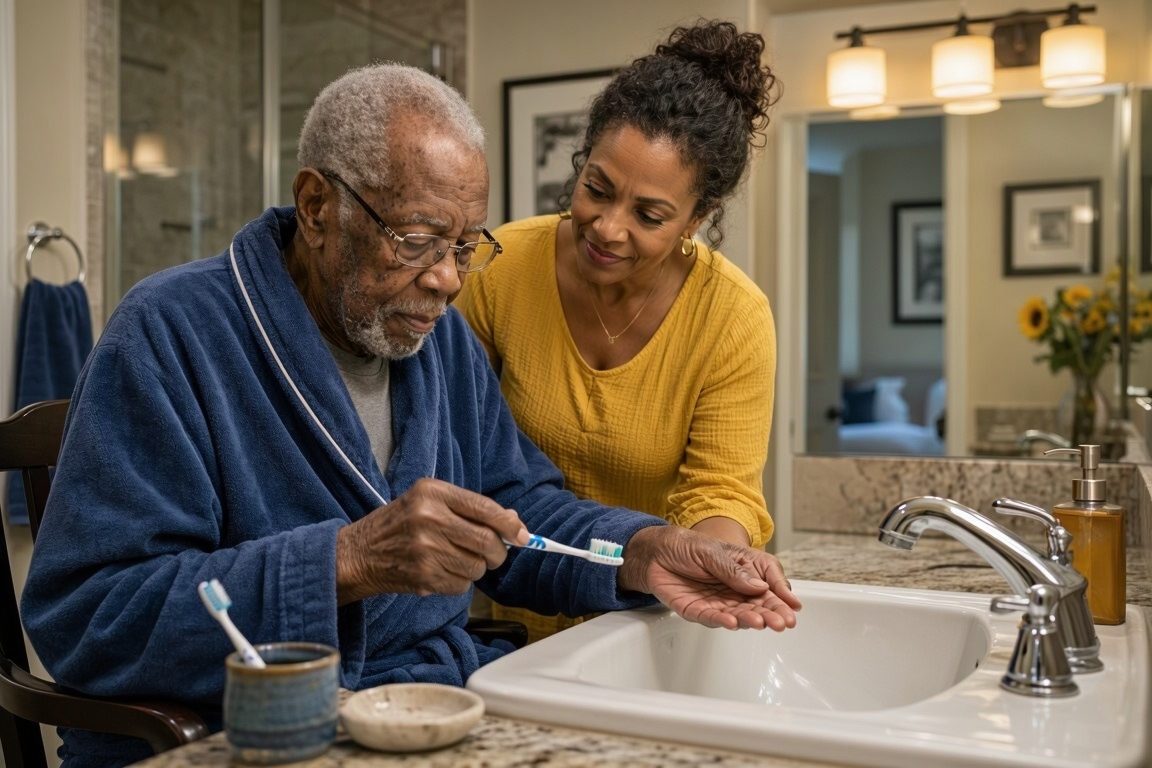
Step by step
What not to do
- Do not try to pry the mouth open with your fingers or the toothbrush. This can cause pain, fear, and a stronger clench.Instead, use the empty spoon or straw cue to trigger a natural opening.
- Do not give multiple instructions at once, like ‘Open your mouth, tilt your head, and spit.’ This overwhelms the person’s processing ability. Give one step at a time: first ‘Let’s hold the brush,’ then ‘Let’s bring it to your lips,’ then ‘Let’s open.’
- Do not stand behind the person to brush their teeth if they are in late stage. This can feel like an attack. Always approach from the front, at eye level, so the person can see you and feel safe.
- Do not use flavored toothpaste or mouthwash without checking for swallowing risk. If the person may swallow, use plain water or baking soda toothpaste instead. Consult the dentist or doctor before using any rinse.
- Do not rush the process. If you are in a hurry, your tension will transfer to the person. Allow at least 10–15 minutes for mouth care. Slow down, breathe, and treat it as a shared activity rather than a chore.
Key points
- Hand-under-hand gives the person a sense of control and reduces resistance during mouth care.
- Use an empty spoon or straw to cue the mouth to open naturally, rather than prying it open.
- Keep the person’s other hand busy with a washcloth or small object to reduce grabbing and pushing.
- In late-stage dementia, the main goal is mouth comfort and moisture, not perfect brushing.
- Approach from the front, at eye level, and give one step at a time to avoid overwhelming the person.
- Always consult a clinician before using any product that could be swallowed, such as mouthwash or toothpaste.
Videos
 Ask Teepa Anything! Live on YouTubeTeepa Snow demonstrates hand-under-hand for mouth care and explains how to use an empty spoon or straw to cue the mouth to open, which is the core technique for this sub-article.
 Oral Care Tips for Loved Ones with DementiaThis video covers step-by-step oral care for dementia, including positioning, using a soft toothbrush, and what to do if the person clenches or refuses.
 Oral Hygiene Concerns and Options for GEMS States | Teepa's ClipsTeepa explains how oral care needs change across dementia stages, with specific advice for late-stage (sapphire and diamond GEMS) where hand-under-hand is most critical.
 6 ways to make dementia care tasks easier: Respect and Dignity in dementia careThis video offers practical tips for reducing resistance during care tasks, including giving the person something to hold, which is a key tool for mouth care.
2 more videos
 Dementia Toileting problemsWhile focused on toileting, this video discusses the hand-under-hand technique and the importance of cueing instead of doing, which applies directly to mouth care.
 How to get someone with dementia to accept help from others: 5 tips (plus bonus)This video offers strategies for introducing a new caregiver, which is useful if you are hiring help for mouth care or if the person is in a facility.
Practical tools
5
The empty spoon or straw cue
Keep a clean, dry spoon or a straw nearby. Before bringing the toothbrush to the mouth, gently touch the spoon or straw to the person’s lips. Their brain may interpret this as a cue for eating or drinking, and they may open their mouth reflexively. Once open, you can slide the toothbrush or oral swab in. This is especially useful when the person is clenching or turning away.
Something to hold in the other hand
Offer the person a small washcloth, a soft book, or a textured object to hold in their free hand. This keeps their hands occupied and reduces the likelihood of them grabbing the toothbrush or pushing you away. It also gives them a sense of purpose and control. Say something like, ‘Can you hold this for me while we brush?’
Moistened gauze pad or oral swab
If a toothbrush is too threatening, use a piece of moistened gauze wrapped around your finger (under the person’s hand) or a soft foam oral swab. Gently wipe the inside of the cheeks, gums, and tongue. This is less invasive and can be more acceptable in late-stage dementia. It also helps remove food debris and keep the mouth moist.
Suction toothbrush (discuss with clinician)
For people at high risk of aspiration, a suction toothbrush that removes saliva and toothpaste as you brush can be a game-changer. Discuss this with the person’s dentist or doctor to see if it is appropriate. It reduces the risk of choking and makes mouth care safer.
Baking soda toothpaste or plain water
If there is a concern that the person may swallow toothpaste, use a small amount of baking soda toothpaste (which is safe to swallow) or simply use plain water on the toothbrush. Avoid anti-plaque rinses unless the doctor or dentist has cleared them, as they can be harmful if swallowed.
Different situations
Late-stage Alzheimer’s disease
The person may have very limited ability to follow verbal cues. Focus entirely on non-verbal cues like the empty spoon or straw. Use hand-under-hand for every step. The goal is comfort and moisture, not thorough cleaning. Expect to do most of the work yourself, but always with the person’s hand under yours.
Lewy body dementia (LBD)
People with LBD often have fluctuating cognition and may be more sensitive to touch and light. Use very gentle pressure and avoid sudden movements. The hand-under-hand approach should be extra slow. If the person has visual hallucinations, they may misinterpret the toothbrush as something frightening. Use a familiar object like a cloth or their own finger wrapped in gauze.
Spouse vs. adult child caregiver
A spouse may have a long history of intimacy, which can make mouth care feel less invasive but also more emotionally charged. Use hand-under-hand to maintain the partner dynamic. An adult child may need to establish a new caregiving role; using hand-under-hand can help the parent feel less like a child and more like a collaborator. In both cases, speak in a calm, familiar voice and use the person’s preferred name.
In a facility setting
If the person is in a memory care unit or nursing home, coordinate with staff to ensure consistency. Share the hand-under-hand technique with the care team. If the person is used to a particular caregiver, ask that person to do mouth care. Use the same tools and cues each time to build a routine. If the person is resistant, try a different time of day or a different location (e.g., in a chair by the window instead of in bed).
Medicaid or limited resources
You do not need expensive tools. A soft cloth, a cup of water, and a spoon are often enough. Use a clean sock or washcloth as a makeshift oral swab. If you cannot afford a suction toothbrush, use a bulb syringe to gently suction saliva after brushing (discuss with a clinician first). Focus on the hand-under-hand technique itself, which costs nothing.
For the doctor
4
- Ask the person’s dentist or doctor about using a suction toothbrush if there is a high risk of aspiration.
- Consult with a clinician before using any anti-plaque rinse or mouthwash, especially if the person may swallow it.
- If the person has dentures and is unable to remove them, ask the dentist for guidance on how to clean them safely without causing discomfort.
- Discuss the use of saliva substitutes or oral moisturizers if the person’s mouth is chronically dry, as some products may be safer than others.