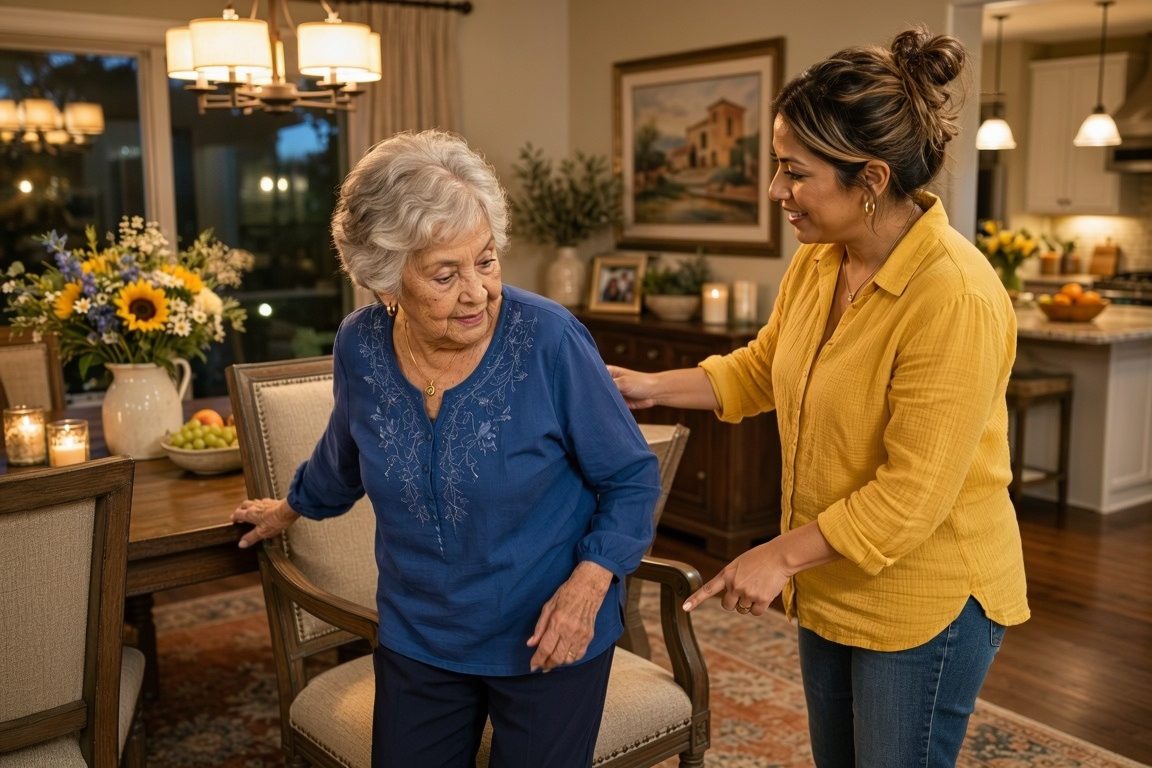
Step by step
What not to do
- Don't say 'Calm down' or 'Relax.' Respond to the feeling: 'I know this is scary. I'm right here.'
- Don't grab or pull. Use gentle guidance and let them control speed.
- Don't give a long string of instructions. Break into one step at a time.
- Don't argue or correct them. Acknowledge their feeling instead.
- Don't rush. Allow extra time for each step.
Key points
- Break the task into one simple step at a time, don't front-load the whole instruction.
- Slow down and allow extra time for processing (latency). Rushing creates anxiety and resistance.
- Use a calm, gentle voice and reassuring touch. Respond to feelings, not logic.
- Prepare the environment: good lighting, stable chair, minimal distractions.
- If they resist, stop, redirect, and try again later. Never force or argue.
- Always prioritize safety and comfort over speed or efficiency.
Videos
 Time with Teepa – Car Transitions Made EasierTeepa Snow demonstrates how to help someone with dementia get in and out of a car, which uses the same principles of sequencing and gentle guidance. This video is directly relevant to sitting transfers.
 How to communicate with a dementia patientThis video covers the core communication techniques, simple words, eye contact, gentle tone, that are essential for any care task, including sitting.
 Professional Alzheimer's & Dementia Training & TipsThis training video offers professional-level strategies for handling resistance and agitation, which are common when trying to assist with sitting.
 How Do You Control Sundowning?Sundowning can increase fear and agitation, making sitting harder. This video provides calming techniques that can be used before or during a sitting transfer.
2 more videos
 Zinnia Caregiver Support - Eating and DementiaWhile about eating, this video emphasizes creating a calm, consistent environment and using simple routines, principles that apply directly to sitting.
 DO NOT Say CALM DOWN! (What to Say Instead!) "What *NOT* To Do in Dementia"This video explains why certain phrases backfire and offers alternatives, which is critical when a person resists sitting.
Background
Why Sitting Can Be So Hard
For someone living with dementia, the brain's ability to process multiple steps at once is significantly impaired. What feels like a simple action to you, walk to the chair, turn around, bend your knees, lower yourself, is actually a chain of many individual movements. When you ask them to 'sit down,' you're essentially asking them to execute a complex series of commands that their brain can no longer sequence easily. This can lead to confusion, hesitation, and what looks like refusal, but is often just an inability to process the request.
Additionally, fear plays a huge role. Many people with dementia experience poor depth perception, making it hard to judge the distance to the chair. They may also have a genuine fear of falling, which is very common. When you rush or use too many words, you add to their anxiety. As one expert notes, people with dementia often feel scared, lonely, and out of control. Your job is to be a calming, reassuring presence who breaks the task down into tiny, manageable pieces.
The Power of One Step at a Time
Instead of saying, 'Let's sit down in this chair,' you want to give one simple instruction at a time. For example, you might start with, 'Turn around,' and wait for them to process and do that. Then, 'Take a step back.' Then, 'Reach for the arm of the chair.' By breaking it down, you reduce the cognitive load and make the task feel achievable. This approach, often called 'chunking,' respects their current abilities and gives them a sense of control and accomplishment.
It's also crucial to slow down. People with dementia often have a delayed response time, called latency. They need extra seconds to hear your words, understand them, and then initiate the movement. If you rush, you'll create anxiety for both of you, and they may shut down or push back. Patience is not just a virtue here, it's a practical tool.
Practical tools
4
One-Step Phrase Bank
Use a short mental list of one-step commands like 'Turn around,' 'Reach for the arm,' 'Bend your knees.' Use the same phrases each time and point to the object.
Comfort Touch
A steady, warm hand on the shoulder can communicate safety. If they pull away, switch to verbal reassurance only.
Distract and Redirect
When they refuse, say 'Look at that bird' or 'I hear your favorite song.' Once attention shifts, gently guide toward the chair.
Feeling First Script
When fear appears, say: 'I see you're worried. That's okay. I'm here. We'll do this together.' Pause and let them feel heard before moving on.
Different situations
Late-stage dementia / bed-bound
If the person is in bed, the goal is to sit up on the edge of the bed before standing. Use the same one-step commands: 'Roll toward me,' then 'Swing your legs over the edge.' Use a pillow for back support. Never lift them alone, use a gait belt or call for assistance.
Frontotemporal dementia (FTD) with rigidity
People with FTD may be very rigid and resistant to any change in position. Use a firm but calm tone. Give clear, direct commands without negotiation. Sometimes a gentle, unexpected distraction (like a favorite snack) can break the rigidity. Be prepared for a longer process.
Spouse vs. adult child caregiver
A spouse may be more familiar and trusted, but also more likely to be resisted due to role reversal. An adult child may need to use more 'professional' language and avoid parent-child dynamics. In both cases, use the same gentle, step-by-step approach, but be aware of emotional triggers.
In a care facility
In a facility, you may have less control over the environment. Ask staff to reduce noise and distractions. Use the person's preferred name and familiar routines. If the person is agitated, a change of scenery (a quiet room) can help before attempting to sit.
Lewy body dementia (LBD) with fluctuating cognition
In LBD, cognition can vary hour by hour. If they are alert, use the full step-by-step approach. If they are confused or drowsy, simplify even further: 'Sit here' with a point. Be extra cautious with balance, as LBD often involves Parkinsonism. Use a chair with arms and a firm seat.
Common questions
9
How can I reposition a person in bed without directly handling them?
Use a draw sheet under your loved one by rolling them gently side to side to place it, then pull the sheet to slide them up or turn them without direct lifting.
How can I prevent bedsores in an immobile loved one?
Reposition your loved one every two hours using pillows or padding to cushion bony areas, and check their skin daily for any red spots.
How do I use pillows and draw sheets to keep a person stable and comfortable in bed?
Place a pillow under their knees to prevent sliding, one on each side to keep hips aligned, and use a draw sheet under their back to adjust their position smoothly.
How can I provide the right amount of cueing to help someone complete a task?
Give just one simple cue at a time, like 'let's move your hand here,' then pause and wait for them to process before giving the next cue.
How can I help my loved one complete tasks they can still do?
Offer the first step of a task, like handing them a washcloth, then step back and let them finish what they can, only stepping in if they get stuck.
How can caregivers help someone with arthritis manage pain and maintain mobility?
Encourage gentle movement like finger squeezes or short walks, and talk to their doctor about heat packs or gentle stretching to ease morning stiffness.
How can I keep my loved one comfortable and dignified while sitting upright?
Support their back with a firm pillow and place a small cushion in the small of their back, keeping their feet flat on the floor or a stool for stability.
How do I help someone with dementia sit down when they don't understand my words?
Get down to their eye level, gently touch their hand or shoulder, and slowly guide them toward the chair with your body, letting them follow your lead.
How do I use touch cues to help someone sit when visual and verbal cues stop working?
Place your hand on their upper back and gently guide them forward while saying 'let's sit' in a soft rhythm, letting your touch replace words they can't follow.
For the doctor
4
- If the person has frequent falls or near-falls when sitting, ask their doctor about a physical therapy evaluation for balance and strength training.
- If they show signs of pain when sitting (e.g., grimacing, guarding a hip), discuss pain management options with their healthcare provider.
- If they are on medications that cause dizziness or low blood pressure (orthostatic hypotension), ask the doctor about timing medications to minimize these effects during transfers.
- If they have a history of hip fracture or osteoporosis, ask about safe transfer techniques and whether a hip protector garment would be helpful.