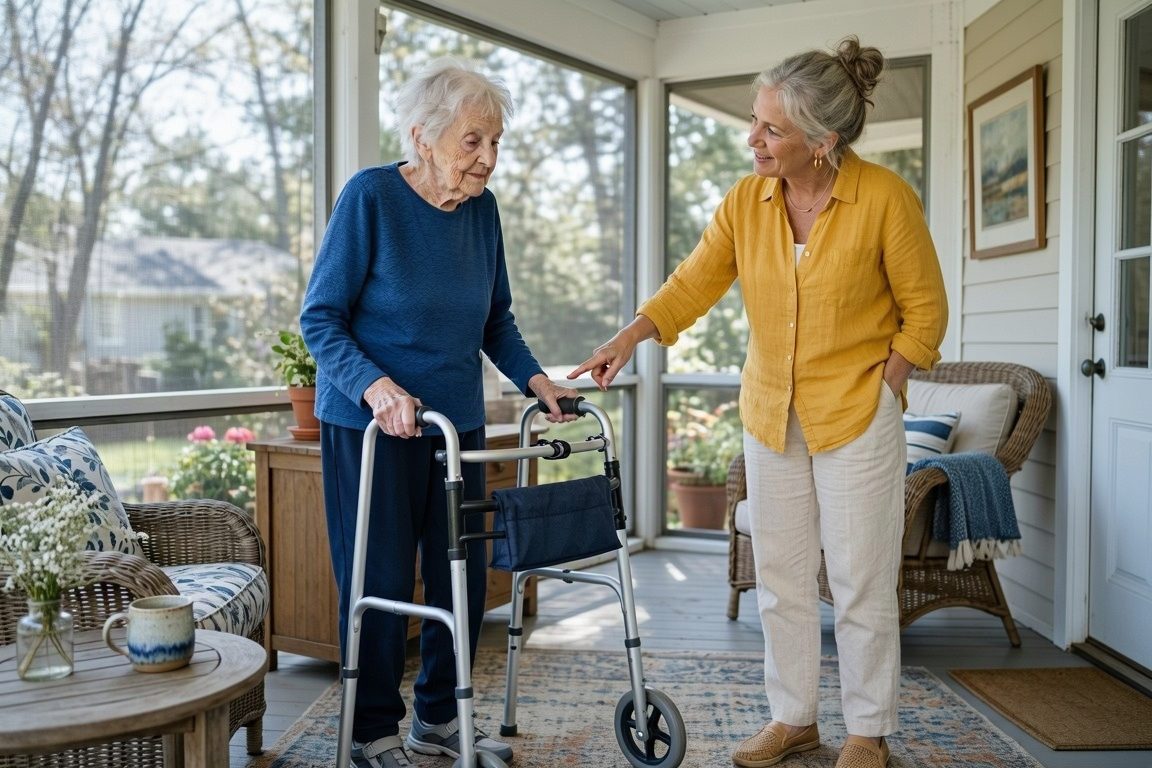
Step by step
What not to do
- Don't rush in and do the task for them at the first sign of hesitation. This robs them of practice and can accelerate skill loss.Instead, wait 5-10 seconds after your cue to give their brain time to process.
- Don't use long, complex sentences like 'Mom, I need you to roll over to the edge of the bed so I can help you sit up.' This overloads their working memory.Instead, break it down: 'Roll toward me.' One step at a time.
- Don't correct small inefficiencies, like reaching for the chair with the wrong hand or sitting at a slightly different angle. If they're safe and moving, let them do it their way. Perfection is not the goal, participation is.
- Don't stand over them or hover. This can feel intimidating and increase anxiety.Instead, get down to their eye level, kneel or sit , so you're a partner, not a boss.
- Don't let your own frustration show in your face or voice. They will mirror your tension. If you feel impatient, step away for a moment, take a breath, and return with a calm smile.
- Don't give up after one failed attempt. Try a different cue type, switch from verbal to visual, or from visual to tactile. Sometimes a gentle touch is all they need to unlock the movement.
Key points
- Start with the simplest cue (verbal) and only escalate to visual or tactile if needed, this preserves independence.
- Slow down your own pace and calm your body language; your speed and mood are powerful cues themselves.
- Use single-step commands, not long sentences, one instruction at a time.
- Hand-under-hand guidance is a respectful, effective tactile cue that lets them feel the motion while still participating.
- Ask permission before helping, it restores dignity and reduces resistance.
- Celebrate small successes with genuine, simple praise, not baby talk.
Videos
 How To Talk To A Person With Alzheimer's Or DementiaThis video demonstrates the verbal cueing techniques, how to simplify language, use a calm tone, and avoid overwhelming the person with too many words.
 Dementia Care Masterclass | Working with Someone in an Amber GEMS® StateThis masterclass shows how to assess a person's abilities in the moment and adjust your cueing level, which is the core of just-right cueing.
 Time with Teepa - A Review on Helping Someone to Sit DownTeepa Snow specifically demonstrates the hand-under-hand and 'Q' spot cue for sitting, directly applicable to this sub-topic.
 How to Use a Positive Physical Approach to Assess Abilities with Someone Living with DementiaThis video walks through the Positive Physical Approach, which is the foundation for delivering cues in a way that feels safe and respectful.

Practical tools
6
The 'One-Step' Verbal Cue Bank
Prepare a short list of single-step phrases for common tasks. For sitting: 'Bend your knees,' 'Reach for the chair,' 'Sit down now.' For standing: 'Stand up tall,' 'Push through your feet.' Keep them short, clear, and consistent. Write them on a card or sticky note near the chair.
Hand-Under-Hand Technique
This is a tactile cueing method where you place your hand under the person's hand, palm to palm, and gently guide their movement. It feels supportive, not controlling, and allows them to feel the motion while still doing it themselves. Practice it first on yourself to get the feel.
The 'Q' Spot Cue for Sitting
When helping someone sit, if they're standing and need to bend their knees, gently press on the tendon behind their knee (the 'Q' spot) with your finger. This gives a physical signal to bend, which can be more effective than words. Use it in combination with hand-under-hand guidance.
Visual Modeling
Before asking them to sit, sit down yourself in a nearby chair, then stand up and say 'Now you try.' Your body demonstrates the motion. This works especially well for people who have lost the 'starter button' for a task, they can copy what they see.
Rhythm and Counting
Use a slow, steady count to pace the movement: 'One, two, three, sit.' Or sing a simple song with a steady beat (like 'Row, Row, Row Your Boat') to help organize the motion. Rhythm can bypass damaged language centers and tap into preserved motor pathways.
The 'Ask Permission' Script
If they seem hesitant or frustrated, use this phrase: 'May I help you with that?' or 'Would you like a hand?' This gives them a sense of control and dignity. Follow with a warm smile and a gentle touch on the arm or shoulder before you begin cueing.
Different situations
Lewy body dementia (LBD)
People with LBD often have fluctuating cognition and may be more sensitive to touch. Start with verbal and visual cues first, and be prepared for sudden changes in ability from one moment to the next. Avoid tactile cues if they startle easily. Also, their motor symptoms (rigidity, tremor) may mean they need more physical support, but still cue first, don't just do.
Late-stage dementia (Sapphire/Ruby GEMS)
In later stages, verbal cues may no longer be understood. Rely more on visual modeling and gentle tactile cues. Hand-under-hand becomes essential. You may need to do more of the physical work, but still try to let them participate in any small way, even just placing their hand on the chair arm. Slow way down and use lots of reassuring touch and calm voice.
Spouse vs. adult child caregiver
Spouses may have a harder time slowing down because they're used to a lifetime of shared routines. Adult children may feel more comfortable asking permission. Both can benefit from practicing the 'pause and breathe' step before starting. Spouses might need to consciously avoid 'taking over' out of habit; adult children might need to avoid 'hovering' out of anxiety.
In a facility setting
Facility staff often face time pressure. The just-right cueing approach can actually save time in the long run by reducing resistance and agitation. Train all staff on the same cueing hierarchy (verbal → visual → tactile). Use the person's preferred cues from their care plan. If the person is used to a certain phrase or song from home, incorporate it.
Early-stage dementia (Amber/Green GEMS)
In early stages, the person may still be able to follow multi-step cues, but may need reminders to start. Use verbal cues with a gentle prompt: 'It's time to sit for lunch. Let's go to the table.' They may also be able to tell you what kind of cue works best for them, ask them directly when they're calm.
For the doctor
4
- If the person has a history of falls or balance problems, ask their doctor or physical therapist what level of physical support is safe during sitting and standing.
- If the person has pain or arthritis that might make certain movements difficult, discuss pain management strategies before attempting cueing for sitting.
- If you notice sudden changes in their ability to follow cues (e.g., they could follow one-step cues yesterday but can't today), consult their doctor to rule out infection, medication side effects, or other medical issues.
- If you are unsure about using the 'Q' spot cue (tendon behind the knee) due to a history of blood clots or knee surgery, ask a physical therapist for guidance.