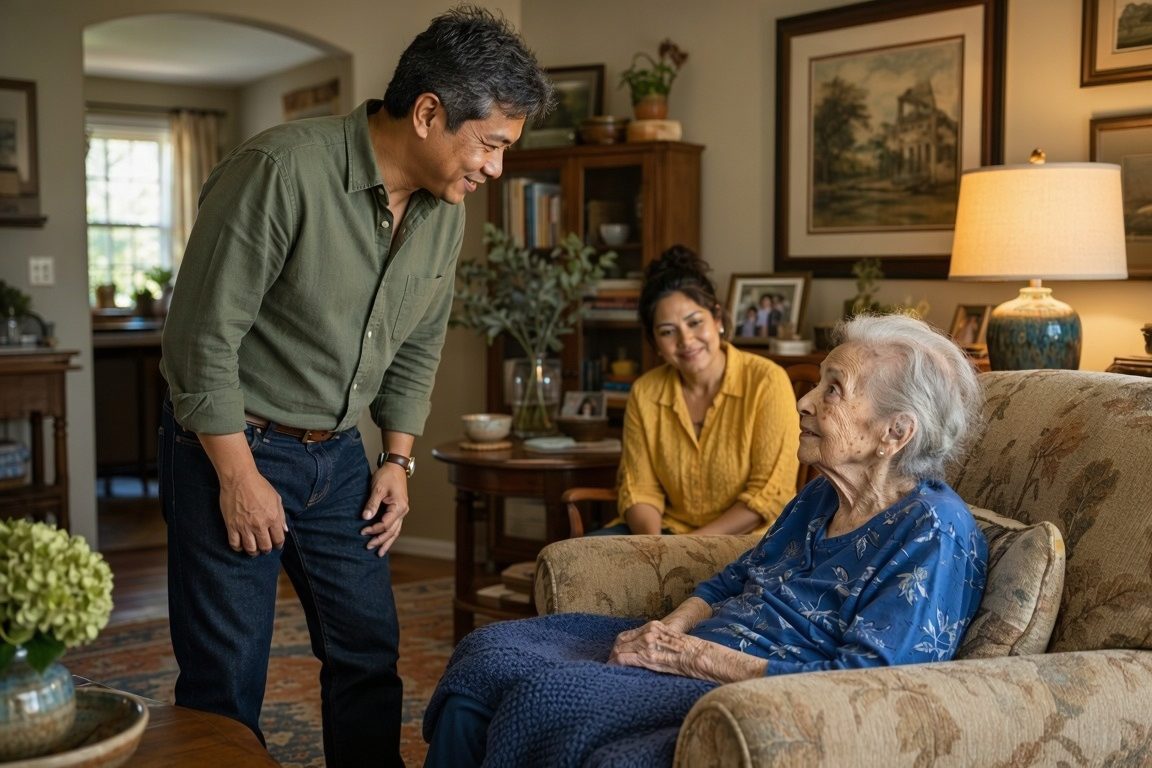
Step by step
What not to do
- Do not approach from behind or stand face-on and lean in close.
- Do not stand above them when they are seated.
- Do not use a loud or high-pitched voice; use a low, slow tone.
- Do not reach for their face, head, or hair first.
- Do not rush the approach; urgency increases anxiety.
- Do not force touch if they pull away; back off and try again later.
Key points
- PPA reduces the startle response by approaching slowly from a 45-degree angle, not face-on.
- Always stop 3-4 feet away and offer an open palm before touching.
- Use the 'Name and Claim' script: say their name and your name before doing anything.
- Break every task into single-step instructions; do not give multiple commands at once.
- End every interaction with a 'thank you' to build trust and partnership.
- Adapt PPA for different dementia types and stages: slower for LBD, more direct for FTD, always present for late-stage.
Videos
 Ep. 187: Would You Open the Can of Worms, or Leave it Closed?This video helps caregivers decide when to engage and when to let things go, which is a key skill for using PPA effectively. It teaches you to read the person's cues and choose your battles.
 Ep. 154: Why Dementia Does Not Always Equal AlzheimersUnderstanding the different types of dementia (like Lewy body, FTD, vascular) helps you personalize your PPA approach. This video explains why one-size-fits-all care does not work.
 Ep. 169: Until There's a Cure, There's Care™This video reinforces the philosophy behind PPA: that care and connection are the most powerful tools we have right now. It is a motivational watch for caregivers feeling hopeless.
 5 Things to Avoid in Dementia CareThis video lists common mistakes that undermine PPA, such as correcting the person or arguing. Watching it helps you identify and stop those habits.

Background
Why PPA Works: The Brain's Changed Alarm System
Dementia progressively damages the parts of the brain that interpret sensory input, recognize faces, and process social cues. A person living with dementia may no longer be able to quickly identify who is approaching them or what that person intends. Their brain's threat-detection system becomes hyperactive, so any sudden movement, unexpected touch, or person appearing directly in front of them can trigger a fight-or-flight response. This is not intentional resistance; it is a neurological reflex. The Positive Physical Approach (PPA) is designed to work with this changed brain by slowing down the approach, staying in the person's peripheral vision, and offering clear, calm signals of safety.
The Core Principle: Approach from the Front, but Not Head-On
The key insight of PPA is that a direct, face-to-face approach can feel confrontational or startling to someone with dementia. Instead, you want to approach from the front but slightly to the side, so the person can see you coming without feeling cornered. This is sometimes called a 'c-shaped' or 'curved' approach. You also want to stop a few feet away, at a respectful distance, and use a gentle open-handed gesture (palm up, fingers relaxed) to signal that you are not a threat. This gives the person's brain time to process your presence and intention before you move closer or touch them.
What Happens When You Don't Use PPA: The Cascade of Distress
Without PPA, a caregiver might walk up quickly, stand directly in front of the person, and immediately reach out to touch them. To a brain with dementia, this can feel like a sudden invasion of personal space. The person may flinch, pull away, or even strike out. The caregiver then interprets this as 'aggression' or 'resistance,' and may respond with frustration or force, escalating the situation. This cycle damages trust and makes future care tasks harder. PPA breaks this cycle by giving the person a sense of control and predictability, which reduces their stress and makes them more willing to accept help.
Practical tools
7
Palm-Up Invitation Gesture
Hold your hand out, palm up, fingers relaxed and slightly cupped, an unconditional peace signal.
Name and Claim Script
Before any action, say '[Their name], it's [your name].' Add a familiar detail if needed: 'It's Linda, we had pancakes this morning.'
3-Second Pause
After reaching 3–4 feet, pause three seconds before speaking or moving to let their brain register you.
C-Shaped Approach Path
Approach in a curved C-path from the front-left or front-right, stopping at a 45° angle, never straight on.
One-Step Instruction Rule
Break tasks into single steps. Say only one action at a time: 'Stand up,' then after it's done, 'Walk to the door.'
Tell-Then-Touch Cue
Before contact, announce where and why you'll touch: 'I'm going to put your arm through this sleeve.' Then touch the arm or shoulder only.
Thank You Close
End each interaction with a sincere 'thank you,' framing the encounter as a partnership.
Different situations
Lewy body dementia (LBD) or Parkinson's disease dementia
People with LBD often have visual hallucinations and fluctuating attention. They may be more easily startled by shadows or sudden movements. Use even slower, more deliberate movements. Approach from a well-lit side. Speak in a very low, rhythmic tone. Avoid standing in front of a window or bright light, as this can create a silhouette that looks threatening. Be prepared for them to not recognize you even after you say your name; repeat it calmly.
Frontotemporal dementia (FTD)
FTD often affects social awareness and impulse control. The person may not care about social niceties or may be easily frustrated. PPA still works, but you may need to be more direct and less 'warm.' Use a neutral, matter-of-fact tone. Do not expect them to smile back. The goal is to reduce their agitation, not to get a positive emotional response. Keep your approach very brief and task-focused.
Late-stage dementia (bedbound or very limited communication)
In late stages, the person may not open their eyes or respond verbally. PPA is still critical. Always announce yourself before touching. Use a gentle touch on the shoulder or hand before moving them. Move slowly to avoid startling them. Their startle reflex may still be intact even if they seem unresponsive. Speak in a soothing tone, even if you get no response.
Spouse caregiver vs. adult child caregiver
A spouse may have decades of history and the person may still recognize them, but dementia can erase that recognition. Do not assume the person knows who you are. Use PPA every time, even if you are their spouse. An adult child may be less familiar to the person, so the approach needs to be even more careful. The adult child should always say their name and relationship: 'Dad, it's your daughter, Emily.'
In a facility or with a professional caregiver
Professional caregivers often have multiple residents to attend to and may feel rushed. But PPA is even more important in a facility setting where the person may not know you. Use the same steps, but add a brief orientation: 'Good morning, Mrs. Jones. I'm Carla, your aide today. I'm here to help you get dressed.' Always knock on the door and wait before entering the room.
For the doctor
3
- If the person with dementia has a history of violent reactions or aggression during care, discuss with their doctor whether a medication review or a referral to a dementia behavioral specialist is appropriate.
- If the person has a condition that causes pain with movement (e.g., arthritis, recent fracture), ask their clinician about the best ways to support them during transfers or personal care without causing pain, as pain can trigger resistance that mimics behavioral symptoms.
- If the person has a vision or hearing impairment, ask their clinician or an occupational therapist for specific adaptations to the PPA approach (e.g., approaching from their better-hearing side, using a flashlight to illuminate your face).