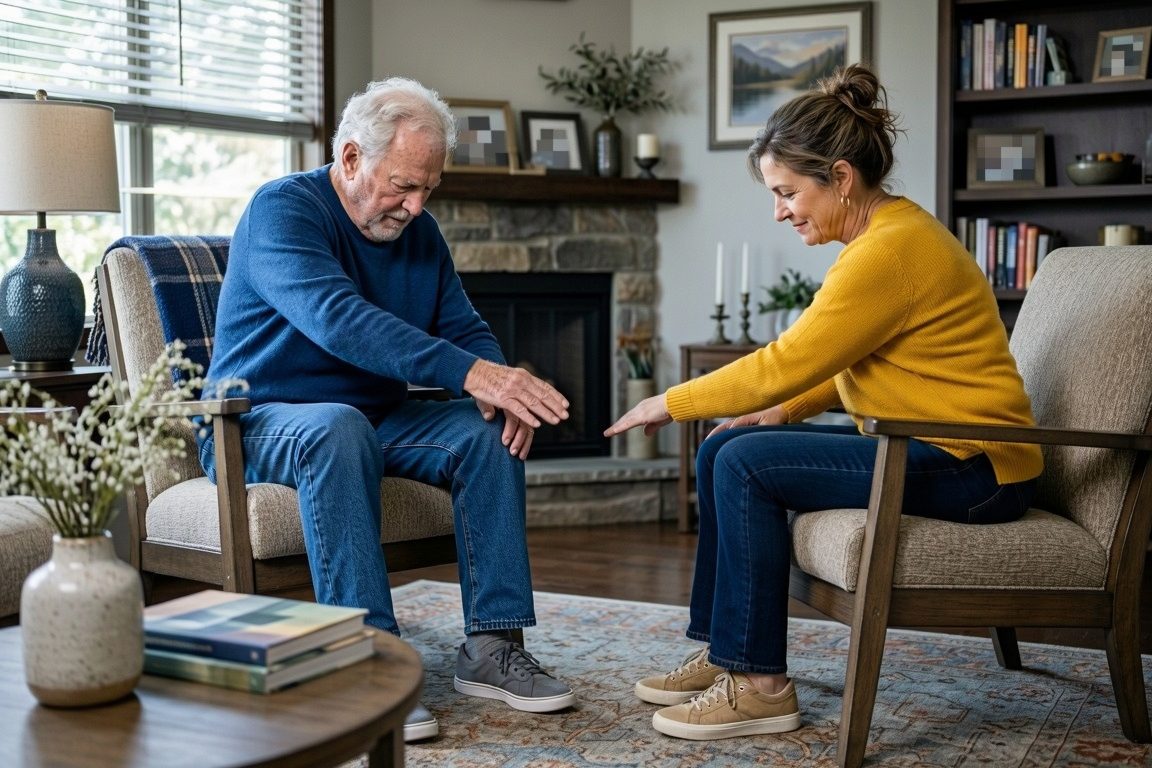
Step by step
What not to do
- Do not force or push. If your loved one refuses or becomes agitated, stop immediately. Forcing can create a negative association with exercise and increase anxiety.Instead, try again later with a different approach, maybe just humming a song or doing one gentle arm stretch.
- Do not expect perfection or memory of steps. Dementia affects the ability to learn new sequences. Avoid correcting or showing disappointment. The brain is still benefiting from the movement even if they don't 'get it right.' Celebrate effort, not accuracy.
- Do not use complex instructions. Avoid saying 'Now do this, then that, then that.' Instead, use simple, one-step cues: 'Lift your arm.' 'Tap your knee.' Use gestures and your own movement to demonstrate. Non-verbal cues are often easier for a person with dementia to follow.
- Do not ignore signs of fatigue or pain. Watch for grimacing, shallow breathing, or slumping. Stop and rest. Overexertion can lead to falls or injury. Chair exercise should feel good, not like a workout. If they seem tired, switch to a calming activity like deep breathing or hand massage.
- Do not compare to past abilities. If they used to walk or dance, don't say 'Remember when you could...' This can cause frustration or grief. Focus on what they can do now, and celebrate small victories like lifting a foot or smiling during a movement.
- Do not do this alone if you are also frail or injured. If you have your own physical limitations (e.g., severe arthritis), get help from a home health aide, physical therapist, or family member. Caregiver strain can lead to injury. It's okay to ask for support.
Key points
- Chair-based exercise like Ageless Grace stimulates neuroplasticity by engaging multiple brain functions through playful, low-risk movement.
- Even 5-15 minutes, twice a week, can improve mobility, mood, and cognitive function in mild to moderate dementia, and maintain independence in later stages.
- The focus is on joy, connection, and expression, not correct form. Mistakes are part of the process and can be a source of laughter.
- Always get medical clearance first, and adapt movements to your loved one's current abilities and stage of dementia.
- Use music from their youth, hand-under-hand guidance, and a calm, encouraging tone to reduce resistance and increase engagement.
- Caregivers benefit too, doing the exercises together reduces stress and creates a shared positive experience.
Videos
 How to keep a dementia patient busyThis video offers practical ideas for engaging activities, which can complement chair exercise by keeping the person occupied and stimulated in other ways.
 Neuroplasticity- The brain's ability to heal and growExplains the science of neuroplasticity in simple terms, reinforcing why chair exercise can help the brain form new connections.
 Discover the Cranium Crunches Workbook by Activity Connection with Co-Author Dr. Rob WinninghamIntroduces another brain-stimulating activity workbook that can be used alongside chair exercise for cognitive engagement.
 Ep. 174: Can Simple Exercise Help Aging Brains?Discusses research on how even simple exercise benefits aging brains, supporting the use of chair-based movement for dementia.
2 more videos
 Dr. Gretchen Hawley PT, DPT, MSCS Founder of The MSing LinkOffers insights on neuroplasticity and exercise from a physical therapy perspective, applicable to dementia care.
 How to Use Double Hand-under-Hand to Help a Person Living with Dementia Sit DownDemonstrates the hand-under-hand technique, which is useful for guiding movements during chair exercise without causing distress.
Background
What is Neuroplasticity and Why Does Chair Exercise Help?
Neuroplasticity is the brain's remarkable ability to change and adapt throughout life, even in the face of dementia. Think of it as the brain's 'plastic' quality, it can form new neural pathways and strengthen existing ones when challenged in the right ways. Exercise, even gentle chair-based movement, triggers the release of a chemical called brain-derived neurotrophic factor (BDNF), which acts like fertilizer for brain cells, especially in the memory center (the hippocampus). This process can help maintain cognitive function, improve mood, and even slow decline, according to research. The key is that the brain is never too old to learn or to benefit from movement, it's never too late to start.
Why Chair-Based Exercise is Ideal for Dementia
Chair-based exercise is uniquely suited for dementia care because it removes many barriers to physical activity. It reduces fall risk, requires no special balance, and can be done even by someone who is bed-bound or wheelchair-bound. Programs like Ageless Grace are designed specifically for neuroplasticity, they use simple, playful movements that engage multiple brain functions at once (like coordination, memory, and creativity). The focus is on joy and expression, not perfection, which lowers anxiety and resistance. This approach aligns with research showing that even 20 minutes of exercise twice a week can improve mobility and independence in later-stage dementia, and it can also reduce caregiver stress by creating a shared, positive activity.
Practical tools
6
Ageless Grace Program (or similar chair-based exercise videos)
Ageless Grace is a structured program of 21 'tools' designed for neuroplasticity, done in a chair with bare feet. It includes music and playful movements. You can find free videos online or purchase a DVD. The key principle: 'There is no right or wrong.' Use it as a guide, not a script. Modify movements as needed, for example, if a tool requires tapping feet, just tap toes if they can't lift their feet.
Hand-Under-Hand Guidance Technique
This is a gentle way to help a person with dementia initiate movement without feeling controlled. Place your hand under theirs, palm to palm, and guide their hand through the motion (e.g., lifting to tap their knee). This gives them a sense of control and reduces resistance. Use a calm voice: 'Let's do this together. I'll help your hand find the way.'
Music Playlist from Their Youth
Create a playlist of songs from their teens and twenties, big band, swing, folk, or early rock. Music from that era is often deeply encoded in memory and can trigger movement, emotion, and joy. Use it as a timer: play one song (2-3 minutes) for a session. Sing along or hum. The rhythm naturally encourages movement.
Simple Visual Cues and Props
Use a brightly colored scarf, a small ball, or a ribbon to make movements more engaging. For example, hold a scarf and wave it side to side, or toss a soft ball gently from hand to hand. Props add novelty and can spark curiosity. Keep it simple, no complicated rules.
Daily Routine Chart with Pictures
Create a simple visual schedule showing 'Chair Time' with a picture of a chair and a smiley face. Place it on the wall or table. This provides structure and reduces anxiety about what's coming next. Point to it and say, 'Time for our chair fun!' Routine helps maintain cognitive function and calm.
Comfortable, Non-Slip Footwear or Bare Feet
Ageless Grace recommends bare feet for sensory feedback, but if your loved one is cold or has foot issues, use non-slip socks or soft slippers. The goal is to feel the floor and engage foot muscles. If they are bed-bound, do foot and ankle movements under the covers.
Different situations
Late-stage dementia (bed-bound or very limited mobility)
Focus on very small movements: finger taps, wrist circles, ankle pumps, facial expressions (smile, frown, raise eyebrows). Do these while lying in bed or propped up. Use music softly in the background. Even passive range-of-motion (gently moving their limbs for them) can stimulate blood flow and brain activity. The goal is comfort and sensory input, not exercise.
Lewy body dementia (with Parkinson's-like symptoms or visual hallucinations)
Be extra cautious with balance, use a chair with armrests and a high back. Avoid rapid or twisting movements that could trigger dizziness or hallucinations. Keep the environment calm: dim lights, no clutter. Use slow, rhythmic movements like rocking side to side or gentle arm swings. If they see something that isn't there, acknowledge it without alarm: 'I see you're looking at something. Let's focus on our hands moving.'
Spouse caregiver vs. adult child caregiver
Spouse caregivers may need to approach exercise as a shared activity to avoid a 'parent-child' dynamic. Say, 'Let's do this together for our health.' Adult children may need to be more patient with resistance, as the parent may feel embarrassed or infantilized. Use humor: 'I know this looks silly, but let's try it for two minutes.' Both should prioritize their own self-care, exercise together can reduce caregiver stress too.
In a facility (nursing home or assisted living)
Coordinate with staff to find a good time and space. Ask if there are group chair exercise classes (e.g., 'Sit and Be Fit') that your loved one can join. If they are resistant to one-on-one, group settings can provide social motivation. Bring headphones with their favorite music if the class music is not to their taste. Advocate for modifications if needed.
Frontotemporal dementia (with behavioral changes or apathy)
This type often affects motivation and social awareness. Use very short, high-interest activities: a single song, a funny movement (like wiggling fingers like rain). Don't expect them to follow instructions, just model the movement and see if they mimic. If they become agitated, stop immediately. Focus on sensory stimulation (e.g., a textured ball) rather than structured exercise.
For the doctor
4
- Ask the doctor or physical therapist: 'Is my loved one cleared for seated exercise? Are there any movements they should avoid due to heart conditions, recent surgery, or osteoporosis?'
- If your loved one has a history of falls, ask: 'What specific chair exercises are safest for improving balance without increasing fall risk?'
- If they have diabetes or blood pressure issues, ask: 'How should we monitor blood sugar or blood pressure before and after exercise?'
- If they are on medications that affect heart rate or blood pressure (e.g., beta-blockers), ask: 'Are there any exercise intensity limits we should follow?'