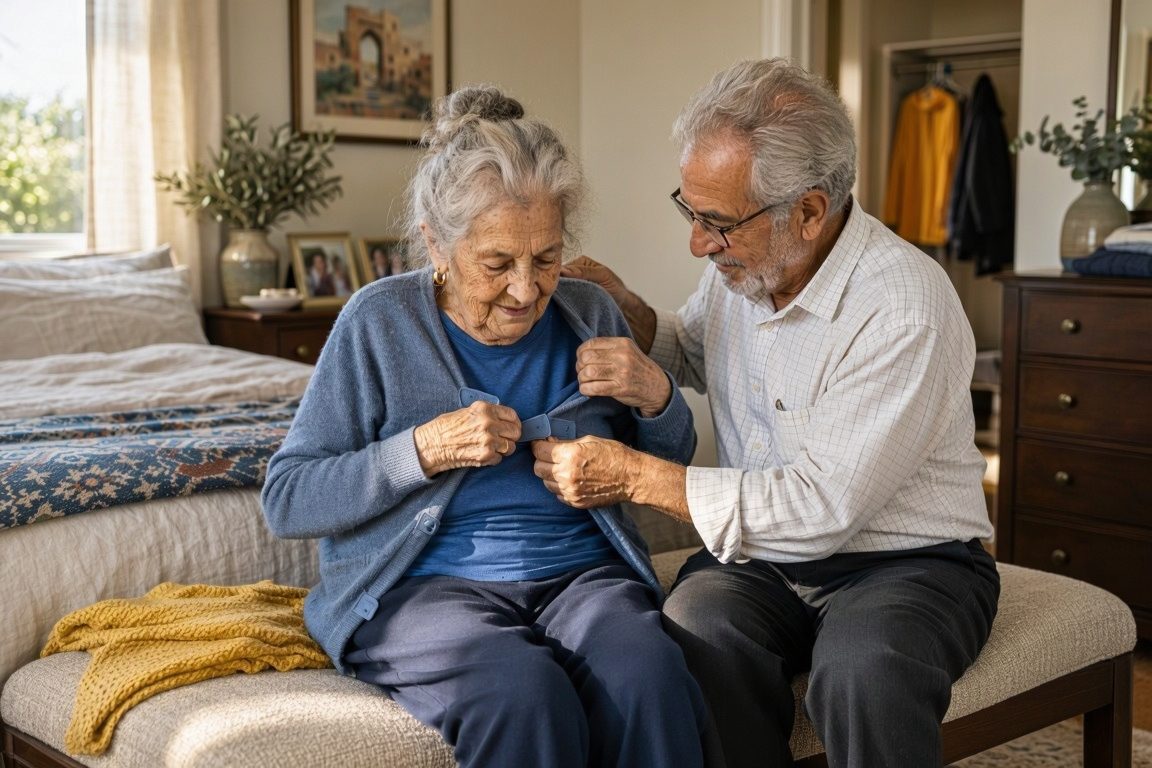
Step by step
What not to do
- Do not buy adaptive clothing without first checking the person's preferences. If they have always worn button-down shirts, a pullover may feel strange.Instead, look for magnetic-button versions of their favorite style. Let them see and touch the item before purchasing.
- Do not rush or force dressing. If you are in a hurry, you may pull too hard or cause pain, which can lead to resistance later.Instead, allow extra time, even 15 minutes more, and approach dressing as a calm, shared activity.
- Do not assume that 'one size fits all' adaptive clothing will work. Some people need open-back tops, others just need magnetic buttons. Buy from companies that offer returns or exchanges, and try one or two items before investing in a full wardrobe.
- Do not hide adaptive clothing in a drawer or closet with regular clothes. The person may become confused or frustrated trying to find the 'right' shirt.Instead, keep adaptive items in a separate, accessible spot, like a small basket on the dresser, so they are the obvious choice.
- Do not ignore signs of pain or discomfort. If the person winces when you lift their arm, stop and check for arthritis or stiffness. A gentle range-of-motion stretch before dressing can help, but if pain persists, discuss pain management with their clinician.
- Do not use adaptive clothing as a substitute for involving the person in the process. Even if they cannot fasten a button, they can still hold the shirt or choose between two colors. Inclusion preserves dignity and reduces feelings of helplessness.
Key points
- Adaptive clothing comes in two main types: self-dressing (magnetic buttons, elastic waists) and assisted-dressing (open-back tops, side-zip pants). Choose based on your loved one's current abilities.
- Simplify choices by keeping only a few adaptive outfits in rotation. Too many options can overwhelm and lead to resistance.
- Always consider pain as a possible cause of dressing resistance. Gentle stretching before dressing can help.
- Involve the person in the process, even if they can only choose between two colors, to preserve dignity and cooperation.
- Try one or two adaptive items before buying a full wardrobe. Many companies offer returns, and preferences vary widely.
- Use a calm, consistent routine and touch cues to guide the person through each step. Rushing or forcing will backfire.
Videos
 Jimmy Zollo, Co-Founder of Joe & Bella Discusses the Importance of Adaptive CloThis video explains the philosophy behind adaptive clothing and shows real examples of magnetic buttons and other features. It helps you understand why these products work and how they restore dignity.
 Assisting with Activities of Daily Living in Dementia CareThis video demonstrates step-by-step techniques for helping someone with dementia get dressed, including how to use touch cues and simplify the environment. Very practical for caregivers.
 How to Help a Person Living with Dementia to Get Dressed and UndressedA clear, compassionate guide that shows exactly what to say and do when dressing a person with dementia. Covers both self-dressing and assisted-dressing scenarios.
 The Caregiver's Journal Lance A. Slatton with Cindy -PT & Christina -ST 'Navigating Care' Chapter 4This video includes expert advice from physical and speech therapists on adaptive equipment, including clothing modifications. Useful for understanding the clinical reasoning behind adaptive clothing choices.
2 more videos
 How Can I Use the Environment and Touch Cues to Help Someone Get Dressed and Undressed?Focuses on environmental setup and non-verbal communication during dressing. Great for caregivers who want to reduce verbal confusion and use gentle touch instead.
 The Baffled Brain Demystifying Dementia Episode 30 June 26 2021This episode covers common dressing challenges and offers practical tips, including the use of adaptive clothing and how to handle resistance. Good for understanding the 'why' behind behaviors.
Background
What Exactly Is Adaptive Clothing?
Adaptive clothing is not just 'larger' or 'looser' clothing, it is thoughtfully engineered to address specific physical and cognitive challenges. For example, a shirt may have magnetic buttons that align and snap together with a gentle touch, instead of requiring fine motor skills to thread tiny buttons through holes. Pants may have elastic waistbands or side zippers that open fully, so a person can be dressed while lying in bed. The goal is to remove the barriers that make dressing frustrating, while keeping the person looking and feeling like themselves. As one expert explains, adaptive clothing helps a person 'look in the mirror and recognize yourself,' which has a deeply meaningful impact on daily life.
Self-Dressing vs. Assisted Dressing: Two Different Needs
Not all adaptive clothing serves the same purpose. 'Self-dressing' products are designed for people who still have the ability to dress themselves if given the right tools, for instance, a person with Parkinson's who can use magnetic buttons or pants with unique pull loops. These items let the person maintain independence and feel capable. 'Assisted dressing' products, on the other hand, are for individuals who cannot dress themselves at all, no matter what features the clothing has. An open-back top that closes in the back (like a hospital gown but more dignified) is an example of assisted dressing, it allows a caregiver to dress the person without having to lift or turn them excessively. Knowing which category fits your loved one is the first step to choosing the right clothing.
Why Dressing Becomes Hard: The Hidden Challenges
Dressing difficulties often go beyond simple forgetfulness. A person may resist getting dressed because of pain from arthritis, stiffness from Parkinson's, or sensory issues like tags that itch or fabric that feels 'wrong.' Cognitive changes can make it hard to sequence steps, like knowing that you put your arm in a sleeve before pulling the shirt over your head. Fatigue, poor lighting, or a cluttered closet full of choices can overwhelm the brain. Adaptive clothing addresses these hidden challenges by reducing the number of decisions, eliminating painful movements, and using fabrics that feel comfortable. As one source notes, if you meet resistance, always consider whether pain might be a factor, gentle range-of-motion exercises before dressing can help.
Practical tools
6
Magnetic Button-Down Shirts
These look like regular button-down shirts but have hidden magnets that snap together when brought close. They are ideal for people with Parkinson's, arthritis, or fine-motor difficulties. Brands like Joe & Bella offer these. Say, 'This shirt has special buttons that just snap together, you can do it yourself.'
Open-Back Tops (Assisted Dressing)
These tops close in the back with Velcro or snaps, allowing a caregiver to dress the person without lifting or turning them. They are excellent for late-stage dementia or bed-bound individuals. Use a calm voice: 'I'm going to help you put this on. It will be quick and easy.'
Elastic-Waist Pants with Side Zippers
Pants that have an elastic waistband and a full-length zipper on one side can be put on while the person is lying down. They eliminate the need to stand or balance. Look for 'adaptive pants' from medical supply companies. Say, 'These pants have a special zipper so we can put them on without you having to stand.'
A 'Dressing Basket' for Limited Choices
Instead of a full closet, use a small basket or tray that holds only two or three adaptive outfits for the day. This reduces overwhelm and decision fatigue. Each morning, let the person choose from the basket: 'Do you want the blue shirt or the green one?'
Gentle Range-of-Motion Warm-Up
Before dressing, do a few gentle stretches with the person:
This loosens stiff joints and makes dressing less painful. Say, 'Let's do some morning stretches first, it will make getting dressed easier.'
Visual Cue Cards for Dressing Sequence
Create simple picture cards showing each step of dressing (e.g., underwear, pants, shirt, socks). Place them in order on the bed or dresser. This helps a person with cognitive decline follow the sequence independently. Point to the first card and say, 'First, we put on our underwear.'
Different situations
Early-stage dementia (still independent but struggling with buttons/zips)
Focus on self-dressing adaptive clothing like magnetic buttons and elastic waists. Keep the person's own style as much as possible, buy adaptive versions of their favorite shirt type. Involve them in selecting the items to maintain a sense of control.
Late-stage dementia (bed-bound or fully dependent)
Use assisted-dressing products like open-back tops and side-zip pants. Prioritize comfort and ease of changing. Consider using a 'chuck' pad under the person to protect bedding during dressing changes. Keep clothing soft and tag-free to prevent skin irritation.
Parkinson's disease (rigidity and tremor)
Magnetic fasteners are especially helpful because fine motor control is impaired. Look for pants with pull loops at the waistband to help the person pull them up. Avoid clothing with small buttons or zippers. Use the gentle range-of-motion warm-up to reduce stiffness before dressing.
Arthritis (pain in hands and joints)
Choose clothing with large, easy-to-grip zipper pulls or Velcro closures. Avoid any clothing that requires twisting or fine finger movements. Consider a 'dressing stick' or long-handled shoehorn to help with socks and shoes. Always check for pain cues and stop if the person winces.
In a memory care facility (professional caregivers involved)
Coordinate with staff to ensure adaptive clothing is labeled with the person's name. Provide a written list of the person's clothing preferences (e.g., 'Prefers blue, hates turtlenecks'). Use open-back tops for easy changing. Ask staff to maintain a consistent dressing routine.
Spouse vs. adult child caregiver
A spouse may feel more comfortable with intimate dressing tasks but may also be more emotionally invested. An adult child may need to practice patience and avoid rushing. Both should use the same calm, step-by-step approach. If the person resists, the spouse might try, 'Let me help you, honey,' while an adult child might say, 'Dad, let's get you dressed so we can have breakfast.'
For the doctor
4
- If the person consistently resists dressing or shows signs of pain (grimacing, pulling away), ask the doctor about pain management options or a referral to a physical therapist for a mobility assessment.
- If the person has difficulty swallowing or choking while dressing (e.g., from a tight collar), discuss with a speech-language pathologist whether adaptive clothing with a wider neck opening is needed.
- If the person has a skin condition or pressure sores, ask a nurse or wound care specialist about clothing materials that reduce friction and moisture buildup.
- If the person is on medications that affect balance or coordination, check with the pharmacist or doctor about whether adaptive clothing with fall-prevention features (e.g., non-slip socks) is appropriate.