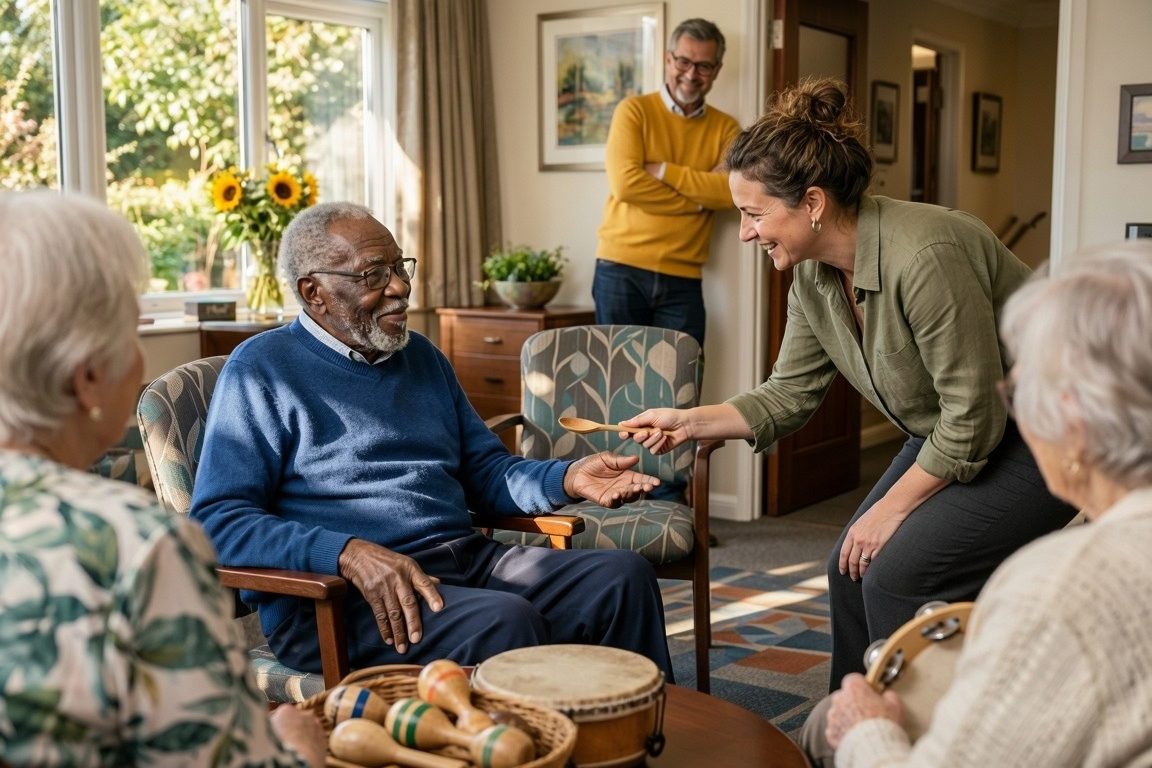
Step by step
What not to do
- Do not start with a question like 'Do you want to...?' or 'Would you like to...?', it invites a 'no.' Use a declarative, inviting statement.
- Do not expect the person to initiate an activity on their own. You must be the warm, positive initiator.
- Do not correct mistakes or point out errors. Gently redirect or simply say 'Thank you, that helps so much.'
- Do not treat the person like a child. Using a baby voice or scolding is disrespectful and can cause distress.
- Do not try to engage when you are rushed or stressed. Your own emotions are contagious; take deep breaths before starting.
- Do not assume that what worked once will work again. Dementia changes day to day, be flexible and willing to try something new.
Key points
- An engagement leader is someone who knows how to lead engagement, not just run activities, for a person with dementia. You can learn this role as a family caregiver.
- Start with an inviting phrase like 'Come with me!' instead of a question like 'Do you want to...?' This avoids the automatic 'no' and sets a positive tone.
- Focus on the process, not the product. The goal is connection and a sense of purpose, not a perfectly folded shirt or clean dish.
- Tailor activities to the person's past roles and passions. This taps into preserved memories and gives deep meaning.
- Take care of yourself. Delegate chores, use respite care, and join a support group. Your well-being directly affects the quality of engagement you can offer.
- If your loved one is in a facility, advocate for staff dementia training. The people with the most contact need the most skill.
Videos
 Ep. 259: How Can We Increase Engagement at an Individual Level?This video offers practical strategies for tailoring engagement to the individual, which is the core of the engagement leader role.
 Dementia Care Partner Talk Show Podcast: Ep. 92 - Engaging in a Meaningful WayTeepa Snow discusses what meaningful engagement looks like and how to lead it, not just run activities.
 Dementia Care Partner Talk Show Podcast: Ep. 88 - How to Engage with Someone in a Meaningful WayAnother episode from Teepa Snow that dives into the specifics of how to connect with a person with dementia in a way that honors their abilities.
 Carrie Aalberts Founder & Creator of 'Dementia Darling'Carrie Aalberts talks about the importance of engagement and her vision for free respite care, which can help caregivers take breaks and return to engagement refreshed.
2 more videos
 How To Entertain Someone With Dementia At Home?This video provides concrete, at-home activity ideas that align with the engagement leader approach, simple, sensory, and person-centered.
 The Baffled Brain: Demystifying Dementia Episode 22 April 24, 2021This episode helps demystify why engagement can be challenging and offers strategies to overcome common barriers.
Practical tools
4
The 'Come With Me' Invitation
A declarative phrase that replaces a question and sidesteps the automatic 'no.' Say: 'Oh, I have this great idea, come with me!' or 'I want to show you something special.' Use a warm voice and gentle hand gesture.
The One-Step Task Basket
A basket with a single, simple task done while sitting: a pile of socks to match, napkins to fold, or a bowl of rice with hidden objects (large beads or coins) to find. Keep it visible and bring it out for quick, calming activity.
The 'This Was Your Job' Memory Kit
A box of items tied to the person's past career or passion. A former carpenter gets sandpaper and wood; a retired nurse gets a stethoscope and a doll to 'check'; a cook gets a wooden spoon and dry beans to stir. Taps into preserved procedural memory.
The Personalized Music Playlist
10–20 songs from the person's young adulthood and meaningful life moments. Play it during transitions, bathing, or agitation. Familiar music often sparks alertness, mood lift, or calm when nothing else works.
Different situations
Early-stage dementia (still living at home, aware of diagnosis)
Engagement can be more complex and involve planning. Ask them to help you with a project they used to enjoy, like sorting photos or planning a simple meal. Use open-ended questions that invite their input, but be ready to step in if they get stuck. The goal is to maintain their sense of competence and contribution. Avoid correcting mistakes; instead, say 'That's a great idea, let's try it this way.'
Middle-stage dementia (needs more supervision, may have behavioral changes)
Simplify tasks to one or two steps. Use sensory activities like sorting fabric, folding towels, or playing with a fidget blanket. Avoid activities that require sequencing or memory, like following a recipe. If they become agitated, stop immediately and redirect to a calming activity like listening to music or looking at a photo album. Use the 'come with me' phrase to guide them away from distress.
Late-stage dementia (bedridden, limited communication)
Engagement shifts to sensory and emotional connection. Gently stroke their arm with a soft cloth, play their favorite music, or hold their hand while you talk about a happy memory. Use a calm, loving voice. Even if they cannot respond, they can feel your presence. The goal is comfort and reassurance, not task completion. Watch for signs of distress (grimacing, tense muscles) and adjust accordingly.
Lewy body dementia (fluctuating cognition, visual hallucinations, movement issues)
Engagement must be flexible because abilities can change hour to hour. Start with a simple activity and be ready to stop if they become confused or see things that are not there. Avoid activities that require fine motor skills if they have tremors. Use calming, familiar activities like listening to music or looking at a simple picture book. Do not argue about hallucinations; instead, say 'I can see that is upsetting you. Let's go sit over here.'
Spouse vs. adult child caregiver
Spouses may struggle with role reversal, your partner is now your care recipient. It can help to frame engagement as 'we are doing this together' rather than 'I am taking care of you.' Adult children may feel guilt or resentment. It helps to remember that the person is not choosing to be difficult; their brain is changing. Both roles benefit from joining a support group to share experiences and reduce isolation.
In a facility (nursing home, memory care, assisted living)
You become an advocate for engagement. Ask the executive director about staff dementia training, especially for aids and activities staff. Request that your loved one be included in small-group activities that match their abilities. If the facility offers a 'welcome kit' or activity cart, ask how it is used. You can also bring in familiar items from home, a favorite blanket, a photo album, to create a sense of continuity.
For the doctor
4
- If your loved one shows signs of pain (grimacing, moaning, agitation) that may be under-recognized and undertreated, discuss pain assessment and management with their doctor. Pain can cause behavioral symptoms and lead to unnecessary use of psychotropic medications.
- If engagement attempts trigger aggression or severe agitation, ask the clinician about possible underlying causes like infection, medication side effects, or unmet needs (hunger, thirst, bathroom). Do not assume it is just the dementia.
- If your loved one expresses suicidal thoughts or feelings of worthlessness, discuss this with their doctor immediately. These feelings are more common in early-stage dementia and require professional support.
- If you are considering using any over-the-counter supplements or alternative therapies to improve cognition or mood, discuss with the clinician first. Some can interact with medications or have side effects.