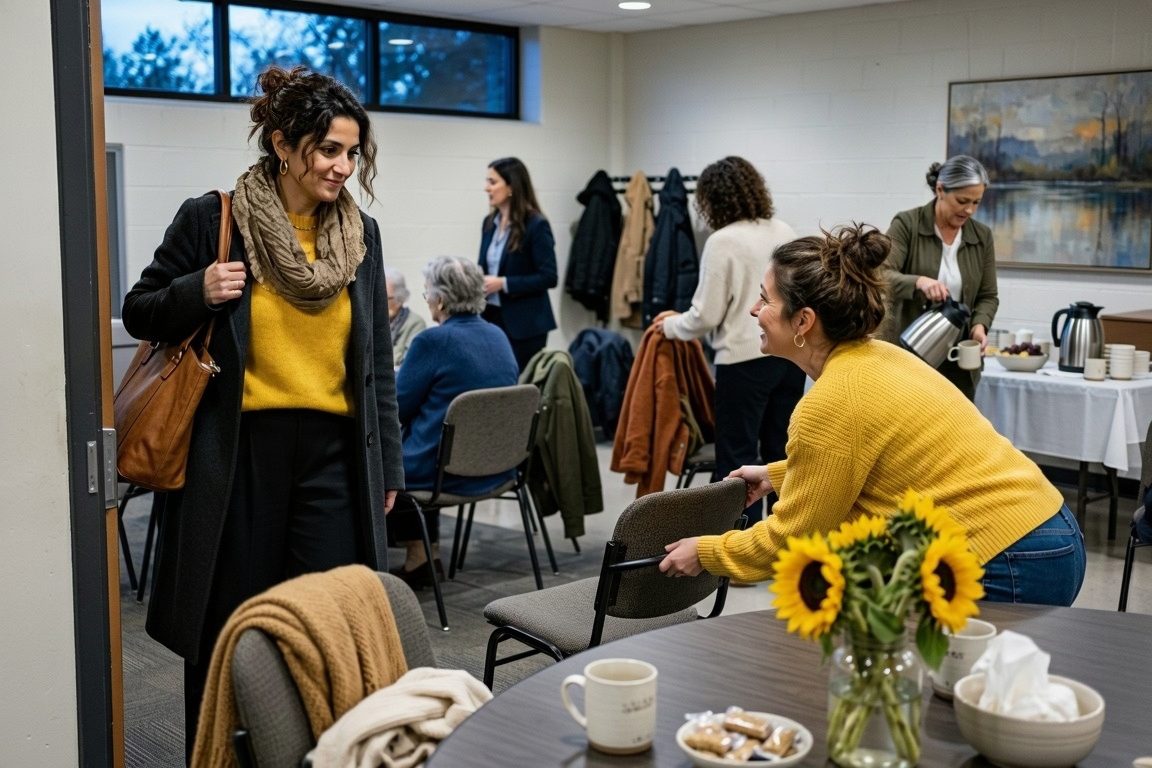
Step by step
What not to do
- Don't settle for a group that isn't a good fit, if one feels negative, judgmental, or mismatched with your style, try another; your wellbeing is worth the search.
- Don't feel pressured to share right away, listening and learning first is a completely valid way to participate.
- Don't skip a group out of fear it will be a 'pity party'; many are solution-focused, and you can always move on if one feels too negative.
- Don't wait until you're in crisis to join, the earlier you connect, the more tools you'll have before burnout sets in.
- Don't compare your situation to others in a way that feeds guilt or anxiety (neither 'theirs is worse so I shouldn't complain' nor 'theirs is better so what am I doing wrong'); use the group to learn and feel supported, not to judge yourself.
- Don't assume friends and family will fully understand, it's not their fault they haven't lived it, so seek that understanding in a support group.
- Don't rely on a support group as your only lifeline, pair it with respite care, professional counseling, and educational resources.
- Don't treat peer advice as medical or legal fact, verify any suggested treatment, legal move, or financial strategy with a clinician or qualified attorney before acting.
Key points
- Peer support groups reduce isolation by connecting you with people who truly understand your experience.
- Both in-person and online groups are effective; choose what fits your schedule, location, and comfort level.
- Start with the Alzheimer's Association (alz.org / 800-272-3900) or the Eldercare Locator to find local groups.
- Good groups offer practical, real-world advice for daily challenges like bathing, feeding, and difficult behaviors, not just venting.
- Private Facebook groups offer 24/7 access and a wide range of perspectives, useful when you can't leave home.
- You don't have to share right away, listening is a valid first step.
- Try a few groups before committing, and don't give up if the first isn't a perfect fit.
- Support groups help prevent burnout by giving you tools, encouragement, and community, make them part of a wider support team.
Videos
 How To Find Local Dementia Caregiver Support Groups? - TestThis video walks you through the exact steps to locate local support groups, including using national organizations like the Alzheimer's Association and local aging services.
 How Can Peer Support Combat Caregiver Isolation?This video explains the emotional benefits of peer support, including validation and reduced loneliness, which is the core reason to join a group.
 Ambiguous Loss in a Time of Pandemic on Alzheimer’s Speaks RadioThis discussion covers the unique grief of dementia caregiving and how peer groups can help you process ambiguous loss.
 136. 5 Tips How To Decrease Your Overwhelm In Dementia CaregivingThis video offers practical tips for reducing overwhelm, including the importance of finding support groups as a key strategy.
8 more videos
 Ambiguous Loss in a Time of Pandemic with Pauline BossThis video dives deeper into the concept of ambiguous loss and how connecting with others can help you cope with the emotional challenges of dementia caregiving.
 6 Ways to Handle Social Isolation with Someone with DEMENTIAThis video provides strategies for managing social isolation, including how to use support groups to stay connected while caring for someone with dementia.
 The Importance of Caregiver Support GroupsThis video explains why support groups are so valuable, including the commonality of experience and how they help when friends and family don't understand.
 LIVE Dementia With Grace Caregiver SUPPORT Group 3-28-2019Watch a real support group in action to see what it feels like. You'll hear caregivers share their struggles and get advice from a professional facilitator.
 How Can Local Dementia Support Groups Prevent Caregiver Burnout? - Dementia Help HubThis video breaks down how support groups prevent burnout by reducing isolation, sharing practical advice, and encouraging self-care.
 I Wish Someone Told Me: The 10 Things All Caregivers and Aging Adults Should Know About CaregivingCovers the importance of asking for help and building a support team, including support groups, as a key way to avoid overwhelm.
 Who Should Be Part of Your Caregiver Support Circle?Explains how a support group is one part of a larger support circle that includes professionals, friends, and family.
 Caregivers NEED to Hear THIS! YOU are AWESOME! (Even if NOBODY Tells YOU!)A powerful reminder that support groups can provide the appreciation and recognition you may not be getting from your loved one.
Background
Understanding the situation
When your days revolve around another person's needs, your own world shrinks, friends who haven't lived this often can't grasp why you can't step away for an hour or why you're always exhausted, which can leave you feeling invisible and alone. Those feelings are normal, not a sign of failure, and they're made worse when the person you care for can no longer thank you or acknowledge your effort. Peer support directly counters this isolation through validation: hearing others describe struggles like yours confirms your feelings are reasonable. The best groups aren't just for venting; they're solution-oriented spaces where you can bring a real problem and receive several approaches from people who have actually tried them, learn new skills, and rebuild a sense of control and motivation. Research indicates that groups organized around the same condition or the same caregiving role work especially well, and that well-run online groups can be just as effective as in-person ones.
Practical tools
8
The 'Just Listen' Starter Script
To introduce yourself without pressure when you first join a group online or in person, say: 'I'm new here and just listening for now. Thank you for having me.' It signals you're observing, not obligated to share.
The 'One Question' Post Template
When you're ready to ask for help, structure your post: 'I'm caring for my [relationship] who has [stage or type of dementia]. Lately, [specific challenge] is really hard. Has anyone found something that helps?' This invites specific, actionable advice instead of vague sympathy.
The 'Group Fit' Checklist
Before committing to a group, ask:
Use these questions to evaluate any group you try.
The 'Emergency Vent' Contact
Identify one or two members you trust enough to message privately during a crisis and ask, 'Is it okay if I reach out to you when I'm really struggling?' This creates a personal lifeline beyond the group meetings.
The 'One Thing' Sharing Formula
When it's your turn to talk, use: 'This week, one thing that went well was [X], and one thing I'm struggling with is [Y].' It keeps your sharing focused and gives the group a clear way to help.
The 'Ask for Help' Script
When you need specific advice, say: 'Has anyone dealt with [specific problem]? What worked for you?' This prompts concrete answers rather than general sympathy.
The 'Caregiver Support Team' List
Write a list of people who can be part of your team
Keep it by your phone, and when someone offers help, respond, 'Thank you, could you help with [specific task from the list]?'
The 'Small Victory' Journal
Keep a small notebook or phone note and write down one small victory each day, even 'Dad smiled at me' or 'I took a 5-minute break.' Share it in your group to focus on the positive and let others celebrate with you.
Different situations
Late-stage dementia (bedbound, non-verbal, full care): Your isolation may feel deepest here, so a group is especially valuable; seek ones with members at similar stages. Bring questions about managing feeding tubes, preventing bedsores, and handling incontinence, and confirm any medical strategy with your loved one's clinician. Look for groups that provide respite care during meetings so you can attend without worry, and lean on the group to find meaning in small moments of connection, like a squeeze of the hand, when your loved one is non-verbal.
Primary and only caregiver: You are at high risk for burnout, so a support group is a lifeline, not a luxury. Choose groups that offer a phone or video option so you can attend even when you can't leave home, and look for ones with a 'buddy system' where another caregiver checks in with you weekly. Use the group to find practical help, like a volunteer who can sit with your loved one for an hour so you can rest, and connect early, before crisis, to build your toolkit.
Online vs. in-person group: Online groups (Facebook, Zoom) are flexible, require no travel, and are ideal if you live in a rural area or if your loved one is too agitated to leave alone; asynchronous pages let you post at midnight and get replies within hours. In-person groups can offer a stronger sense of local community and easier access to nearby resources like respite care. Many caregivers find that trying both, and combining them, gives the most complete support.
Spouse caregiver: The emotional dynamics differ from those of adult-child caregivers, so a group for spousal caregivers can help with marital grief, intimacy changes, and the loss of partnership; online groups such as 'Dementia Spouse Caregivers' on Facebook can be especially supportive.
Adult-child caregiver: You may feel caught between your parent, your job, and your own family. Seek groups (or welcoming mixed groups) that address balancing these roles, sibling conflict, financial and legal planning, talking to your own children about dementia, and the guilt and grief of watching a parent decline.
Specific type of dementia (Lewy body, frontotemporal, vascular): Some symptoms are condition-specific, such as hallucinations or movement issues in Lewy body dementia. General groups still help, but disease-specific resources like the Lewy Body Dementia Association (lbda.org) and the Association for Frontotemporal Degeneration (theaftd.org) understand unique symptoms and personality changes.
Loved one in a facility (nursing home or memory care): Your challenges center on advocacy, staff communication, and the emotional transition of placement; the Alzheimer's Association online community has forums for caregivers whose loved ones are in care facilities.
Faith-based caregiver: You may find comfort in a group that integrates your beliefs, such as 'Christian Dementia Caregiving' on Facebook, which offers prayer support and scripture-based encouragement; local houses of worship may also host groups.
Common questions
8
GEMS and puzzle-piece cards can be used in caregiving and support groups as a shared framework for understanding a loved one's abilities and communicating about them.
Veterans can access free, non-judgmental peer support groups, ask the group network or aging services about veteran-specific options.
Online support groups are a common place to share ADL challenges (bathing, dressing, feeding) and crowdsource practical solutions from other caregivers.
Structured psychosocial group programs that combine information sessions with conversation groups can reduce caregiver burden.
Alzheimer's Association chapter support groups are among the most helpful resources for a struggling family caregiver.
Joining a group early, before crisis, helps with anticipatory grief and builds emotional resilience.
When local in-person groups don't exist or are too far away, online groups bridge the gap for both practical information and emotional connection.
A support group can help you feel less guilty and more in control by reminding you that your struggles are shared and normal.
For the doctor
1
- If you are feeling severely depressed or anxious, or having thoughts of harming yourself or your loved one, contact your doctor or a mental health professional immediately, a support group is never a substitute for professional mental health care. Discuss safety planning and respite options if your loved one's behaviors are escalating and you feel unsafe, and review new or worsening medical symptoms (such as difficulty swallowing, seizures, or severe agitation) with their doctor before trying care strategies you hear in a group. Always confirm any medication or supplement mentioned in a group (for example, melatonin for sleep or CBD for anxiety) with the prescribing clinician first, since interactions and side effects can be serious. If you feel too burned out to continue, talk with your loved one's healthcare team and a social worker about respite care or other levels of care, including hospice or a care facility.