Step by step
What not to do
- Don't expect a traditional 'vent and support' session every time: If you go to a PAC group expecting only to share your story and receive empathy, you may be disappointed when the facilitator shifts to teaching a skill.Instead, embrace the dual purpose: you'll get emotional support, but you'll also leave with a tool. If you need pure emotional support, look for a session labeled 'open sharing' or 'caregiver connection' within the PAC group's menu.
- Don't compare your progress to others: In traditional groups, comparison can breed fear. In PAC groups, the focus is on skill-building, not on who is 'further along.' Avoid the trap of thinking, 'They've been caregiving for five years, so they must have it all figured out.' Everyone's journey is different, and PAC groups emphasize that you are the expert on your loved one. Use others' experiences as ideas, not benchmarks.
- Don't stay silent if you're struggling with a skill: PAC groups are built on collaboration. If you tried a technique and it failed, share that! The group can help you troubleshoot. Staying silent because you feel embarrassed will rob you of the group's collective wisdom. Remember, the facilitator is there to help you 'work through challenges together.'
- Don't assume all PAC groups are the same: Just as traditional groups vary by facilitator, PAC groups can differ in focus. Some may be heavily skill-based, while others may be more balanced. Ask the facilitator about the group's typical format before committing. If one group doesn't feel right, try another: PAC has a 'menu' of options, and you deserve a good fit.
- Don't skip the practice: The biggest difference between a PAC group and a traditional one is the expectation that you'll try the skills at home. If you just listen and don't practice, you won't see the change. Set a small goal after each session (e.g., 'I will use the 'Positive Physical Approach' when helping my mom with breakfast tomorrow').
Key points
- PAC groups blend emotional support with hands-on skill-building, unlike traditional groups that focus mainly on sharing.
- You are seen as the expert on your loved one; the facilitator is a coach, not a fixer.
- PAC groups are flexible, they offer a 'menu' of session types (informational, skill-based, emotional support) so you can choose what you need.
- You will leave each session with a specific technique to try at home, like the 'Hand-under-Hand' or 'Positive Physical Approach.'
- PAC groups are designed to reduce comparison and fear by focusing on learning, not on who is 'further along.'
- You can find PAC groups online or in person; many are free and open to all caregivers regardless of stage or diagnosis.
Videos
 PAC Community RelationshipsThis video shows how PAC builds community through collaboration, not just emotional support. It illustrates the 'team' approach that makes PAC groups different.
 PAC 10 at 5 - Getting Frustrated When Someone Says NO!A perfect example of a skill you'd learn in a PAC group: how to respond when your loved one refuses care. Watch this to see the technique in action before trying it yourself.
 Podcast #35: Three Things That Surprised Me About the Dementia Care Partner Support SeriesHear directly from caregivers about what surprised them about PAC-style support, including the shift from passive listening to active learning.
 136. 5 Tips How To Decrease Your Overwhelm In Dementia CaregivingPractical tips that align with PAC's skill-building approach. Use this to supplement what you learn in a PAC group.
2 more videos
 The Care Advocates with Lance A. Slatton & Sharon's Son, George 'Managing Grief'Explores the emotional side of caregiving that traditional groups address, but with a focus on actionable grief management, a blend of support and skill.
 Zinnia Caregiver Support Session: Responding to Dementia-related Changes in the Person You SupportA real support group session that demonstrates the mix of sharing and teaching. Watch to see how a facilitator guides the group toward practical solutions.
Background
The Core Difference: Emotional Support vs. Skill-Building
Traditional support groups often center on sharing stories, venting frustrations, and receiving empathy from others who 'get it.' While this can be deeply validating, it can also leave you feeling stuck, you've unloaded your emotions, but you haven't gained new strategies for tomorrow's challenges. As one experienced facilitator noted, some groups can create a 'level of comparison' that breeds fear, especially when members are at very different stages of the journey. You might hear someone whose loved one is in late-stage dementia and feel hopeless about your own situation, or you might feel pressure to 'keep up' with others who seem to have it all figured out.
PAC support groups take a different approach. They are designed to be a 'menu' of options, some sessions are purely emotional support, but others are focused on teaching specific skills. For example, a PAC group might spend a meeting practicing how to respond when your loved one says 'no' to bathing, using the 'Positive Approach to Care' techniques. The goal is not just to feel better, but to become more effective and confident in your daily care. As Teepa Snow's team explains, PAC empowers people to 'get curious and support one another' by providing 'knowledge and skill' in addition to emotional support. This shift from passive listening to active learning can be a game-changer for caregivers who feel overwhelmed by the practical demands of dementia care.
Empowerment Over Expertise: You Are the Expert on Your Loved One
Another key difference is the role of the facilitator. In many traditional groups, the facilitator is seen as the expert who dispenses advice. In a PAC group, the facilitator's job is to help you discover your own expertise. As the PAC team puts it, they help caregivers 'stop looking at us as the expert that's going to come in and fix things' and instead realize that 'we have to work together as a team.' This collaborative approach reduces the pressure to have all the answers and instead builds your problem-solving muscles.
This is especially important because every person with dementia is unique. A technique that works for one family may not work for another. PAC groups teach you a framework, like the 'Positive Approach to Care' tools, that you can adapt to your specific situation. You learn to observe your loved one's cues, experiment with different responses, and adjust based on what works. This is far more empowering than simply being told what to do. One caregiver in a PAC group described it as learning to 'figure things out to change how things are done so that it can be a better experience for everybody.' That's the heart of the PAC difference: you leave not just with sympathy, but with a new skill you can use tomorrow.
Flexibility and Community Responsiveness
PAC groups are also designed to be flexible and responsive to the specific needs of their community. Unlike a one-size-fits-all support group, PAC facilitators are trained to adapt the format based on what participants need. Some groups may focus heavily on skill-building for early-stage caregivers, while others might offer more emotional support for those in later stages. The PAC team emphasizes that they have 'been very flexible with the different communities' and that 'each community is different in what they need.' This means the group you join will likely feel tailored to your local reality, whether that's dealing with rural isolation, urban resources, or specific cultural considerations.
Additionally, PAC groups often offer a mix of formats: some are purely informational, some are open for sharing, and some are a blend. This variety allows you to choose what you need on any given day. You might attend a session focused on a specific challenge (like wandering or bathing) and then join a separate session just to connect with others. This 'menu' approach ensures that you're not forced into a single mode of support, which can be a relief when you're already stretched thin.
Practical tools
6
The 'GEMS' State Model
PAC uses the GEMS model (Sapphire, Diamond, Emerald, Amethyst, Ruby) to describe different cognitive states. In a PAC group, you'll learn to identify which 'gem' your loved one is in at any moment and adapt your approach accordingly. For example, if your loved one is in the 'Emerald' state (early-stage, anxious), you might use calming language; if they're in 'Ruby' (late-stage, very low function), you might focus on sensory comfort. This tool replaces guesswork with a clear framework.
The 'Positive Physical Approach' (PPA)
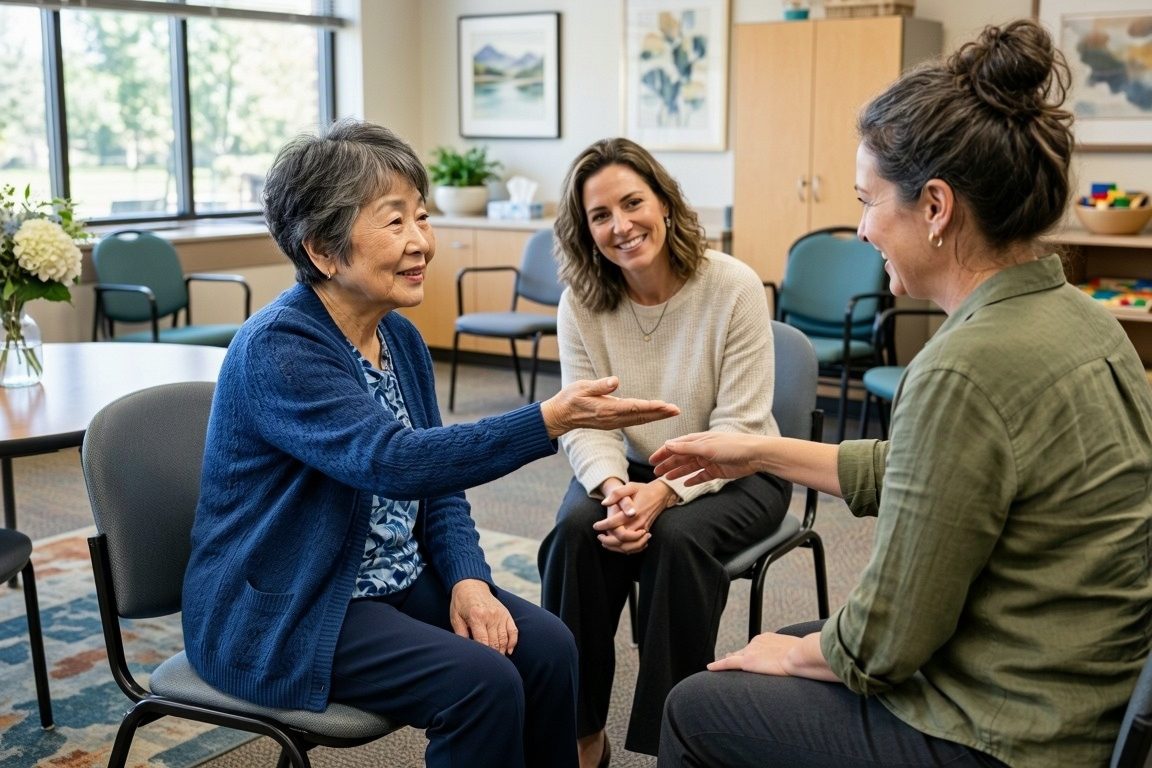
A core PAC skill taught in groups. It involves approaching your loved one from the front, at eye level, with a warm smile, and offering your hand (palm up) for them to take. This reduces startle and builds trust. In a PAC group, you'll practice this with another member (or a doll) and get feedback on your pacing and body language.
The 'Hand-under-Hand' Technique
When your loved one resists care (e.g., bathing or dressing), PAC teaches you to place your hand under theirs, gently guiding rather than forcing. This gives them a sense of control. In a group, you'll practice this on a partner, learning to feel the difference between 'doing to' and 'doing with.'
The 'Care Partner Menu'
PAC groups often provide a 'menu' of session types: some are informational (guest speakers on legal or medical topics), some are skill-building (practicing techniques), and some are purely emotional support. Ask your facilitator for a schedule so you can pick the sessions that meet your current need.
The 'Three-Part Validation' Script
When your loved one says something that seems false or confused, PAC teaches you to validate first: 'I hear you saying that you need to go home.' Then connect: 'I can see that you're feeling unsettled.' Then redirect: 'Let's sit down together and look at this photo album.' Practice this script in the group until it feels natural.
The 'Care Partner Buddy' System
Many PAC groups encourage you to exchange contact info with one other member for weekly check-ins. This is not a formal mentorship, but a peer support connection. You can text each other: 'Tried the hand-under-hand today, it worked for 2 minutes!' This accountability helps you stay consistent with new skills.
Different situations
If you are an adult child caregiver (vs. spouse)
Adult children often feel guilt or role reversal. PAC groups acknowledge this and offer specific skills for navigating parent-child dynamics. For example, you might practice using the 'Positive Physical Approach' with a parent who resists your help because they still see you as a child. The group can help you find language that honors their authority while ensuring safety.
If your loved one has Lewy body dementia (LBD)
LBD involves fluctuating cognition, visual hallucinations, and movement issues. PAC groups teach you to adapt the GEMS model for these fluctuations. For instance, you might learn to use a 'low-stimulation' approach during a hallucination episode, rather than arguing. The group can also help you distinguish between LBD-specific behaviors and general dementia behaviors.
If you are caring for someone in a facility
Facility caregivers often feel powerless. PAC groups teach you how to advocate using the 'team' approach: you can share the PAC techniques with staff (e.g., 'Could you try the hand-under-hand when helping Dad dress?'). The group can also help you navigate the emotional distance of not being the primary hands-on caregiver.
If you are in early-stage dementia yourself (care partner with diagnosis)
Some PAC groups are designed for people living with dementia and their care partners together. These groups focus on mutual skill-building, like using the 'Positive Physical Approach' to maintain connection. If you're in early-stage, you can also attend a separate PAC group for care partners to learn how to support you without taking over.
If you are on a tight budget or have limited internet access
Many PAC groups are free or low-cost, and some offer recorded sessions you can watch later. If you can't attend live, ask the facilitator for a summary of the skill taught that week. You can also use the PAC website's free video library to practice skills on your own time.
For the doctor
3
- If you are considering changing your loved one's medication to reduce agitation, discuss this with their doctor before trying any new behavioral techniques. PAC skills are complementary, not a replacement for medical advice.
- If your loved one has a history of falls or physical aggression, ask their physical therapist or doctor for guidance before practicing the 'Positive Physical Approach' to ensure safety for both of you.
- If you feel overwhelmed by the emotional content of a support group session, talk to your own therapist or a social worker about whether a skill-based group is right for you at this time.