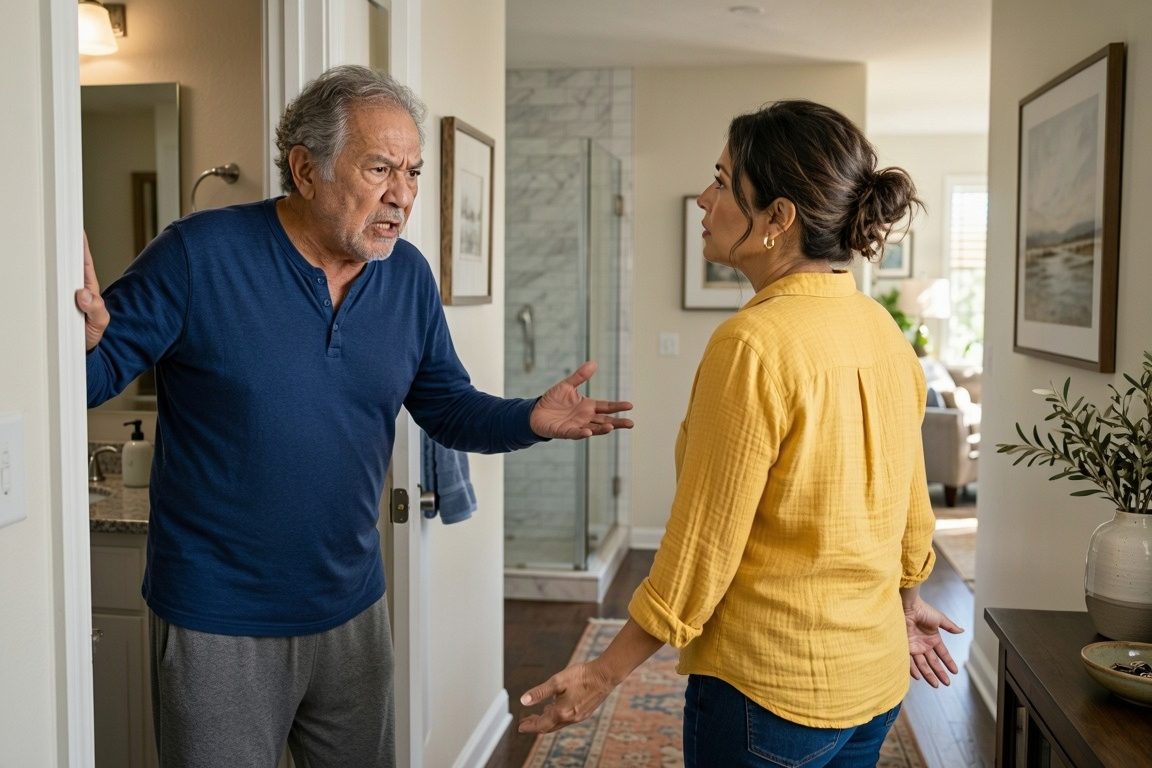
Step by step
What not to do
- Don't argue, reason, or try to correct a delusion, the brain cannot process logic during an episode, and debate makes things worse.
- Don't raise your voice or show alarm. Keep your tone low and your body language relaxed.
- Don't initiate physical contact, grabbing, hugging, or restraining. Restraint escalates aggression and risks injury; use distance and the environment as a buffer.
- Don't take the behavior personally. It is the disease, not your loved one; carrying the hurt burns you out and clouds your judgment.
- Don't scold, lecture, or punish afterward. They won't remember and can't learn, lecturing only plants fear that fuels the next episode.
- Don't rush them through tasks. Move slowly, give one step at a time, and allow extra time.
- Don't skip the medical investigation, pain, UTIs, constipation, and medication side effects are common, treatable causes, not 'just the disease.'
- Don't leave weapons, sharp objects, or medications within reach.
- Don't sacrifice your own safety. Stepping away, calling for help, or considering a different care setting is not selfish, you cannot pour from an empty cup.
Key points
- Aggression is a symptom of brain failure, not a personal attack. It is the person's only remaining way to signal an unmet need or distress.
- Your safety comes first. It is okay to leave the room, call for help, or consider a care facility if the aggression becomes unmanageable.
- Never argue, raise your voice, or initiate physical contact during an outburst, these reliably escalate it. Validate the emotion, then distract and redirect.
- Always investigate physical causes (infection, pain, constipation, medication side effects) before assuming the behavior is permanent.
- Look for patterns. What happened just before the outburst is your clue to preventing the next one, document every episode.
- Have a written emergency plan everyone involved knows, and practice the steps so they become automatic.
- You are not alone, aggression affects nearly all people with dementia at some point. Lean on a doctor, support group, or helpline.
Videos
 How to stay safe in a dementia emergencyThis video gives a concrete four-step plan for what to do when aggression escalates to a point where you fear for your safety. It covers how to create distance, call for help, and protect yourself without escalating the situation.
 how to prevent anger in dementiaPrevention is key. This video shares five general approaches to reduce the likelihood of aggressive outbursts, including adjusting communication, environment, and daily routines. The fifth approach is especially practical.
 Aggressive Behavior in People with Dementia | Linda Ercoli, PhD | UCLAMDChatA geriatric psychologist explains the difference between agitation and aggression, common triggers (including caregiver actions), and how to respond. This is a professional, evidence-based overview that is very helpful for understanding the 'why' behind the behavior.
 How to reduce violence in dementiaThis video focuses on reducing violent behaviors by addressing underlying causes and using a calm, structured approach. It includes tips for both preventing and de-escalating violence.
5 more videos
 What To Do With A Violent Dementia PatientThis video addresses the tough decision of when to consider placement outside the home. It also covers how to handle violent episodes in the moment and the importance of creating a paper trail for legal and medical purposes.
 At What Stage Do Alzheimer's Patients Become Aggressive?Understanding the typical timeline of aggression in Alzheimer's disease helps caregivers know what to expect and when to plan ahead. This video explains that aggression is most common in the middle stages but can occur at any point.
 How to Deal with Aggressive Dementia Patients (4 Strategies)This video breaks down four levels of approaches for handling aggressive behavior, from mild to severe, with concrete examples of what to say and do.
 How to Manage Anger and Aggression in Alzheimer's DiseaseThis video focuses on the underlying brain changes that cause aggression and provides practical tips for preventing and de-escalating angry outbursts.
 Is Your Aging Parent With Dementia Refusing Help? Do This!A neuropsychologist shares three effective ways to handle refusal of care without power struggles, with real-life examples from caregivers.
Background
Understanding the situation
Dementia is progressive brain failure. The regions that handle language, reasoning, and impulse control are damaged, while the primitive 'fight, flight, or freeze' response stays fully intact. When your loved one feels threatened, rushed, in pain, or unable to understand what's being asked, they can no longer reason it out or put the distress into words, so the brain defaults to a physical or verbal outburst. This is why arguing, explaining, or correcting almost never works mid-episode: the thinking brain simply cannot process it. Aggression is also almost always triggered by something specific, physical discomfort (pain, infection, especially a UTI, constipation, hunger, thirst, fatigue, a full bladder), environmental overload (noise, glare, clutter, crowds, unfamiliar settings), or a communication breakdown (feeling misunderstood, rushed, criticized, or treated like a child). The person may no longer recognize you and may perceive care, like bathing or dressing, as a threat from a stranger. Painfully, people with dementia often save their hardest behavior for the person they trust most, because they feel safe enough to let their raw fear out with you. That is not manipulation, and it does not mean you must tolerate being hurt: your safety always matters.
Practical tools
11
Safety First Home Audit
Proactively lock away anything that could become a weapon BEFORE a crisis:
Use childproof locks if needed. Doing this when things are calm means you're not scrambling during an episode.
Time Out Protocol
When an episode is escalating and nothing is working, say 'I need to step out for a moment. I'll be right back,' and leave for 5–10 minutes. The brief separation breaks the escalation cycle and lets you both reset. Return with a completely different, calming activity rather than picking up where you left off.
The GATHER Trigger Scan
Run this mental checklist the instant aggression flares: G: Gather: what just happened? A: Assess for pain, infection, environment, recent medication changes. T: Try a calm approach: low voice, slow movements. H: Help them feel safe with a familiar object or activity. E: Evaluate: did it work, what else? R: Reassess and document. Turns panic into problem-solving in under a minute.
De-escalation & Validation Phrase Bank
Replace 'Calm down!' and 'No, you can't' with validating, redirecting phrases: 'I can see you're upset: I'm here to help.' / 'You are safe. I am with you.' / 'Let's sit together for a moment.' / 'I can see you're [angry/frustrated]; let's go look at the birds outside.' / 'Yes, I know you want to go home, tell me about your home.' / 'That must be so hard.' / 'Would you like a drink of water?' Avoid 'why' questions, use short sentences, and repeat gently.
Calm Environment Checklist
Post and run through it:
Calm-Down Safe Room
Designate one room as a retreat. Remove sharp objects, heavy throwable items, and tripping hazards; keep lighting soft and noise low. Stock a comfortable chair, a familiar blanket, a photo album, and calming music. Use it to guide the person to settle, or to step away to yourself.
Pain & Infection Quick Check
When aggression appears suddenly, check:
If yes to any, contact the doctor, an undetected UTI, pain, or constipation is a frequent hidden cause.
Care Refusal Toolkit
When care (bathing, dressing) is refused: stop, walk away for about 5 minutes, then return with a different approach. Reframe bathing as 'spa time' or 'freshen up,' use warm lighting and soft music, and limit full baths to about twice a week with sponge baths in between. Never force the task.
3 more tools
Third-Person Medication Approach
If medication is refused, shift the authority away from you: 'Your doctor wants you to take this to help you feel better.' Ask the pharmacist whether it can be safely crushed or mixed with food, confirm with the pharmacist or doctor before doing so.
Dementia Emergency Plan Card
Make a small card for your wallet and the fridge listing:
Share it with everyone who helps with care and practice the steps.
Episode / After-Action Log
Keep a notebook or phone note, one line per episode: date, time, location, likely trigger, what you tried, what helped, duration, and severity (mild/moderate/severe). After 3–4 entries, patterns emerge (a medication timing, a daily transition like 4 PM sundowning, a specific task) that become your prevention plan. Bring the log to medical appointments.
Different situations
Lewy body dementia: Aggression is often sparked by vivid visual hallucinations or sudden swings in alertness. Never argue that the hallucination isn't real; acknowledge the fear: 'That looks scary: I'm here with you,' then redirect to a safe, familiar activity. People with LBD are extremely sensitive to antipsychotic medications and can have severe reactions, so discuss every medication change with a neurologist who knows LBD.
Middle-stage dementia: This is the most common stage for aggression to emerge. The person senses their losses but can't express the frustration and often resists care because it feels like losing independence. Use 'ask, don't tell': 'Would you like the blue shirt or the red one?' instead of 'Put on your shirt.' Offering choices restores a sense of control.
Late-stage dementia: Episodes may be more frequent and intense, and the person may not recognize you, which heightens their fear. Approach slowly from the front, identify yourself by name, keep interactions short, and focus on comfort (pain relief, positioning, hydration). Use gentle touch only when they are calm, and consider a palliative care team. A professional caregiver in a uniform may sometimes feel less threatening for personal care than a family member.
Spouse vs. adult child caregiver: Spouses often feel deep grief and betrayal, as if the person they married is gone; remind yourself the disease, not your partner, is driving this. Adult children may carry guilt or resentment and may need to set firmer boundaries and bring in help earlier. If aggression targets one person, consider rotating caregivers or respite. Both roles benefit greatly from a support group.
In a facility, memory care, or psychiatric hospital: You have less control over the environment but you can advocate. Ask staff about their de-escalation protocol, request they avoid physical restraints, and share what works at home (a favorite song, a specific phrase). Request a care plan meeting, and ask for a medication review or geriatric psychiatry consult if aggression is frequent. If your loved one doesn't recognize you as a visitor, don't take it personally, introduce yourself calmly by name.
Medicaid or limited financial resources: Most of these strategies are free. Call the Alzheimer's Association 24/7 Helpline (800-272-3900), join free online support groups (ALZConnected), and contact your local Area Agency on Aging about respite vouchers and free caregiver training. Use household items for calming distraction (folding towels, sorting socks). Ask the doctor about generics, samples, or patient-assistance programs if medication cost is a barrier.
Common questions
4
Aggression after a medication increase: If the outbursts started or got worse soon after a medication was started or a dose was raised, treat the timing as a major clue, the drug may be the cause rather than the dementia itself. Write down the date the medication changed and the date the aggression began. Do not stop the medication abruptly on your own; contact the prescriber promptly to review it and ask whether the change should be reversed or adjusted.
Reframe aggression as a response to accumulated loss: Try seeing an outburst not as bad behavior but as the overflow of a lifetime of mounting losses, lost independence, lost words, lost recognition of familiar people and places, lost control over their own day. When you picture the fear and grief underneath the anger, it becomes easier to respond with compassion instead of taking the behavior personally, and easier to ask 'what need is unmet?' rather than 'why are they doing this to me?'
Handling aggression without fear: Going in expecting and dreading conflict can tighten your own tone and body language and accidentally escalate things. Prepare ahead, know your exits, keep your phone charged, have a backup person to call, so you can approach calmly and confidently. A relaxed, unhurried caregiver is itself a de-escalation tool.
Make and rehearse an emergency plan: Before a crisis, write down your step-by-step plan: where you'll go for safety, who you'll call, the 911 script, the nearest ER, and what usually calms your loved one. Put it on the Dementia Emergency Plan Card, share it with everyone who helps, and walk through the steps so they become automatic when adrenaline is high.
For the doctor
2
- Ask: 'Could a urinary tract infection, constipation, or pain be causing this sudden aggression, and how can we check?' Ask for a full medication review: 'Could any current medications, especially anticholinergics, benzodiazepines, or sleep aids, be worsening agitation?' If aggression began or worsened right after a medication was started or increased, flag that timing specifically. Ask: 'Are there non-drug approaches we should try first? If medication is needed, what are the risks and benefits for this specific type of dementia, and for the shortest time possible?' For Lewy body dementia, ask which medications to avoid due to sensitivity and what the safest option is for severe agitation. Ask about a referral to a geriatric psychiatrist, behavioral neurologist, or dementia specialist for severe or persistent aggression. And if you ever feel unsafe, including being physically attacked, tell your doctor
- they can help build a safety plan and connect you with emergency respite. Never start, stop, or change any medication without your prescriber's guidance.