Step by step
What not to do
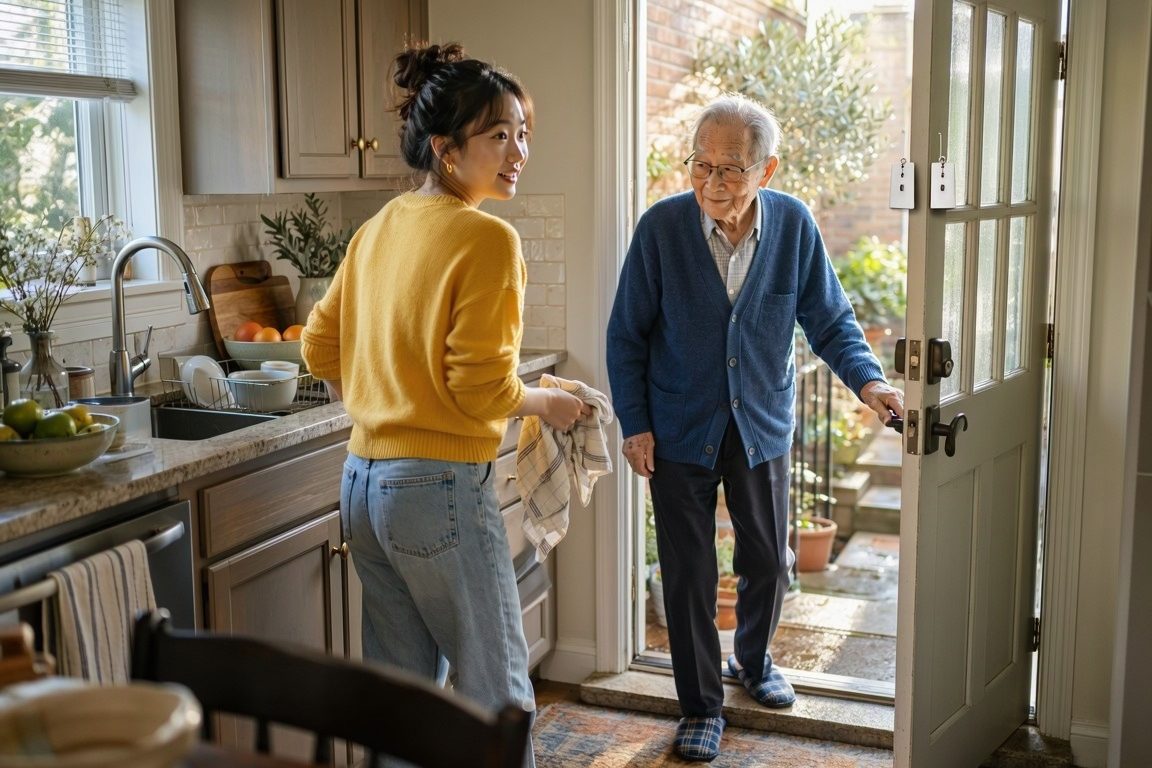
- Don't confront, scold, argue, or try to reason if you catch them heading out, it raises confusion and agitation; approach calmly and redirect instead.
- Don't insist 'this IS your home' or debate where they are going; acknowledge the feeling first, then gently guide them to an activity.
- Don't physically restrain unless absolutely necessary, it risks injury and escalation.
- Don't rely on a single lock or alarm; layer at least two or three measures (for example a high deadbolt, a door alarm, and a visual barrier).
- Don't leave them unattended near unsecured yards, stairs, water, or in a wheelchair or movable bed.
- Don't delay calling 911 if you can't find them quickly, every minute matters.
Key points
- Wandering is a symptom, not a choice, driven by unmet needs, disorientation, or time-traveling. Respond with calm redirection, not correction.
- Layer your prevention: locks, alarms, GPS, and neighborhood notification work together; no single tool is enough.
- A predictable daily routine with built-in activity reduces restlessness and lets you anticipate triggers.
- Prepare a go bag, a Wandering Safety Plan, and brief neighbors and police in advance, readiness saves precious time.
- If your loved one goes missing, stay calm, check the house and yard, call 911 immediately, and state they have dementia.
- Wandering can happen by foot, wheelchair, or car, secure keys and plan for every form of mobility.
- Always confirm new devices or medications with your clinician, and adjust any strategy that causes agitation or distress.
Background
Understanding the situation
Wandering is almost never an attempt to leave you, it is driven by confusion or an unmet need. It usually traces back to one of three drivers: an unmet need (hunger, thirst, pain, boredom, or needing the bathroom but forgetting where it is), disorientation (no longer recognizing a home of 50 years, so getting up to find a place that 'feels like home', often voiced as 'I want to go home' even while already there), or time-traveling (reliving an old memory, such as feeling they must pick up children from school or get to a long-ago job). As dementia progresses, the brain regions that normally let us pause and think 'it's midnight, I shouldn't go outside' shrink, so impulse control fades and your loved one may act on a sudden urge with no internal 'brake.' Visual-spatial problems make it easy to get turned around even in familiar places. Because the behavior can be sudden and unpredictable, prevention must be layered, no single lock or alarm is enough. Remember too that wandering is not just on foot: a person with car keys can drive off and become lost for hours or days, and someone in a wheelchair can roll out of an unsecured area, so your plan must cover every form of mobility.
Practical tools
17
Door and window alarms
Chime-style, adhesive, or smart-home sensors that sound or notify your phone when an exit is opened. Inexpensive and easy to install on front, back, garage, and patio doors.
Pressure-sensitive floor mats
Place directly in front of exit doors and in hallways that lead to them so they trigger an alert the instant someone steps on them. A mat beside the bed catches nighttime waking.
Bed alarms
Sensors that alert you the moment the person gets out of bed at night, buying you time to intervene before they leave the room. Pair with the bed kept in its lowest position.
Motion-sensor lights
Mount near outside doors and along walkways; they light up on movement, alerting you and reducing falls in dark areas.
Exit-disguise supplies
to make exits less noticeable and harder to open unnoticed, while always leaving a fast emergency release for you.
GPS tracker or smartwatch
A small wearable (belt clip, shoe insert, pocket device, or wristwatch) showing real-time location on your phone; some include fall detection. Introduce it early as a habit before a crisis.
MedicAlert + Alzheimer's Association Safe Return
Nationwide enrollment providing a medical ID bracelet and a 24/7 emergency response line that helps locate a person who wanders. Ask your clinician to help you enroll.
Project Lifesaver program
A local first-responder program (offered by many sheriff's and police departments) using a personal locating device so trained teams can quickly find an enrolled person who has wandered. Ask your police non-emergency line if it is available in your area.
9 more tools
Local vulnerable-person registry
Offered by many police departments. Pre-register
via your non-emergency line so responders can act faster if your loved one goes missing.
Community-safety net card
A small prepared card with a recent close-up photo and brief description that you share with trusted neighbors and local police so they can recognize and help your loved one.
Neighbor notification card
Hand or mail nearby neighbors a simple card explaining that your loved one has dementia, your phone number, and a request to call you (not to confront) if they see the person out alone. A photo on the card makes recognition easy.
Go bag / Wandering-safety folder
Keep by the door or phone:
Snap a daily phone photo of the day's outfit.
One-page Wandering Safety Plan sheet
A single fill-in sheet kept by the phone, in the go bag, and with a trusted contact. Fields to complete:
Update it as the disease progresses.
Search protocol with caregiver as home contact
Step 1: search the house, yard, and immediate surroundings (especially near water and stairs). Step 2: call 911 and state the person has dementia. Step 3: list yourself as the home contact and stay near home with a charged phone in case they circle back. Step 4: call neighbors and family. Step 5: hand the go bag and Safety Plan to the first responding officer.
Validation–ask–redirect script
When they want to leave, first VALIDATE the feeling ('It sounds like you really need to get somewhere'), then ASK gently to learn the need ('I see you want to go somewhere, can you tell me where you're headed?'), then REDIRECT to a shared activity ('I need your help in the kitchen first, come with me?'). This honors dignity while steering them to safety.
Safe walking loop with activity stations
Set up a circular, obstacle-free indoor (or secured outdoor) path with good lighting, familiar objects, and a few small 'stations', a resting chair, a basket of laundry to fold, photos to look at, so restless energy has a safe, satisfying outlet.
Wandering journal
For one week, log the time, context, and behavior of each episode plus what helped. Use the pattern to intervene about 30 minutes before a high-risk time with a snack, music, walk, or comforting object.
Different situations
Early-stage dementia (still living at home, some independence): Your loved one may still be aware of the risk and willing to help plan. Set a daily check-in time, review the day's schedule together each morning using a calendar or whiteboard, identify a companion for times you're away, plan alternative transportation if driving becomes unsafe, and introduce a pocket or purse GPS tracker early as a habit.
Late-stage dementia (bedbound or very limited mobility): Wandering may look like pacing or repetitive movement. Focus on comfort and fall prevention: bed alarms and pressure mats, the bed in its lowest position, a safe padded area for pacing, and never leaving them unattended in a wheelchair or movable bed. Ask your clinician about a low bed or floor mattress.
Lewy body or Parkinson's dementia: Cognition fluctuates and hallucinations are common, so wandering may be triggered by seeing something frightening. Use calm redirection rather than arguing about what they see, keep the home well lit to reduce shadows, and be extra cautious with locks because impulsive movements are more likely. Ask your clinician about treatments for hallucinations or agitation.
Spouse caregiver: Locking doors or adding alarms can feel like a betrayal of partnership. Reframe these as acts of love, not imprisonment. Because you also sleep, nighttime is high-risk, consider a bed alarm or a night aide.
Adult child caregiver: Balance care with work and family by building a support network: ask siblings or friends to take shifts during high-risk late-afternoon hours, and use cameras or GPS to monitor from a distance when you can't be present. A support group helps with the guilt of 'restricting' a parent.
Language difficulty (semantic aphasia): Your loved one may not be able to explain why they want to leave. Watch non-verbal cues like restlessness, pointing, or repeated door attempts; use visual signs (a picture of a toilet on the bathroom door, a simple 'stop' sign on off-limits doors) and keep a calm, reassuring presence.
Living in a facility (assisted living or memory care): Even secure units have wandering. Give staff a recent photo, medical info, and a list of triggers; ask how their door alarms and elopement response work; visit at different times to observe staffing; request a room away from exits; and report every incident immediately.
Common questions
6
Most people who wander are found close to home and often return to where they started, stay near the house as the home contact while others search outward.
What are the safety risks of wandering, and how do I prioritize them? Lead with the highest-risk hazards first: traffic, water, extreme heat or cold, and getting lost after dark. Layer protections against those before lower-risk concerns.
How do I prevent the person from leaving unsupervised? Combine a predictable routine, secured and disguised exits, exit-cue removal, and a daytime activity plan rather than relying on locks alone.
What affordable technology can help? Inexpensive door and window chimes, pressure mats, motion-sensor lights, and a basic pocket GPS tracker give strong coverage at low cost.
Anticipate, don't just react: a one-week journal usually reveals a predictable high-risk window you can defuse 30 minutes early.
Update your safety plan and photo regularly, appearance, clothing, and abilities change as the disease progresses.
For the doctor
7
- Confirm any device or medication question with your clinician before acting, never start or stop a medication on your own. Helpful questions: 'Is a GPS device or wearable alarm appropriate for my loved one's stage and ability, and could it confuse them or be removed?'
- 'Could any medication help reduce wandering linked to agitation, sundowning, or hallucinations, and what are the risks?'
- 'Can you formally assess whether my loved one is still safe to drive and, if not, recommend stopping and advise on reporting to the DMV?'
- 'Can you help me enroll in MedicAlert + Safe Return?'
- 'If wandering comes with falls or injuries, what home safety modifications (bed alarms, floor mats, hip protectors) do you recommend?'
- 'What should I do if my loved one becomes very agitated or aggressive when I try to prevent them from leaving?'
- and 'Are there local resources or caregiver support groups for wandering?'