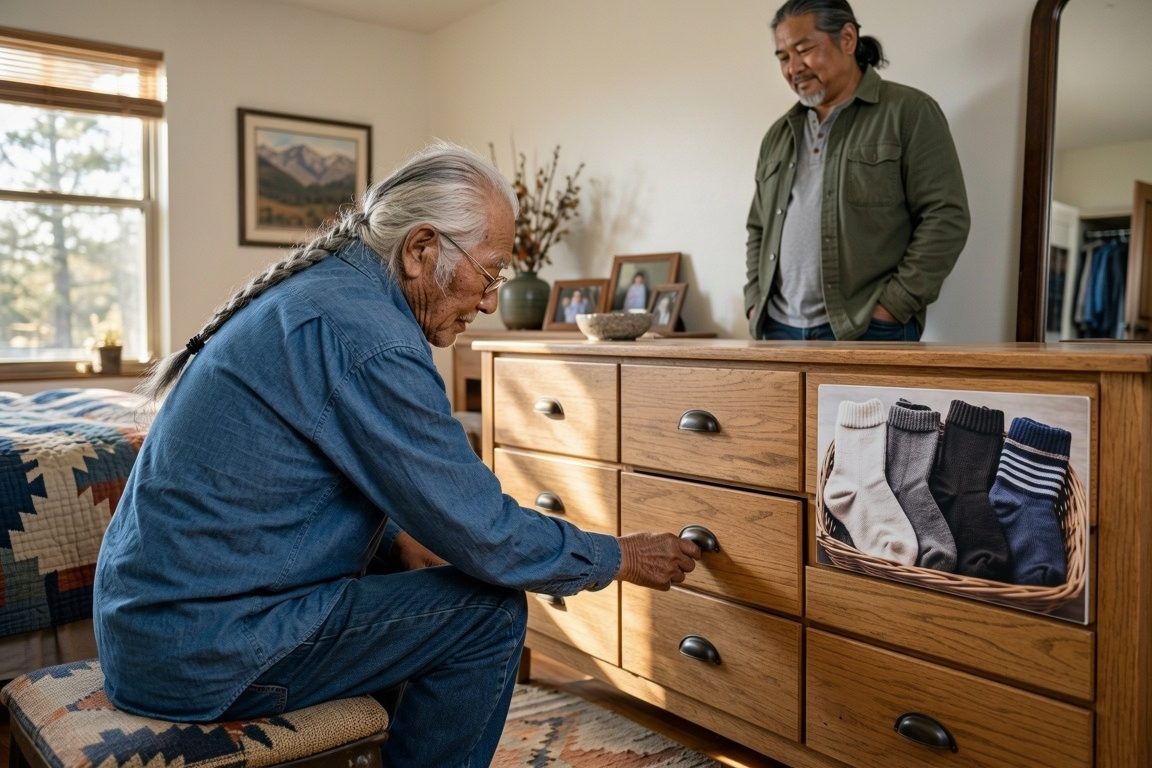
Step by step
What not to do
- Don't use low-contrast cues like white signs on white walls or dark tape on dark floors.
- Don't install light-sensitive cues that require the person to recognize or remember their purpose.
- Don't add multiple new cues in one day, as this can overwhelm rather than guide.
Key points
- Visual cues work best when they are simple, high-contrast, and placed at eye level in the most-used areas of the home.
- Start with one or two cues at a time and observe how your loved one responds before adding more.
- Use pictures instead of words whenever possible, especially for people who have difficulty reading.
- Combine visual cues with a calm verbal prompt to help your person learn to use them.
- Safety first: avoid trip hazards, remove clutter, and ensure adequate lighting, especially at night.
- Adapt cues as the disease progresses, what works today may need to be simplified or replaced tomorrow.
Videos
 Care Partner Tips: Creating Cues for Independence Around the HouseThis video shows real examples of how to set up visual cues like signs and calendars, with practical tips from a care partner who uses them daily.
 Steady Steps: Practical Strategies for Managing Falls in DementiaLearn how to use visual cues like contrasting tape and clear pathways to reduce fall risk, a key concern when placing cues around the home.
 Posterior Cortical Atrophy Lecture Series with Karen HookstadtIf your loved one has PCA, this video explains how visual processing is affected and offers specific strategies for adapting visual cues.
 How to communicate with a dementia patientThis video covers how to pair visual cues with simple verbal prompts, which is essential for helping your person understand and use the cues.
2 more videos
 Dementia Proofing Your HomeA comprehensive walkthrough of home modifications, including where to place visual cues for maximum safety and independence.
 How to Manage Repetitive Behaviors in Alzheimer's DiseaseVisual cues can reduce repetitive questions about time or location; this video explains how to use them to break the cycle.
Background
Why visual cues work when memory struggles
Dementia affects the brain’s ability to process and recall information, but visual cues tap into preserved skills like recognizing familiar faces, colors, and objects. As one expert explains, the brain may struggle with ‘figure-ground’ perception, picking out an object from its background, so a cluttered drawer or a busy hallway can become overwhelming. By simplifying the visual environment, you reduce the mental load and make it easier for your loved one to navigate daily tasks without frustration or agitation. This isn’t about teaching new skills; it’s about using what’s still intact to support independence.
The role of contrast, lighting, and familiarity
People with dementia often lose depth perception and contrast sensitivity. That means a white toilet against a white wall may be invisible, or a dark rug on a dark floor may look like a hole. Experts recommend using high-contrast colors, like a red toilet seat or bright tape along baseboards, to create clear visual paths. Natural light during the day and even, shadow-free lighting at night (especially on the way to the bathroom) help prevent falls and reduce confusion. Familiar objects, like a favorite chair or a family photo, act as landmarks that orient your person to where they are and what room they’re in.
How cues support both memory and safety
Visual cues do double duty: they remind your loved one of what to do (e.g., ‘this door leads to the bathroom’) and they prevent accidents. For example, placing a picture of a toilet on the bathroom door eliminates the anxiety of opening the wrong door. Using colored tape to mark the ‘stop’ button on the microwave helps someone use it safely without reading tiny numbers. And a whiteboard calendar in a high-traffic area, like a stairwell, keeps appointments top of mind without relying on short-term memory. The goal is to make the environment so intuitive that your person can move through their day with less help and more confidence.
Practical tools
4
High-contrast tape
Bright red or yellow tape to mark floor edges, steps, and doorframes for safety.
Picture signage
Pre-printed or laminated photos of the room's function (e.g., toilet, bed) to mount on doors.
Red toilet seat
Solid-colored seat to contrast with standard white bathroom fixtures.
Whiteboard for appointments
Small whiteboard with a single daily reminder, placed at eye level by the exit.
Different situations
For someone with posterior cortical atrophy (PCA) or vision changes
PCA affects the back of the brain, causing difficulty with visual processing, depth perception, and reading. In this case, use very high-contrast colors (e.g., bright yellow tape on black baseboards). Avoid patterns or busy backgrounds. Use tactile cues as well, like a textured sticker on the bathroom door. Keep lighting even and reduce glare from windows or shiny floors. Place signs at a lower height, as the person may have trouble looking up. Test each cue by asking, ‘Can you see this clearly?’
For a spouse vs. an adult child caregiver
If you are a spouse, your loved one may still recognize you as their partner, but they may not remember your name or role. Wear a familiar piece of clothing or jewelry that they associate with you (e.g., a favorite flannel shirt or a wedding ring). Use photos of the two of you together as cues. If you are an adult child, your loved one may mistake you for a sibling or a stranger. Use photos of you as a child or recent photos with clear labels like ‘Your daughter, Sarah.’ Speak in a calm, familiar tone and avoid correcting them if they misidentify you.
For someone in late-stage dementia or who is bedbound
Visual cues become less effective as the person loses the ability to process images. Focus on tactile and auditory cues instead. Use a soft, familiar blanket or a favorite pillow as a landmark in the bed. Place a photo of a loved one on the bedside table where they can see it when they turn their head. Use a simple night light with a warm glow. Speak in short, simple phrases and point to the cue while saying, ‘This is your blanket. It’s soft.’
For someone who wanders or is at risk of leaving the house
Place a ‘stop’ sign or a red piece of tape on the inside of the front door at eye level. Use a chain lock or a doorknob cover that is out of sight (high or low) to prevent wandering out. Install motion-sensor lights outside the door so you are alerted if they try to leave. Create a ‘wandering path’ inside the home with chairs, familiar objects, and bright tape on the floor to guide them in a safe loop. Say, ‘Let’s walk this way together. See the red line on the floor? It leads to the living room where your favorite chair is.’
For someone with Lewy body dementia or Parkinson’s-related dementia
These conditions often involve visual hallucinations and fluctuating attention. Avoid using mirrors, as they may see a stranger in the reflection. Use simple, solid-colored signs without patterns. Keep lighting consistent and avoid sudden changes in brightness. Use a day clock that shows ‘morning,’ ‘afternoon,’ ‘evening,’ and ‘night’ to help with time disorientation. If hallucinations occur, do not argue; instead, acknowledge their experience and redirect to a visual cue: ‘I see you’re looking at something. Let’s look at this photo of your dog instead.’
For the doctor
4
- Ask your doctor or occupational therapist: ‘Are there any specific vision or perceptual issues my loved one has that would affect how they see visual cues? Should we have a vision test to rule out cataracts or other treatable problems?’
- Discuss with a pharmacist: ‘Could any of my loved one’s medications be causing visual disturbances or confusion that might make visual cues less effective?’
- If your loved one has a history of falls, ask a physical therapist: ‘What is the safest way to mark pathways without creating a trip hazard? Should we use floor tape or wall-mounted cues?’
- For someone who is prone to wandering or agitation, ask a dementia care specialist: ‘Are there any visual cues that might trigger agitation or aggression? Should we avoid certain colors or patterns?’