Step by step
What not to do
- Do not play music that is too loud or too fast; start at low volume with a moderate tempo and switch to something calmer if the person becomes restless.
- Do not test their memory with questions like 'Do you remember this song?', let memories surface naturally.
- Do not force participation in singing or playing instruments; pushing creates resistance.
- Do not use the music as a babysitter by leaving the person alone; your shared presence gives the activity meaning.
- Do not mix songs from across their whole life in one session, stick to one era, ideally young adulthood (ages 15-30).
- Do not push through if the person becomes upset or asks for the music to stop; pause or end the session.
Key points
- Music is processed across the entire brain, so it often remains accessible even when other memories fade.
- The goal is connection and enjoyment, not testing memory. Avoid asking 'Do you remember this?'
- Prepare a short playlist of 5-7 songs from the person's young adulthood (ages 15-30).
- Create a calm, distraction-free environment and sit at the person's eye level.
- Model participation (humming, swaying) and offer simple instruments, but never force engagement.
- Watch for non-verbal cues and adapt the volume, tempo, or song choice based on the person's response.
Videos
 Top 5 Indoor Activities for Seniors with Dementia (For Free)This video offers practical, free indoor activities that can be adapted to include music, such as using household items for rhythm instruments.
 How to keep a dementia patient busyProvides general tips on engaging a person with dementia, including the use of music to create a positive and structured routine.
 Cognitive Activities for Dementia and Older AdultsExplores a range of cognitive activities, with music-based reminiscence as a key strategy for stimulating memory and conversation.
 An Interview with Music Therapist Alexis Baker MT-BCA professional music therapist explains how to use music therapeutically, including specific techniques for engaging people with dementia.
2 more videos
 An Interactive and Media Collection for people living with dementia & their care partnersShowcases a multi-sensory media collection that includes music, videos, and aromas, demonstrating how to create an immersive reminiscence experience.
 Radio Show VoiceAmericaA discussion on the benefits of music and reminiscence therapy, with real-world examples and expert advice for caregivers.
Practical tools
5
Pre-made era playlist
A playlist of 5-7 songs from the person's young adult years, gathered with family help on Spotify, YouTube, or Apple Music; label it with their name and the era (e.g., 'Dad's 1950s Favorites').
Simple percussion basket
A small basket holding easy-to-grab items like
offer with 'You can play along if you like,' modeling first. A bell bracelet works for limited hand mobility.
Over-ear headphones for sensitive listeners
Comfortable, padded headphones for later-stage dementia or those overstimulated by room noise;
Name That Tune variation (for early stages)
For mild-stage dementia, play the first few seconds and ask playfully 'What song is this?'; if unknown, reveal the answer and enjoy the full song together without turning it into a test.
Era-appropriate mementos and photos
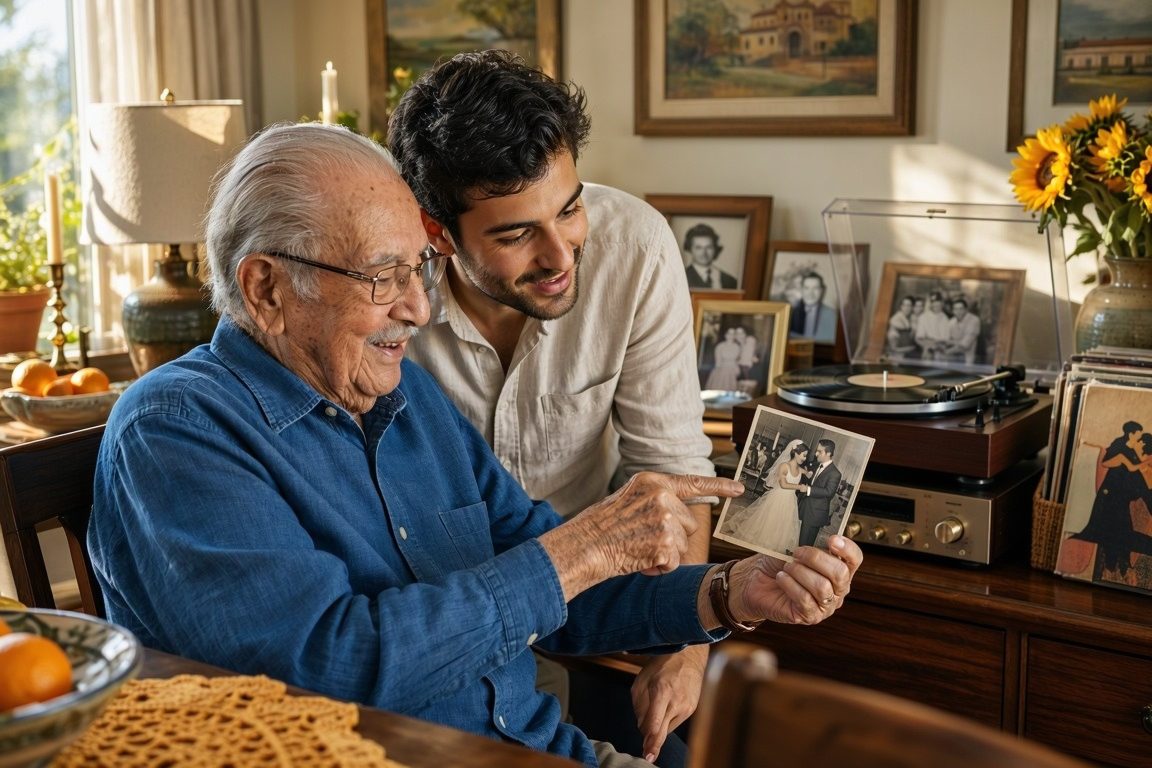
A small collection of photos, postcards, or keepsakes from the same period as the music (wedding pictures, prom snapshots, a vintage magazine) to look at together after a song plays, providing a visual anchor for memories.
Different situations
Lewy body dementia
People with Lewy body dementia may be more sensitive to sound and can experience visual hallucinations. Keep the volume very low and choose music with a slow, steady rhythm. Avoid complex orchestral pieces that might be overstimulating. Watch for signs of confusion or agitation, and stop immediately if the person seems distressed. Also, be aware that movement (like swaying) may be more difficult due to Parkinsonism; focus on listening or humming instead.
Late-stage dementia (bedbound or very limited communication)
Focus on the person's comfort and non-verbal cues. Play a single, very familiar song (like a lullaby or a hymn) at a low volume. Hold their hand or gently stroke their arm while the music plays. Watch for changes in breathing, facial expression, or eye movement, these can be signs of recognition and engagement. Do not expect any verbal response. The goal is simply to provide comfort and connection.
Spouse vs. adult child caregiver
If you are the spouse, you likely share many musical memories with the person. This can be a beautiful source of connection, but it can also be emotionally painful. Allow yourself to feel the emotions, but try to stay focused on the present moment with your loved one. If you are an adult child, you may not know their favorite songs from their youth. Ask other family members or look for clues (e.g., old record albums, a favorite radio station). You can also say, 'I'd love to hear some of the music you loved when you were my age.'
In a facility (nursing home or assisted living)
Coordinate with the staff to find a quiet time and place for the activity. You may need to use headphones to avoid disturbing other residents. If the facility has a music therapist, ask for their advice on songs that might work well. Some facilities have a 'Music & Memory' program; ask if your loved one can participate. You can also bring in a small speaker and create a playlist on your phone.
Frontotemporal dementia (behavioral variant)
People with this type of dementia may have changes in musical taste or become fixated on a particular song. Go with their interest, even if it seems unusual. They may also have difficulty with impulse control, so avoid songs that might trigger strong negative emotions. Stick to calming, familiar tunes. If they become agitated, stop the music and redirect to a different activity.
Common questions
3
How does a patient's lack of awareness of memory problems affect their use of home health care?
Focus on creating a calm, familiar environment with your playlist of 5-7 songs from their young adulthood; sit at their eye level and start humming or swaying gently to model participation without any pressure.
What simple presentation techniques improve picture recall in Alzheimer's?
If they seem restless or distant, lower the music volume or switch to a slower tempo; if they appear happy and engaged, you can offer a simple instrument like a shaker and follow their lead.
How can music activities be adjusted to match the person's current ability?
Watch their body language closely, if they tap a foot or hum along, keep going; if they turn away or look upset, pause the music or try a different song, always prioritizing their comfort over the activity.
For the doctor
4
- If the person has a history of seizures, ask the doctor if certain types of music (e.g., very fast or repetitive beats) could be a trigger.
- If the person is on medications that affect heart rate or blood pressure, ask if music that is very exciting or sad could cause a physiological response that is unsafe.
- If the person has hearing aids, ask the audiologist or doctor about the best way to use headphones or speakers without causing feedback or discomfort.
- If the person has a known history of severe agitation or aggression triggered by sound, ask for a referral to a music therapist who can create a personalized, safe plan.