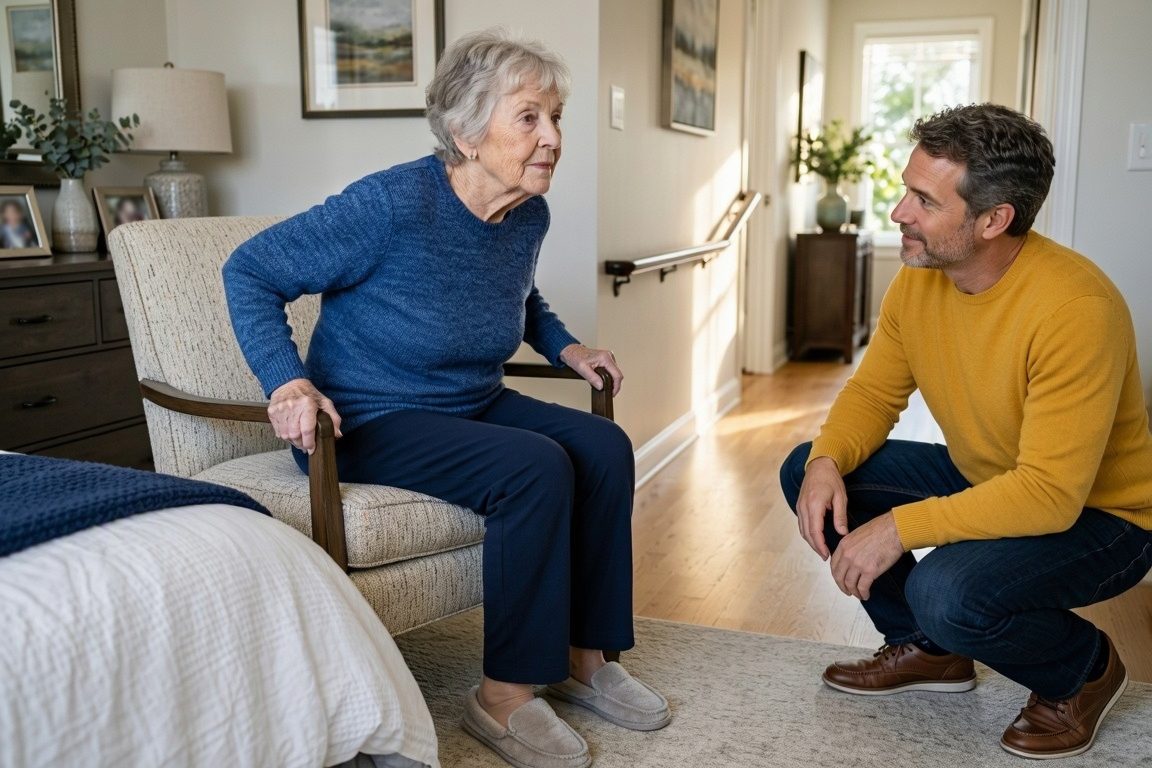
Step by step
What not to do
- Do not rush the person during transitions. If you hurry them to stand up or turn, they may panic and freeze or lurch, increasing fall risk.Instead, slow down your own movements, use a calm voice, and give them time to process each step before moving.
- Do not assume that a familiar room is safe just because it looks tidy. Clutter like shoes, pet toys, or extension cords can be invisible to someone with poor depth perception. Walk through each room at their eye level and remove anything that could catch a foot or walker.
- Do not leave throw rugs in place because they 'look nice' or 'have always been there.' Rugs are a leading cause of falls in dementia. Remove them entirely or secure them with double-sided tape. Better yet, replace them with non-slip mats if needed.
- Do not use dark or patterned flooring that blends with walls or furniture. This can confuse depth perception.Instead, use contrasting colors between floors and walls, and between furniture and floors, so the person can clearly see where one surface ends and another begins.
- Do not place furniture in the middle of a room or in a way that creates a narrow path. This forces the person to turn sharply or squeeze through, increasing fall risk. Arrange furniture along walls or in open layouts that allow straight-line walking.
- Do not ignore the bathroom as a high-risk area. A white toilet on a white floor is invisible. Install a colored toilet seat and grab bars. Use a shower chair and non-slip mats. These simple changes prevent the most common falls.
Key points
- Ruby state has the highest fall risk; falls can lead to serious injury or loss of mobility that speeds decline.
- Slow down all transitions, rushing triggers panic and imbalance. Use calm, step-by-step verbal cues.
- Remove all throw rugs and clutter from walkways; these are invisible hazards to someone with poor depth perception.
- Use contrasting colors (bright tape, colored toilet seat) to mark changes in floor surface, stairs, and thresholds.
- Install motion-sensor lights, grab bars, and a shower chair to create a safe, slip-resistant environment.
- Place a chair against the wall in long hallways for resting, and keep frequently used items within easy reach to prevent reaching or bending.
Videos
 Movement and Dementia - Ask Teepa Anything! Live on YoutubeTeepa Snow explains why Ruby state has the highest fall risk and how to slow down transitions to prevent panic and falls.
 The GEMS Approach: Seeing Progression as More than LossThis video provides an overview of the GEMS states, including Ruby, and how to adapt care strategies for each stage.
 Steady Steps: Practical Strategies for Managing Falls in DementiaOffers practical, step-by-step strategies for fall prevention, including environmental modifications and transfer techniques.
 Creating a Dementia-Proof HomeDemonstrates how to modify a home for safety, including using contrasting colors, removing rugs, and installing grab bars.
2 more videos
 7 Reasons People With Dementia Fall (and how to help)Breaks down common fall causes like poor depth perception, clutter, and rushing, with actionable solutions.
 Quick Tips: Fall Prevention Tips for SeniorsA concise video covering footwear, lighting, and home modifications that directly apply to Ruby state care.
Background
Why Ruby State Brings the Highest Fall Risk
In the Ruby state, the brain's ability to coordinate movement, balance against gravity, and judge depth perception is significantly compromised. This isn't just about walking, it includes oral mobility (chewing and swallowing), hand-to-mouth mobility (eating), and upright posture. The risk of a fall-related injury that leads to death or loss of mobility is greatest here. The challenge is that people in Ruby state still feel the need to move, they want to get up, walk to the bathroom, or reach for something, but their body can't keep up with their intentions. If they stop moving altogether, they risk pressure sores, social withdrawal, and faster decline. So the goal isn't to stop movement, but to make every movement safer and slower.
The Problem with Speed: Why Rushing Triggers Panic and Falls
When you try to help a person in Ruby state move quickly, whether to stand up, turn, or sit down, their brain can become overwhelmed. This triggers a panicky response where they freeze or lurch, increasing fall risk. Teepa Snow explains that if we get too quick, they 'can't do it right now' and may shut down entirely. This is especially true during transitions like getting out of a chair, moving from room to room, or even eating. The key is to build in extra time for every transition. Slow down your own pace, use calm verbal cues, and allow them to process each step before moving to the next. This reduces the 'squirrelly' feeling that leads to imbalance.
Environmental Hazards That Become Invisible to Ruby State
What looks like a harmless area rug or a dim hallway to you is a major fall hazard for someone in Ruby state. Their depth perception is poor, so they may not see the edge of a rug or the step down into another room. Throw rugs can catch a toe or a walker. Clutter on the floor, shoes, pet toys, extension cords, becomes a trip risk they can't anticipate. Even the color of a toilet seat against a white floor can make it invisible, leading them to miss the seat when sitting down. The environment must be modified to remove these hidden dangers and to provide clear visual cues that guide safe movement.
Practical tools
6
The 'Slow Down' Verbal Script
When helping the person transition (e.g., from sitting to standing), use these exact words slowly and calmly: 'Let's take our time. I'm right here. First, put both feet flat on the floor. Good. Now, place your hands on the armrests. I'll count to three, and we'll stand up together. One... two... three.' Pause between each step. If they seem panicky, stop and say, 'That's okay. Let's rest a moment and try again.'
Contrasting Color Tape Kit
Buy a roll of bright neon yellow or red duct tape (or painter's tape). Use it to mark:
This creates a visual cue that helps the person see changes in surface or elevation.
Motion-Sensor Nightlight Checklist
Install motion-sensor nightlights in these locations:
Test them weekly to ensure they work. This eliminates the need to find a light switch in the dark and reduces confusion.
Grab Bar and Shower Chair Installation Guide
Have a handyman install grab bars into wall studs (not just drywall) near the toilet and inside the shower. Use a shower chair with rubber tips on the legs. Place a non-slip mat inside the shower and another on the bathroom floor outside the shower. This creates a stable, slip-resistant bathing area.
The 'Clear Path' Walk-Through
Once a week, walk through every room in the house at the person's eye level. Look for:
Remove or secure each item. This simple habit prevents new hazards from accumulating.
Familiar Landmark Placement Guide
Place a small, familiar object (like a framed photo, a colorful ceramic bird, or a favorite hat) at key decision points:
This helps the person orient themselves and reduces wandering confusion that can lead to falls.
Different situations
For someone with Lewy body dementia (LBD)
People with LBD often have fluctuating attention and visual hallucinations. Use even simpler, high-contrast cues (e.g., bright yellow tape on stairs) and avoid patterns that could be misinterpreted as faces or objects. Keep lighting consistent, avoid flickering bulbs. Discuss with their clinician about medication adjustments that might affect balance.
For late-stage Ruby state (approaching Sapphire)
At this stage, the person may be mostly bed-bound or in a wheelchair. Focus on positioning in the chair or bed to prevent pressure sores and falls during transfers. Use a transfer belt and always have two people assist if needed. Keep the bed at a low height with bed rails (if approved by clinician) to prevent rolling out. Use a bedside commode to reduce the need to walk to the bathroom.
For a spouse caregiver vs. an adult child caregiver
A spouse may be older and at risk of injury themselves when assisting with transfers. Use mechanical aids like a transfer board or a lift if available. An adult child may be stronger but less experienced, take a training session on safe transfer techniques. Both should prioritize their own safety to avoid caregiver injury, which can lead to falls for both parties.
For someone living in a facility (nursing home or assisted living)
Work with the facility staff to ensure the room is modified: ask for a colored toilet seat, grab bars, and motion-sensor nightlights. Request that clutter be kept to a minimum and that the path to the bathroom is clear. If the person wanders, ask staff to place a chair against the wall in the hallway and to use contrasting tape on the floor. You can bring your own familiar landmarks (like a photo) to place in their room.
For someone on Medicaid or with limited budget
Many modifications can be done cheaply: use painter's tape instead of duct tape for contrast cues; buy motion-sensor nightlights at a dollar store; use a sturdy kitchen chair as a rest stop in the hallway (placed against the wall); remove rugs instead of buying new flooring. Contact your local Area Agency on Aging for free or low-cost home safety assessments and grab bar installation programs.
For the doctor
7
- Ask the doctor or physical therapist: 'Is it safe for my loved one to walk independently, or do they need a walker or wheelchair for safety? What type of walker is best (e.g., four-wheeled vs. standard)?'
- Discuss any medications that may cause dizziness, low blood pressure, or muscle weakness, and whether adjustments could reduce fall risk.
- Ask about a referral to an occupational therapist for a home safety evaluation and personalized recommendations for positioning and equipment.
- If the person has had a recent fall, ask: 'Should we get a head CT or other imaging to rule out injury? What signs of a fracture or head injury should I watch for?'
- Inquire about a bone density test to assess osteoporosis risk, which affects how serious a fall injury might be.
- Ask: 'What type of grab bars and shower chair do you recommend for my loved one's specific needs? Are there any positioning aids I should consider?'
- Ask: 'Are there any medications or supplements that could help with balance or muscle strength?'