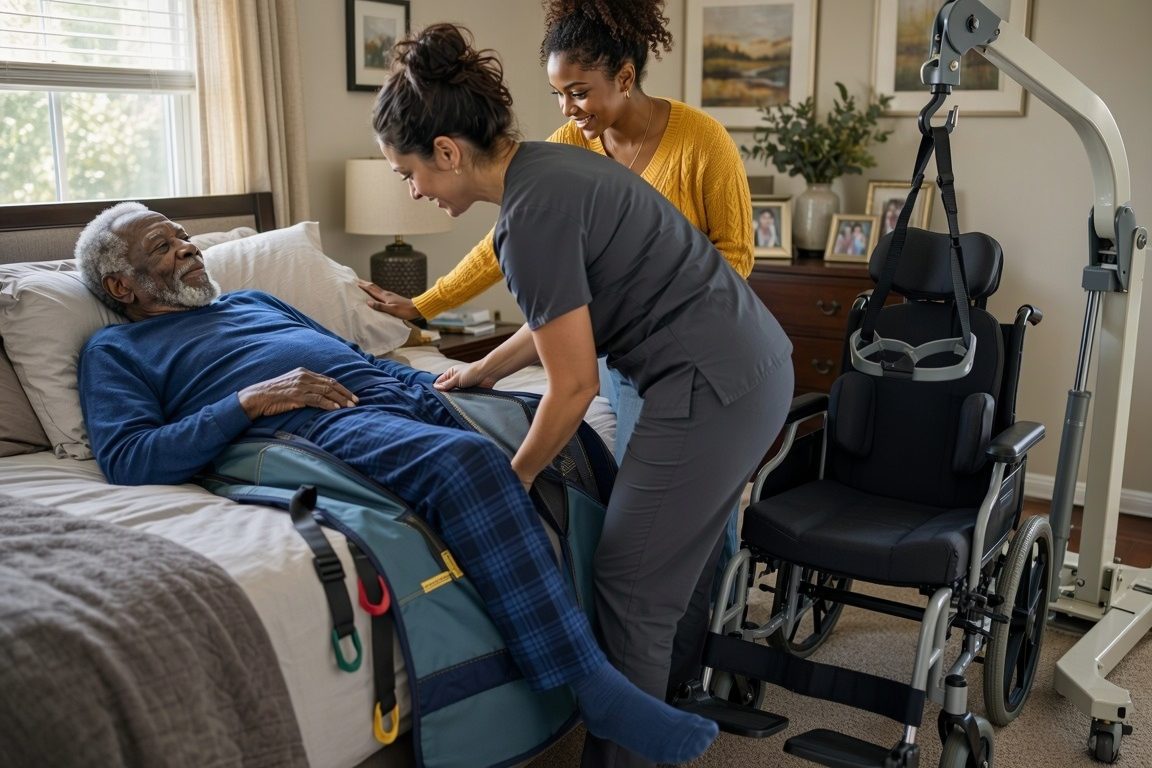
Step by step
What not to do
- Do not try to lift or catch someone who is falling. This is a common instinct, but it can cause serious back injury to you and may not prevent the fall.Instead, let them slide down gently if possible, then use a lift device to get them up.
- Do not use a standard gait belt alone for someone who cannot bear weight. A narrow belt can dig in and cause discomfort, and it does not provide enough support. Use a padded belt with handholds or a full lift device.
- Do not ask the person to 'help' or 'hold on' if they cannot. This can confuse or frustrate them. They may try but fail, leading to a fall.Instead, take full control of the movement with the equipment.
- Do not rush the transfer. Moving too quickly can startle the person and cause them to stiffen or resist. Take your time, talk them through it, and pause if they seem upset.
- Do not assume that because they could transfer yesterday, they can today. Abilities can fluctuate day to day, especially with infections or fatigue. Always reassess before each transfer.
- Do not skip a therapy consult because you think it is too late or too expensive. Even on hospice, you can request a therapist to teach you safe techniques. It may be a covered service, check with your hospice team or Medicare to confirm, and can prevent injury.
Key points
- When weight-bearing is lost, do not try to lift or catch the person yourself, use a lift device.
- A transfer lift (like the Indie Lift) or a stand lift with knee block and waist strap are the safest options.
- Always assess ability before each transfer; it can change day to day.
- Use simple, reassuring language and avoid asking questions they cannot answer.
- Involve a physical or occupational therapist for training, even if on hospice.
- Do not rush, take your time and prioritize safety over speed.
Videos
 Time with Teepa - Can Dementia Make Your Legs Quit Working?Teepa Snow explains why the legs may stop working in later-stage dementia and demonstrates techniques for blocking at the knees to help with transfers.
 Time with Teepa - Does Their Comfort Matter?This video covers how to use a padded gait belt and why comfort and proper positioning are critical during transfers.
 Tips For Moving Someone With DementiaPractical tips for reducing transfer trauma and making the move to a new setting less distressing.
 7. Home Safety: Three Essential Tips / Alzheimer's and Other DementiasCovers home safety audits and environmental adjustments that reduce fall risk after transfers.

Background
What Is Happening: The Loss of Core Strength and Weight-Bearing
In later-stage dementia, the brain's ability to coordinate the muscles needed for sitting upright and bearing weight declines significantly. This is not just weakness, it is a neurological change. The person may still have some strength in their legs, but they no longer know how to use it to stand or support themselves. As one caregiver described, 'he doesn't know what to do' even though he is physically large. This means that even if they can hold themselves up briefly when positioned, they cannot initiate or sustain the movement safely on their own.
This loss often happens gradually. You might notice that your loved one starts to slide forward in their chair, or they cannot push themselves up from a seated position. They may also have trouble holding their head steady or keeping their trunk from collapsing sideways. These are signs that the automatic postural reflexes are fading. The risk of falls and injury to both of you increases dramatically if you try to lift or guide them without proper technique and equipment.
Why This Is Different from Earlier-Stage Transfers
In earlier stages, a person with dementia can often follow simple instructions like 'stand up' or 'hold onto my arm' and can bear some weight through their legs. They may also be able to use a walker or cane with reminders. But when weight-bearing is lost, these strategies no longer work. The person cannot cooperate in the transfer, and trying to force them to stand or sit can cause panic, resistance, or a fall.
This is also the point where caregiver injury becomes a serious risk. If you try to lift or catch someone who is 6'2' and all legs, as one caregiver noted, you can hurt your back or be pulled down. The goal shifts from 'helping them stand' to 'moving them safely while they are unable to participate.' This requires a different mindset: you are now the primary mover, and you need tools and techniques that do not rely on their strength or cooperation.
The Role of Professional Assessment and Equipment
Because this is a complex and high-risk situation, it is essential to involve a physical or occupational therapist. As one source emphasized, families are often asked to do tasks 'without a lot of preparation,' which is unfair. A therapist can assess your loved one's specific abilities, like whether they can hold themselves upright on the edge of the bed, or if they can bear any weight at all, and recommend the right equipment. This might include a stand lift, a transfer lift (like the Indie Lift described by a caregiver), a padded gait belt with handholds, or a full-body sling lift.
Even if your loved one is on hospice, you can request a therapy consult. Medicare may cover it, but check with your hospice team or call Medicare to confirm coverage before assuming it is automatically paid. The therapist is legally required to provide training for the caregiver on how to transfer safely. Do not wait until after an injury to seek this help. The right equipment can keep you from having to call 911 for a fall, which is both traumatic and disruptive.
Practical tools
6
Transfer Lift (e.g., Indie Lift)
This device looks like a dolly for a person. You scoot it up to their backside, pull them onto it, secure a belt, and press a button to lift them to chair height. Then they step off. It is ideal for someone who cannot bear weight but can still stand briefly when lifted. One caregiver called it 'wonderful' and said it kept her from calling 911.
Stand Lift with Knee Block and Waist Strap
This lift has a strap around the waist and a block at the knees. It uses a hydraulic mechanism to stand the person up. It is especially useful for toileting because you can hold them upright while pulling pants up or down and wiping. Medicare does not pay for it, but it is a worthwhile upgrade for safety.
Padded Gait Belt with Handholds
A six-inch-wide padded belt with multiple handholds on the outside. It distributes pressure across a larger area and is more comfortable than a narrow belt. Use it to guide someone who has some trunk control but cannot bear weight. It is easier to put on and take off than a standard gait belt.
Phrases to Say During the Transfer
Use simple, direct language: 'I am going to help you move now.' 'You are safe.' 'I will lift you up.' Avoid questions like 'Can you stand?' because they may say yes but cannot do it. Use a calm, low tone. If they resist, pause and say 'I know this is hard. We will go slowly.'
Checklist for Each Transfer
Before starting:
Home Safety Audit
Arrange for a home safety audit from an occupational therapist or a senior safety specialist. They can identify fall hazards like loose rugs, poor lighting, or furniture that blocks movement. This is especially important after a transfer because the person may be unsteady even when seated.
Different situations
Late-stage Alzheimer's or other dementia (e.g., vascular, Lewy body)
In late-stage, the person may have very little trunk control and may not be able to hold themselves upright at all. Use a full-body sling lift rather than a stand lift. The padded gait belt may still be useful for guiding, but do not rely on it for full support. The transfer lift (Indie Lift) works well if they can still briefly bear weight when lifted.
Spouse vs. adult child caregiver
Spouses may be older and at higher risk for injury. They should prioritize using a lift device even for short transfers. Adult children may be stronger but still need to avoid lifting. Both should seek therapy training. Spouses may also need emotional support to accept that they cannot do it alone.
In a facility vs. at home
In a facility, staff should be trained in safe transfers. Ask for a care plan that specifies the lift device and technique. At home, you are the primary mover. Make sure you have the right equipment and have practiced with a therapist. If you are alone, consider a medical alert system in case of a fall.
Medicaid or limited budget
Some lift devices are not covered by Medicare. Check with your local Area Agency on Aging or a dementia support group for loaner programs or grants. You can also ask the hospice team if they can provide a lift. If you cannot afford a lift, use a padded gait belt and a sturdy chair with arms, but only if the person can still bear some weight.
Person is agitated or resistant
If they resist, do not force the transfer. Stop, take a breath, and try again in a few minutes. Use redirection: offer a favorite snack or a photo album. Sometimes just changing the routine or doing a calming activity first can reduce resistance. If resistance is frequent, ask the doctor about possible pain or discomfort.
For the doctor
5
- Ask your doctor or therapist: Is a stand lift or a full-body sling lift more appropriate for my loved one's current stage?
- Discuss: Are there any medications or conditions (like low blood pressure or infection) that could be making the weight-bearing loss worse?
- Ask: Can I get a referral for an occupational therapist to come to the home and teach me safe transfer techniques?
- Discuss: If my loved one is on hospice, can I still request a therapy consult for transfer training? Also, ask your hospice team or call Medicare to confirm whether a therapy consult is covered.
- Ask: Are there any safety concerns with using a transfer lift for someone who has a history of falls or fractures?