Step by step
What not to do
- Do not buy a chair without checking the weight capacity. A chair that is too small can tip or break, causing a serious fall.Instead, always verify the maximum weight rating and choose a model that exceeds your loved one’s weight by at least 50 pounds for a safety margin.
- Do not assume the chair will work in any tub. Some chairs are designed for standard tubs only, and others may not fit in a deep soaking tub or a tub with a curved interior.Instead, measure your tub and compare it to the chair’s dimensions before purchasing.
- Do not rush the introduction. Forcing a person with dementia to sit on a new device can cause panic and refusal.Instead, take several days or even a week to let them see the chair, touch it, and watch you use it before they try it themselves.
- Do not leave the remote on the edge of the tub where it can fall into the water. Even waterproof remotes can fail if submerged.Instead, keep the remote on a dry surface or attach it to a lanyard that you wear around your neck.
- Do not use the chair if your loved one is agitated or resistant. Trying to proceed can lead to a physical struggle and injury for both of you.Instead, stop, take a break, and try again later with a calm approach or a different cue (like 'time to freshen up for your video call').
- Do not forget to check for grab bars near the tub. A bath lift chair is safer when combined with grab bars that your loved one can hold onto while sitting or standing.Instead, install grab bars on the wall next to the tub, making sure they are anchored into wall studs.
Key points
- A bath lift chair eliminates the need to step over a high tub wall, reducing fall risk and caregiver strain.
- Choose a chair that fits your tub, supports your loved one’s weight, and folds flat for easy storage.
- Introduce the chair gradually and use positive, calming language to reduce fear and resistance.
- Combine the chair with grab bars, a handheld shower head, and a non-slip mat for maximum safety.
- Personalize the choice based on your loved one’s specific condition, such as Lewy body dementia or incontinence.
- Always discuss medical concerns like pacemakers or fall history with a clinician before purchasing.
Videos
 VOCIC's Lightweight Electric Bath Lift ChairThis video demonstrates a specific bath lift chair model, showing how to charge the remote, operate the chair, and fold it for storage. It gives you a clear visual of what to expect in terms of size and ease of use.
 Home Safety For Your Loved OnesThis video covers broader home safety, including bathroom modifications. It helps you understand how a bath lift chair fits into an overall safety plan, especially regarding grab bars and non-slip surfaces.
 How to create a safe home for Dementia family members (Replay)This replay provides tips on creating a dementia-friendly bathroom, including color contrast and reducing clutter. It complements the bath lift chair advice by showing how to set up the environment for success.
 How to create a safe home for Dementia family membersAnother version of the safe home video, offering additional insights on bathroom safety and the importance of visual cues. Useful for reinforcing the need for a calm, organized space.
2 more videos
 How to create a safe home for Dementia family membersA third perspective on home safety, focusing on fall prevention and the role of assistive devices like bath lift chairs. Helps you see the chair as part of a larger safety system.
 Go Live on TikTok: Tips for Toileting, Getting Up from the Floor, Common Unhelpful Phrases, and MoreThis live session covers transfer techniques and common mistakes caregivers make. It is relevant because it teaches you how to assist someone getting in and out of a bath lift chair safely, and what phrases to avoid.
Background
Why a Bath Lift Chair Matters
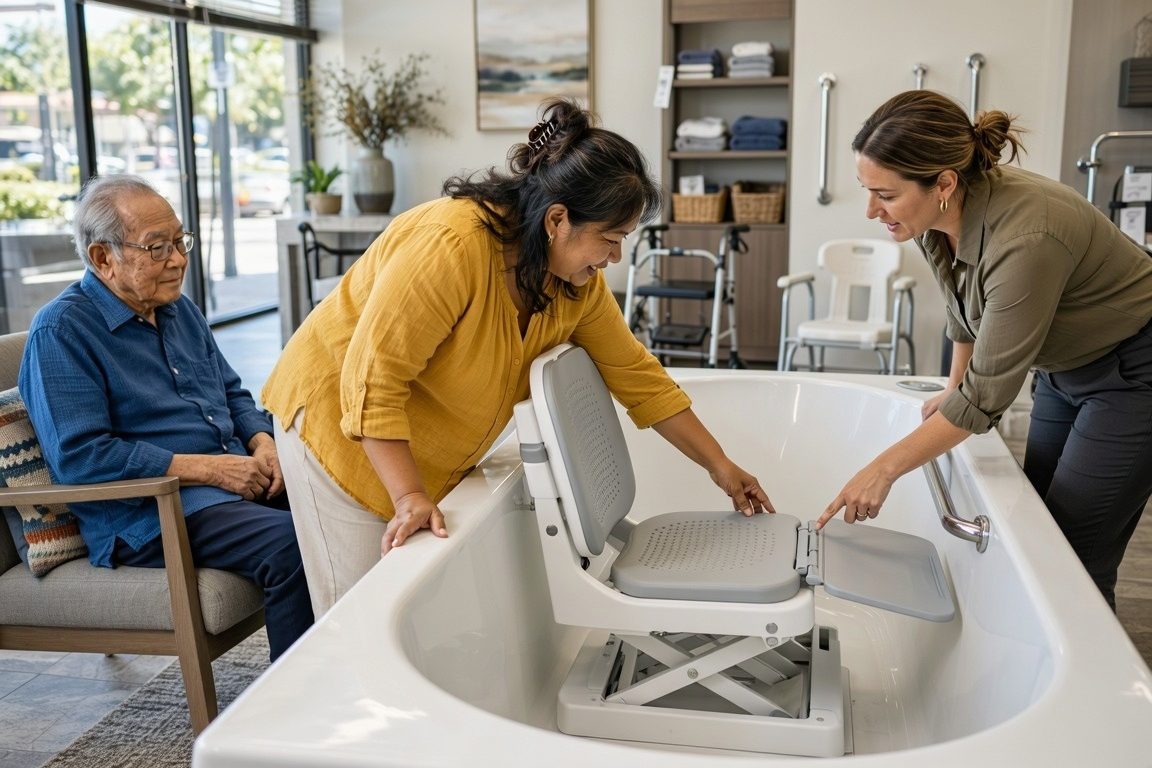
For many people with early-stage dementia or physical limitations, getting into and out of a standard bathtub becomes a major challenge. The risk of falling is high, and the fear of falling can make bathing a source of anxiety and resistance. A bath lift chair is designed to gently lower a person into the tub and then raise them back up, eliminating the need to step over a high tub wall or squat down. This device is lightweight, durable, and easy to use, often with a rechargeable remote control that lets you or your loved one operate it with a simple press of a button. It is primarily intended for use in the bathroom, but some models can be used nearly anywhere, offering flexibility if you need to bathe someone in a different location while waiting for a bathroom remodel.
How It Addresses Common Caregiving Challenges
When a person has dementia, they may not remember how to use a walker or may forget to lock it, which can lead to dangerous falls. A bath lift chair removes the need for complex steps: the person sits on the chair while it is flat, then the chair lowers them into the water. This reduces the need for them to stand or balance. For caregivers, it means less physical strain because you do not have to lift or support your loved one during the transfer. The chair also helps with dignity, many models do not look like medical equipment, which can reduce resistance from someone who feels embarrassed about needing help. As one expert notes, these chairs are often used for medical reasons but can feel like a regular piece of furniture, which is a big plus for maintaining a sense of normalcy.
What to Look For in a Bath Lift Chair
The most important features to consider are weight capacity, ease of cleaning, and the chair’s ability to fold flat for storage. For a bariatric individual (typically over 300 pounds), you need a chair specifically designed for that weight range, and you must check whether the person’s feet can reach the floor when seated, this provides stability and a sense of control. The chair should have a waterproof, easy-to-wipe surface, as incontinence is common. Look for a model with a remote that is simple to use, with large buttons and clear up/down arrows. The chair should also be lightweight enough for you to move and store, especially if the bathroom is small. Finally, consider the chair’s color: a contrasting color (like a dark seat against a white tub) can help a person with dementia see the chair more clearly, reducing confusion and fear.
Practical tools
6
Phrases to Introduce the Chair
Instead of saying 'You need to use this lift chair,' try: 'I found this new seat that makes bath time feel like a spa. Let me show you how it works.' Or: 'This chair helps you get in and out of the tub without any trouble. It’s like a gentle elevator for your bath.' Use a warm, excited tone and avoid medical terms like 'lift' or 'equipment.'
A Simple Checklist for Evaluating a Chair
Before buying, print or write this checklist:
Use this when shopping online or in a store.
Setting Up the Bathroom for Success
Before using the chair, make the bathroom calming:
Place a non-slip mat on the floor outside the tub. Have a towel and robe ready within arm’s reach. If your loved one is sensitive to water, use a handheld shower head to control the spray direction.
A Step-by-Step Script for the First Bath
Step 1: Say, 'Let’s get ready for your spa time. I’ll help you sit on this special chair.' Step 2: Guide them to sit on the chair (outside the tub first). Step 3: Press the down button slowly and say, 'Here we go, gently down.' Step 4: Once in the water, say, 'You’re doing great. Let me wash your back.' Step 5: After washing, press the up button and say, 'Time to rise up. Nice and easy.' Step 6: Help them stand by saying, 'Put your hands on the chair arms, and I’ll be right here.'
Product Feature: Lightweight Electric Bath Lift Chair (e.g., VOCIC)
This type of chair is designed for home use, is lightweight, and folds flat for storage. It comes with a rechargeable remote that disconnects from the wall charger and connects to the chair. To use, lift the back of the chair, press the up button to raise it, then press down to lower it. After use, fold the back flat and store it away. It is a good option for caregivers who need a portable, easy-to-clean solution.
Using Color Contrast to Improve Visibility
If your loved one has trouble seeing the chair against the white tub, choose a chair in a contrasting color like dark blue, green, or red. You can also place a brightly colored towel on the chair seat to make it more visible. This simple visual cue can reduce confusion and help your loved one feel more confident about sitting down.
Different situations
For a person with Lewy body dementia or Parkinson’s disease
These conditions often cause stiffness and difficulty with movement. Choose a chair with a wider seat and higher back for extra support. The remote should have very large buttons because fine motor skills may be impaired. Also, be aware that these individuals may have visual hallucinations, keep the bathroom well-lit and avoid patterns on the chair that could be misinterpreted. Use a slow, steady descent speed (some chairs have adjustable speed settings).
For a person in late-stage dementia who cannot follow instructions
You will need to do most of the work. Choose a chair that is easy to clean and has no crevices where moisture can hide. Use a two-person transfer: one person operates the remote and supports the back, the other supports the legs. The chair should have a very low profile when flat so the person does not have to step up high. Consider using a bath lift chair with a built-in sling or harness for extra security, but discuss this with your clinician first.
For a spouse caregiver vs. an adult child caregiver
A spouse may be older and have less physical strength. In this case, choose a chair that is very lightweight (under 15 pounds) and has a remote that can be operated with one hand. An adult child may be stronger but may also be managing other responsibilities like work and children. For them, a chair that folds quickly and stores easily is key. Both should practice using the chair before the first bath to build confidence.
For a person who is incontinent
Incontinence is common, so the chair must be waterproof and easy to sanitize. Look for a chair with a seamless seat (no cracks or seams where urine can seep). After each use, wipe the chair with a disinfectant spray. You may also want to place a waterproof pad on the chair seat for extra protection. The chair should be stored in a well-ventilated area to prevent odors.
For a person who is very anxious about bathing
Use the chair as part of a calming routine. Before the bath, play soft music, use a flameless candle, and speak in a low, soothing voice. Let your loved one hold a washcloth or a favorite object during the bath. The chair’s gentle movement can be reassuring, but start with just a few minutes in the water and gradually increase the time. If they become upset, stop and try again later.
For the doctor
5
- Ask your loved one’s doctor or occupational therapist if a bath lift chair is appropriate given their specific mobility and balance issues. Some conditions may require a different type of bathing aid, such as a transfer bench or a roll-in shower.
- If your loved one has a history of falls or fractures, discuss whether a bath lift chair with a safety belt or harness is recommended. The clinician can advise on proper use and whether additional grab bars are needed.
- For a person with severe arthritis or joint pain, ask if the chair’s seat height and angle can be adjusted to reduce strain on hips and knees. Some chairs have adjustable leg rests or reclining backs.
- If your loved one is on blood thinners or has fragile skin, ask about the risk of bruising or skin tears from the chair’s movement. The clinician may recommend a chair with padded armrests or a slower descent speed.
- For a person with a pacemaker or other implanted device, check with their cardiologist to ensure the chair’s electric motor and remote do not interfere with the device. Most modern chairs are safe, but it is best to confirm.