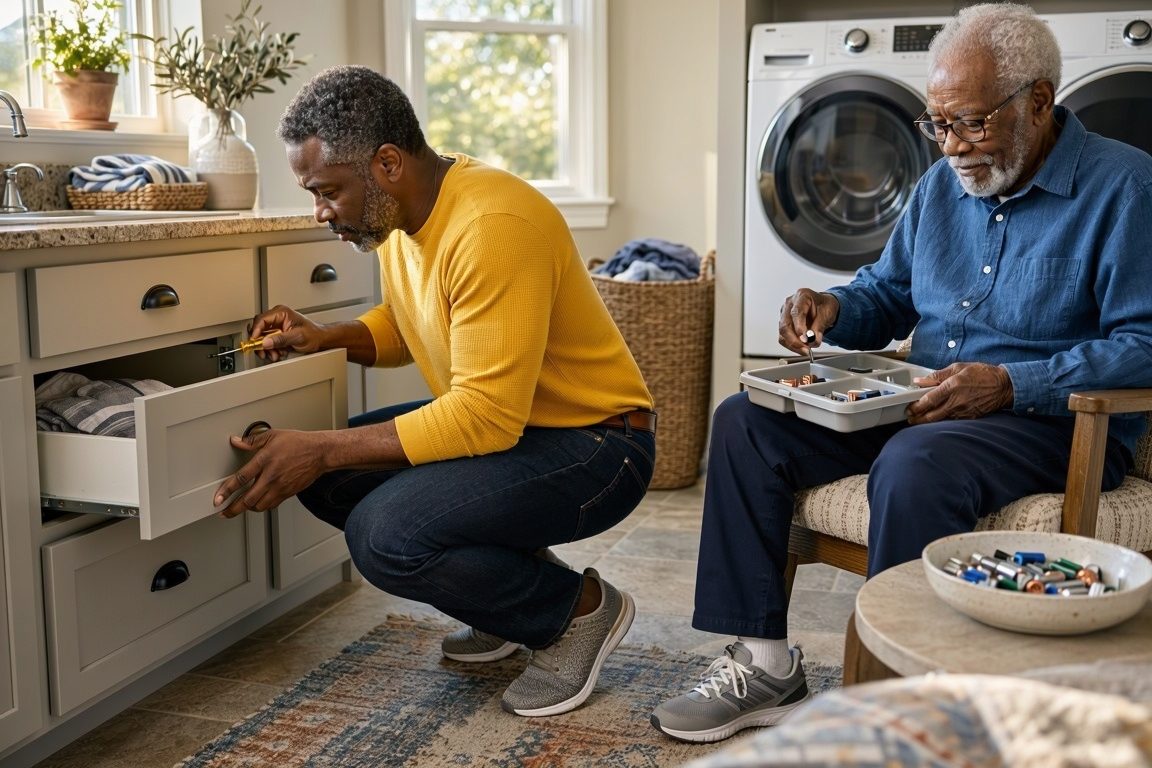
Step by step
What not to do
- Do not lock safe drawers (towels, plastic cups, snacks), this causes unnecessary frustration and reduces independence.
- Do not install locks at handle height; that is where the person naturally looks and tries.
- Do not frame locks as punishment or distrust; keep tone neutral and matter-of-fact.
- Do not hide the key or release mechanism where you cannot find it quickly in an emergency.
- Do not rely solely on locks, they are only one layer among ongoing supervision and environmental changes.
Key points
- Only lock drawers and cabinets that contain truly dangerous items (knives, chemicals, medications, matches). Leave safe drawers unlocked to allow exploration and reduce frustration.
- Install locks out of your loved one's natural line of sight, at the very top or very bottom of the drawer or cabinet, not at mid-range where the handle is.
- Choose locks that are easy for you to operate quickly but confusing for your loved one (magnetic locks, squeeze-and-turn covers, or slide latches).
- Introduce locks calmly and matter-of-factly, without shaming or lecturing. Redirect if they seem upset.
- No lock is foolproof, always supervise your loved one, especially in the kitchen and bathroom. Locks are a deterrent, not a substitute for vigilance.
- Reassess regularly as dementia progresses. What works today may not work in six months. Be prepared to change your approach.
Videos
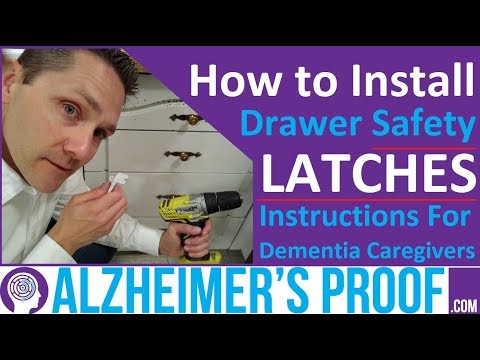 Alzheimer's Kitchen Safety: Drawer-Latch Installation for CaretakersThis video provides a step-by-step visual demonstration of installing a drawer latch, which is exactly the skill you need. It also explains the philosophy of using locks as deterrents, not foolproof solutions.
 5 Cheap Safety Devices for At-Home Alzheimer's Dementia CareThis video covers multiple low-cost safety devices, including drawer and cabinet locks, and gives you ideas for other areas of the home. It helps you think beyond just the kitchen.
 The Baffled Brain: Demystifying Dementia Episode 22 April 24 ,2021This episode discusses home safety modifications in a broader context, including why people with dementia wander and how to address the underlying needs, not just the behavior.
 095. How to create a safe home for Dementia family membersThis video offers a room-by-room approach to safety, which helps you identify which drawers and cabinets are most critical to lock in each area of the home.
2 more videos
 How Do You Ensure Home Safety For Dementia Patients? - Dementia Help HubThis video reinforces the importance of combining locks with other safety measures like good lighting, clear pathways, and removing tripping hazards.
 Dementia Proofing Your HomeThis video provides a comprehensive overview of home modifications, including drawer locks, and emphasizes the need to balance safety with dignity and independence.
Practical tools
4
Invisible magnetic locks or slide latches
Choose based on risk level and visibility; avoid hook-and-eye for early-stage dementia.
Screwdriver or drill with appropriate bits
For screw-mounted locks; adhesive locks require no drilling but need surface prep.
Rubbing alcohol and clean cloth
To clean surfaces before applying adhesive locks so they bond properly.
Pencil and measuring tape
To mark consistent placement of latches and catches.
Different situations
Early-stage dementia (still able to problem-solve somewhat)
In early stages, your loved one may still be able to figure out simple locks like hook-and-eye latches. Use more complex locks like magnetic locks or squeeze-and-turn covers. Also, involve them in the conversation: 'I'm putting these on to help keep us both safe, what do you think?' This can reduce feelings of being controlled. You may also need to remove trigger items like keys or purses that prompt them to want to leave, as mentioned in the source materials.
Late-stage dementia (significant cognitive decline)
In later stages, simpler locks like hook-and-eye latches or even just moving dangerous items to a completely different room (like a locked closet) may be enough. Your loved one may no longer have the curiosity or ability to open drawers. Focus more on fall prevention (remove rugs, improve lighting) and wandering prevention (door alarms, bed alarms). Locks may become less relevant as their mobility decreases.
Lewy body dementia or Parkinson's disease dementia
These conditions often involve movement difficulties, tremors, and rigidity. Your loved one may have trouble with fine motor skills needed to operate squeeze-and-turn covers or slide latches. Use magnetic locks that require only a simple swipe of a magnetic key. Also, be aware of visual hallucinations, they may see things that aren't there, which could make them try to open a drawer to 'check' something. Keep the environment calm and well-lit to reduce confusion.
Frontotemporal dementia (FTD)
FTD often affects behavior and impulse control more than memory. Your loved one may be more likely to impulsively open drawers and grab things, including dangerous items. They may also be more resistant to restrictions. Use locks that are very discreet (magnetic) and avoid power struggles. If they become fixated on a locked drawer, redirect to a safe activity immediately. You may need to remove all dangerous items from the kitchen entirely and store them in a locked closet or garage.
Spouse caregiver vs. adult child caregiver
A spouse may feel more conflicted about 'locking up' their partner's things, as it can feel like a betrayal of trust. It can help to frame it as a safety measure for both of you: 'This helps me feel less worried when I'm cooking.' An adult child may find it easier to be more directive, but should still use a gentle tone. In both cases, avoid shaming language. If the person with dementia is the one who used to do the cooking, they may feel a loss of identity, acknowledge that: 'I know you used to love cooking, and I miss those meals too. For now, I'm going to handle the sharp knives.'
Common questions
1
How do I install and use a double-keyed deadbolt?
For safety, ensure the deadbolt is installed with the key slot facing outward so you can unlock it quickly from outside the room, and keep a spare key nearby but out of sight. Lock it only when your loved one is safely on the other side, and always keep the key accessible to you in an emergency.
For the doctor
4
- If your loved one has a history of violent behavior or has access to firearms, discuss safe storage with your doctor or a social worker. The source materials mention that a person with dementia may not recognize a loved one and could mistake them for an intruder, which could be disastrous if a gun is accessible. Your clinician can help you create a safety plan.
- If your loved one is on multiple medications, ask the doctor or pharmacist about the safest way to store them. Some medications need to be kept in a cool, dry place (not a hot kitchen cabinet). A locked drawer in a bedroom may be better. Also, ask about using a pill organizer to prevent double-dosing.
- If your loved one has a tendency to eat non-food items (pica), discuss this with the doctor. You may need to lock up not just chemicals but also items like soap, toothpaste, or even small toys. The doctor can rule out nutritional deficiencies that might contribute to this behavior.
- If you are considering using a lock on a door that leads to a basement, garage, or outdoors, ask your clinician or an occupational therapist about the best type of lock. Some locks can be a fire hazard if they prevent easy exit. The source materials mention that locks placed high on a door can be a problem in a fire because smoke rises. Discuss fire safety with your local fire department as well.