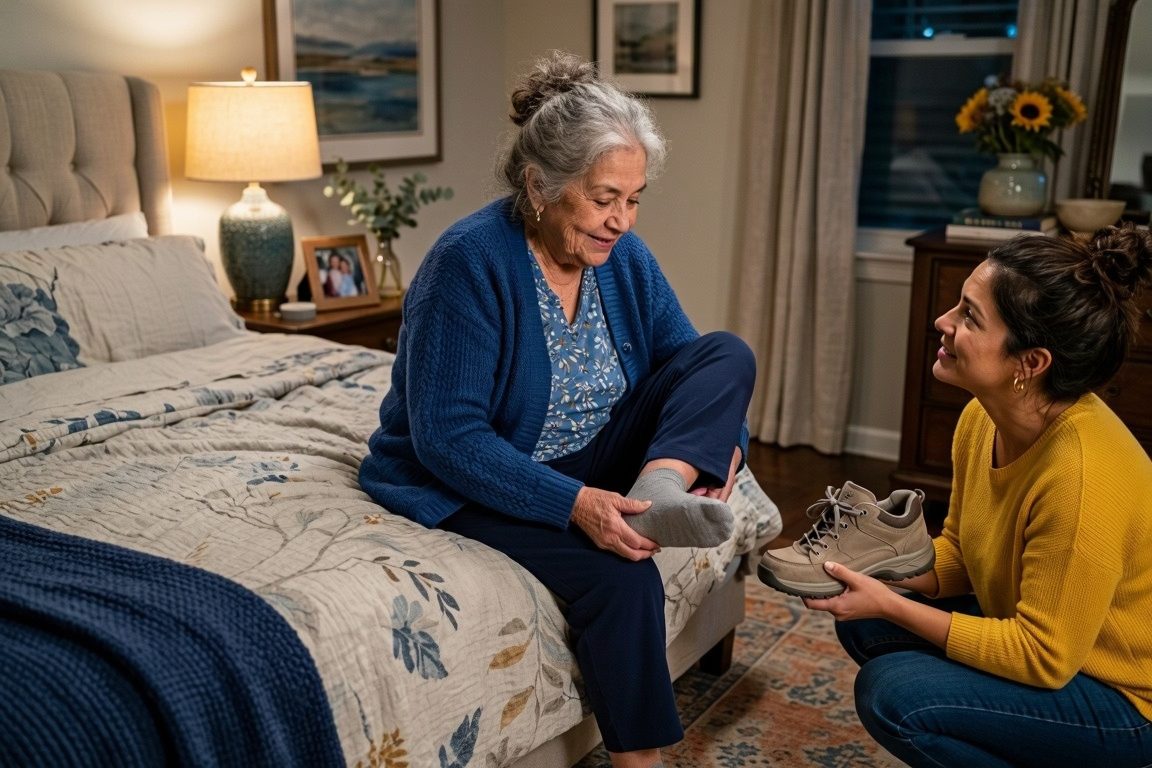
Step by step
What not to do
- Do not argue or try to convince them they are wrong. Arguing about why they need help or that they are being unreasonable will only increase their agitation.Instead, validate their feeling: 'I know this feels strange. I'm here with you.'
- Do not rush or use a commanding tone. Saying 'We have to do this now' or 'You need to cooperate' triggers a fight-or-flight response. Slow down, speak softly, and use a warm, collaborative tone.
- Do not assume they are being stubborn or manipulative. The behavior is a symptom of brain changes, not a personal choice. Labeling them as difficult will only frustrate you. Stay curious about the 'why.'
- Do not force physical contact or restrain them. Grabbing their arm or pulling them can cause pain and increase fear. Always ask permission before touching, and use gentle, guiding movements.
- Do not ignore signs of pain or discomfort. If they consistently refuse a particular activity, it may be a sign of an underlying medical issue like a urinary tract infection, arthritis flare, or even a new injury. Consult their doctor if the refusal is new or persistent.
- Do not take the refusal personally. Your loved one is not rejecting you, they are reacting to a confusing, painful, or frightening experience. Your calm presence is the most important thing you can offer.
Key points
- Refusal is often a communication of pain, fear, or sensory confusion, not stubbornness.
- Always start with curiosity: ask yourself what might be hurting or scaring them.
- Use gentle, guiding touch (hand-under-hand) and a calm, collaborative tone.
- Simplify the environment and the task to match their current ability.
- Give them choices and a sense of control to reduce resistance.
- If you hit a wall, take a break and try again later, forcing never works.
Videos
 3 Steps to Get Someone with Dementia to Stop Refusing CareThis video offers a clear, three-step method to uncover the root cause of refusals and turn them into cooperation, which aligns directly with our focus on hidden pain and fear.
 Should You Force a Loved One with Dementia to Bathe?This addresses the specific fear and sensory issues behind bathing refusals, a common scenario where pain or fear is the hidden barrier.
 Is Your Aging Parent With Dementia Refusing Help? Do This!Provides practical strategies for when a parent refuses help, emphasizing empathy and environmental adjustments, perfect for our sub-topic.
 Quick Tips: Caring for a Loved One and Dealing with ResistanceOffers quick, actionable tips for handling resistance in the moment, which is exactly what caregivers need when faced with a refusal.
2 more videos
 What to do when a person with dementia refuses care: 6 simple strategiesThis video breaks down six simple strategies that directly address the fear and pain behind refusals, making it a perfect companion to this article.
 Family Caregiving Discussions With Elderly Parents Who RefuseFocuses on communication techniques for when a parent refuses help, which is central to our topic of hidden barriers like fear and pain.
Background
The Brain is Playing Tricks: Pain and Sensory Confusion
When your loved one refuses to get dressed or join an activity, it's easy to assume they are being difficult or uncooperative. But in early to moderate Alzheimer's, the brain's ability to process sensation and perception is changing. The insula, the part of the brain that interprets how things feel against the skin , can misfire. A gentle stream of water or the soft touch of a shirt may feel like stabbing pain. The parietal lobe, which helps us navigate space, can also misfire, making a normal bathtub look like a bottomless pit or a hallway feel like a confusing maze. What feels comfortable to you may feel terrifying or painful to them.
Fear of Falling, Drowning, or Losing Control
Many refusals are driven by fear, fear of falling in the shower, fear of drowning during a bath, or fear of losing the last shreds of independence. A person with Alzheimer's may not be able to articulate that they are afraid. Instead, they say 'No' or push you away. They may also be in physical pain from arthritis, neuropathy, or an undiagnosed injury. When you try to help them dress or move, you might be unknowingly causing pain by pulling on a sore joint or asking them to stand when they feel unsteady. The refusal is their only way to communicate, 'This hurts' or 'I'm scared.'
Loss of Insight and the Need for Autonomy
Another layer is that Alzheimer's damages the brain's ability to recognize one's own limitations. Your loved one may genuinely believe they can still dress themselves or that they don't need help. When you step in, it can feel like a violation of their personhood, like you are treating them like a child. This can trigger anger or withdrawal. The key is to approach not as a commander but as a partner, using curiosity and empathy to uncover what's really going on beneath the surface.
Practical tools
6
The 'Curiosity Script' for Refusals
When they say no, use this phrase: 'I can see you don't want to do this right now. Can you help me understand what's bothering you?' If they can't answer, offer guesses: '
' This opens a dialogue and shows you are on their side.
The 'One-Step-at-a-Time' Dressing Checklist
Lay out clothes in order on the bed:
Point to each item and say, 'First this, then this.' Use verbal cues like 'Let's put your arm through here' rather than grabbing. This reduces confusion and gives them a clear visual roadmap.
The 'Comfort First' Bathing Kit
Assemble
Warm the room and the water before they enter. Offer a towel to hold or a washcloth to squeeze, this gives them something to focus on and reduces fear. If they resist, try a sponge bath at the sink instead.
The 'Activity Match' Tool
Match the activity to their current ability. If they loved gardening, try a small pot with soil and seeds. If they liked puzzles, start with a 25-piece one. If they resist, simplify further, sorting coins or folding napkins can feel purposeful. Observe what they engage with and build from there.
The 'Hand-Under-Hand' Technique
Instead of taking their hand to guide them, place your hand under theirs and gently support their movements. This feels less controlling and more collaborative. Practice it first with a neutral task like picking up a cup. It can transform a power struggle into a partnership.
The 'Redirection to a Pleasant Memory' Script
If they refuse an activity, pivot to a memory they enjoy. Say, 'Remember how we used to bake cookies together? Let's just look at this recipe book for a minute.' This can shift their mood and open the door to participation later.
Different situations
Early stage vs. moderate stage
In early stage, your loved one may still have some insight and can often articulate fear or pain. Use more direct questions and offer choices. In moderate stage, insight is fading, rely more on environmental cues, routines, and gentle redirection. Simplify tasks further and expect more trial and error.
Spouse vs. adult child caregiver
A spouse may be more readily accepted for intimate care, but also more likely to trigger a power struggle. Use the 'hand-under-hand' approach and avoid a parental tone. An adult child may need to lean on a neutral third party (like a home health aide) to reduce resistance, as the parent may feel embarrassed or resentful being cared for by their child.
In a memory care facility vs. at home
In a facility, the environment is already structured for safety, but the person may feel less in control. Work with staff to create a consistent routine and use the same phrases and approaches. At home, you have more flexibility to adapt the environment, rearrange furniture, reduce clutter, and control lighting and noise to reduce sensory overload.
When the person has a history of falls or arthritis
If they have fallen before, their fear is real and deep. Prioritize safety equipment (grab bars, shower chair, good lighting) and involve a physical therapist. If arthritis is present, choose clothing with easy closures (Velcro, elastic) and warm the clothes slightly with a dryer before dressing to reduce joint pain.
When the person is in denial about needing help
Avoid direct confrontation. Instead of saying 'You need help,' say 'I could use your help with this' or 'Let's do this together.' Frame care as a shared activity, not a service you are providing to them. This preserves their dignity and reduces resistance.
For the doctor
5
- Ask the doctor: 'Could there be an undiagnosed pain condition (like arthritis, neuropathy, or a urinary tract infection) causing my loved one to refuse care?'
- Ask the doctor: 'Is a physical therapy evaluation appropriate to address weakness, balance issues, or fear of falling?'
- Ask the doctor: 'Could medication side effects be contributing to confusion, agitation, or sensory changes that lead to refusal?'
- Ask the doctor: 'Should we consider a swallowing evaluation if they are refusing food or drink, as this may indicate a swallowing problem?'
- Ask the doctor: 'Are there any assistive devices (like a shower chair, grab bars, or a raised toilet seat) that you would recommend for safety and comfort?'