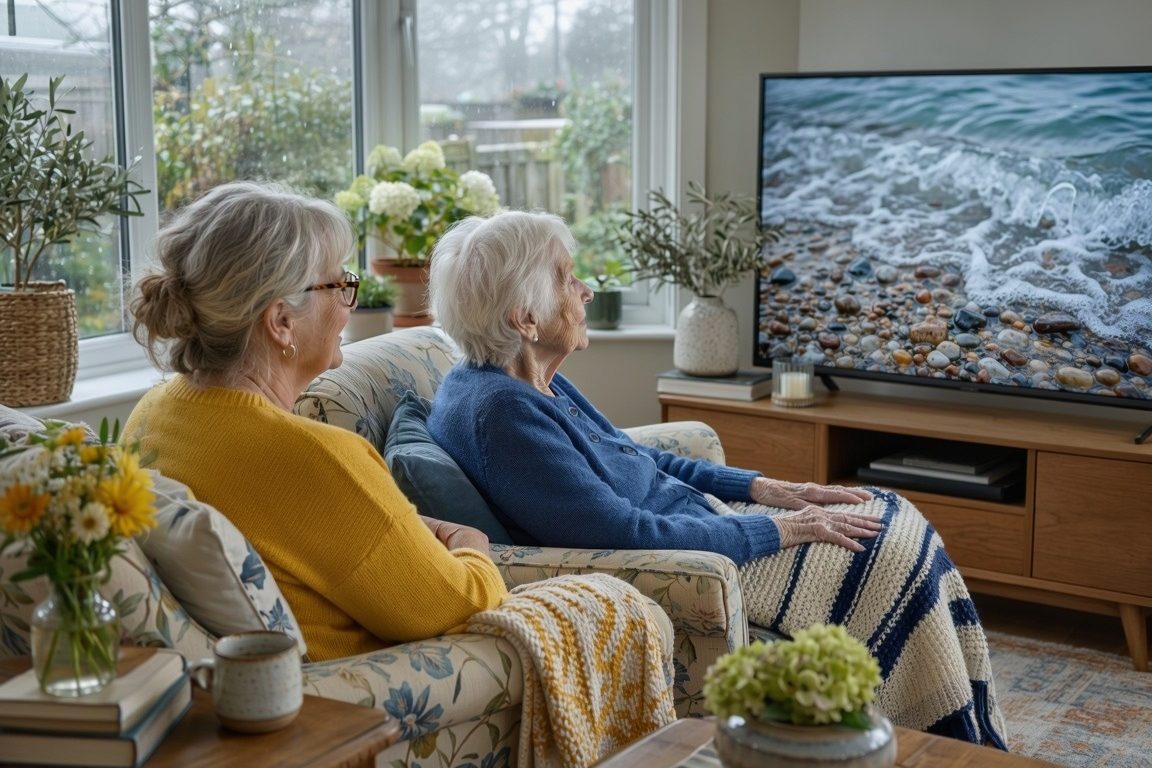
Step by step
What not to do
- Do not use Memory Lane TV as background noise: Leaving the film on while you do chores or talk on the phone defeats the purpose. The therapy relies on your shared attention. If you can't sit with them, it's better to not start the session at all.Instead, play calming music or nature sounds if you need background noise.
- Do not quiz or test their memory: Avoid saying 'Do you remember this?' or 'What year is that?' This can cause anxiety and shame. The goal is emotional connection, not factual recall. If they say something inaccurate, just nod and say 'That's interesting' or 'Tell me more.' Let the memory be whatever it is.
- Do not force the session if they are resistant: If they say 'No' or turn away, do not insist. This can create a power struggle and associate the films with stress. Simply say 'Okay, maybe later,' and try again at a different time or with a different film. Sometimes a different aroma or a different time of day makes all the difference.
- Do not use a film that is too stimulating for their current state: If they are already agitated, a fast-paced, loud film will make things worse. Always match the film to their mood. A 'Wake and Engage' film is for lethargy, not for agitation. Using the wrong type can increase anxiety or trigger a catastrophic reaction.
- Do not leave them alone with the film: Even if they seem engaged, your presence is part of the therapy. The communion between you and your loved one is what makes the session therapeutic. If you leave, the emotional connection is broken, and the session becomes just passive watching, which has limited benefit.
- Do not expect a miracle every time: Some sessions will be magical, they will talk, sing, or laugh. Others will be quiet. Both are okay. The goal is not to 'fix' them but to share a moment of peace and connection. Consistency over weeks and months is what builds the therapeutic effect, not a single perfect session.
Key points
- Memory Lane TV sessions are not passive watching; they are active, shared therapeutic experiences that rely on your presence and emotional attunement.
- There are three main session types: Wake/Engage (for lethargy), Calm/Redirect (for agitation), and Relaxation/Bonding (for connection). Always match the film to your loved one's current mood.
- The 28-minute length is scientifically chosen to maximize benefit without causing overstimulation or fatigue.
- Do not quiz or test memory; the goal is emotional recall and connection, not factual accuracy.
- Use scent pairing (lavender for calm, citrus for wakefulness) to deepen the sensory experience, but always test for allergies first.
- Document each session in a simple journal to track patterns and improve your choices over time.
Videos
 Radio Show VoiceAmericaThis interview with the co-founder of Memory Lane TV explains the science behind the films and gives real examples of how reminiscence therapy works, including the story of Lillian.
 An Interactive and Media Collection for people living with dementia & their care partnersThis video provides an overview of Memory Lane TV as a multi-sensory intervention, explaining how the films are designed to improve mood, communication, and well-being.
 Simple dementia trick to get your loved one talking and feeling happy.This video from Dementia Careblazers demonstrates a practical, step-by-step approach to using reminiscence therapy to spark conversation and joy, which directly complements Memory Lane TV sessions.
 An Interview with the Co-Founder of Saltbox TV Jerry GoehringThis interview provides background on the development of Memory Lane TV and the importance of the 28-minute length, as well as the role of the caregiver in the therapeutic process.
2 more videos
 Dementia Care Partner TalkShow: Ep. 105 - Managing Challenging Situations and Later Stage DementiaThis episode with Teepa Snow offers strategies for adapting activities for later-stage dementia, which is essential for personalizing Memory Lane TV sessions for non-verbal or bedridden individuals.
 Enhancing Everyday Activities in Dementia CareThis video from AlzOrangeCounty provides practical ideas for incorporating meaningful activities into daily care, which helps you integrate Memory Lane TV sessions into a broader routine of engagement.
Background
What Makes Memory Lane TV Sessions Different from Regular TV?
Unlike typical television shows that rely on plot and characters to hold attention, Memory Lane TV films are designed specifically for the dementia brain. Each film is a medley of images and soundscapes that are not plot-dependent, meaning your loved one doesn't need to follow a story to benefit. The films are crafted to promote wakefulness, increase appetite, engage, redirect, or induce the relaxation response. This is a non-pharmacological, digital intervention that leverages over 50 years of scientific studies on multi-sensory stimulation and mind-body medicine. The key is that the films are tested in clinical settings and are intentionally short, 28 minutes, because research shows that is the optimal length for engagement without causing overstimulation or fatigue.
The Core Therapeutic Mechanism: Reminiscence and Emotional Recall
The primary therapeutic type is reminiscence therapy, but Memory Lane TV takes it a step further. When a person with dementia watches a film featuring scenes from their youth, like a 1950s diner, a beach boardwalk, or a family farm, the brain doesn't just recall the memory; it relives the full intensity of the emotion associated with that time. This is often joy, which then motivates the person to communicate. For example, one 86-year-old woman named Lillian, who grew up in northern Massachusetts with a shoemaker father and vacationed in Atlantic City, might watch a film of a seaside boardwalk. The images and sounds trigger not just the memory of the vacation, but the happiness of being with her family. This emotional reconnection is what opens the door to conversation and bonding. The communion between you and your loved one during these sessions is just as important as the film itself.
Three Distinct Session Types: Wake/Engage, Calm/Redirect, and Relaxation
Based on the science behind Memory Lane TV, sessions can be categorized into three main types, each with a different goal. The first is the 'Wake and Engage' session, used when your loved one is lethargic, withdrawn, or not eating. These films are more visually stimulating, with bright colors, lively music, and fast-paced scenes to promote wakefulness and increase appetite. The second is the 'Calm and Redirect' session, used when your loved one is agitated, anxious, or sundowning. These films feature slower, more soothing imagery like nature scenes, gentle water, or quiet landscapes, paired with soft soundscapes to induce the relaxation response. The third is the 'Relaxation and Bonding' session, which is purely about creating a peaceful, shared experience. These films are often paired with specific aromas (like lavender or baked bread) to add another dimension of sensory engagement, deepening the emotional connection without requiring active conversation.
Practical tools
6
The 'Mood Match' Checklist
Before each session, quickly assess your loved one using this checklist:
Print this checklist and keep it near the remote.
Exact Phrases to Start a Session
Use these warm, inviting phrases instead of commands: 'Come sit with me, I found something beautiful.' / 'Let's take a little trip together.' / 'I want to show you something that made me smile.' / 'Let's watch the pretty pictures for a while.' / 'I have a surprise for you.' Avoid: 'Let's do therapy now' or 'Watch this, it's good for your brain.'
The 'Scent Pairing' Kit
Memory Lane TV films can be paired with specific aromas to deepen sensory engagement. Create a small kit with:
Use a diffuser or a cotton ball placed nearby (not directly under the nose). Always test a tiny amount first to ensure no allergic reaction.
The 'Post-Session Transition' Activity Box
After the film ends, have a small box ready with simple, repetitive activities:
This helps your loved one transition from the emotional experience back to the present moment without feeling disoriented. Keep the box in the same spot as the remote.
The 'Film Journal' Template
Create a simple log with columns: Date, Film Title, Mood Before (1-5 scale), Mood After (1-5 scale), Did they speak? (Y/N), Did they smile? (Y/N), Notes. Reviewing this journal weekly will help you see patterns, like that the 'beach' film always calms them, or the 'farm' film always makes them talk about their childhood.
The 'One-Sentence Summary' Cue Card
Write on a card: 'The film is not about facts. It is about feelings. I am here to share the feeling with them.' Keep this card near the TV as a reminder for yourself when you feel frustrated or unsure. It reframes the session from a task to a connection.
Different situations
Late-stage dementia (non-verbal, bedridden)
In late-stage, the goal shifts from conversation to sensory comfort. Use only 'Relaxation and Bonding' films with very slow, gentle imagery (like clouds or flowing water). Keep the volume low. Sit close, hold their hand, and speak softly. Do not expect any verbal response. The therapy is in the shared presence and the calming effect on their nervous system. You can also use the scent pairing more intentionally, as smell is often preserved longer than other senses.
Lewy body dementia (visual hallucinations, fluctuating cognition)
Be very cautious with visual stimulation. Lewy body dementia often involves visual hallucinations, and fast-moving or complex images can worsen them. Start with very simple, slow films (like a single flower blooming or a quiet lake). Watch their face closely for signs of distress. If they seem confused or point at something that isn't there, stop the film immediately and redirect to a non-visual activity like listening to music or holding a familiar object. Discuss with your clinician before using any visual therapy.
Frontotemporal dementia (behavioral variant, loss of empathy, repetitive behaviors)
The emotional recall aspect may be less effective because the brain regions for empathy and social connection are affected. Instead, use the films for their sensory and calming properties. Choose films with strong, simple patterns or repetitive sounds (like waves or rain). The goal is to reduce agitation or repetitive pacing, not to spark conversation. Keep sessions very short (10-15 minutes) and end them before they become overstimulating.
Adult child caregiver vs. spouse caregiver
As an adult child, you may feel pressure to 'get it right.' Remember that your loved one may respond to you differently than to a spouse. Be patient if they are more resistant. Use the phrase 'I found something I want to show you' to avoid a parent-child dynamic. As a spouse, you have decades of shared memories. Use that to your advantage: 'Remember when we used to go to the beach? This reminds me of that.' Your shared history is a powerful tool for connection.
In a facility (nursing home or assisted living)
Coordinate with staff to find a quiet, private room or a corner of the common area with minimal distractions. Use headphones if needed, but be aware that some people with dementia find headphones disorienting. If using a tablet, hold it at a comfortable distance. If other residents are present, they may also benefit from watching, but keep the group small (2-3 people max) to avoid overstimulation. Document the session in the facility's communication log so staff can reinforce the calming effect later.
For the doctor
4
- If your loved one has a history of seizures, ask your doctor if visual stimulation from the films could trigger a seizure. Some flashing or fast-paced scenes might be a risk.
- If your loved one is on medications that affect heart rate or blood pressure, ask if the relaxation response induced by the films could interact with those medications (e.g., causing a drop in blood pressure).
- If your loved one has severe anxiety or PTSD, discuss whether reminiscence therapy could inadvertently trigger traumatic memories. A clinician can help you choose films that are safe and avoid triggering content.
- If your loved one has a swallowing difficulty or is at risk of aspiration, ask if the 'Wake and Engage' films used to increase appetite should be paired with specific food textures or supervision during meals.