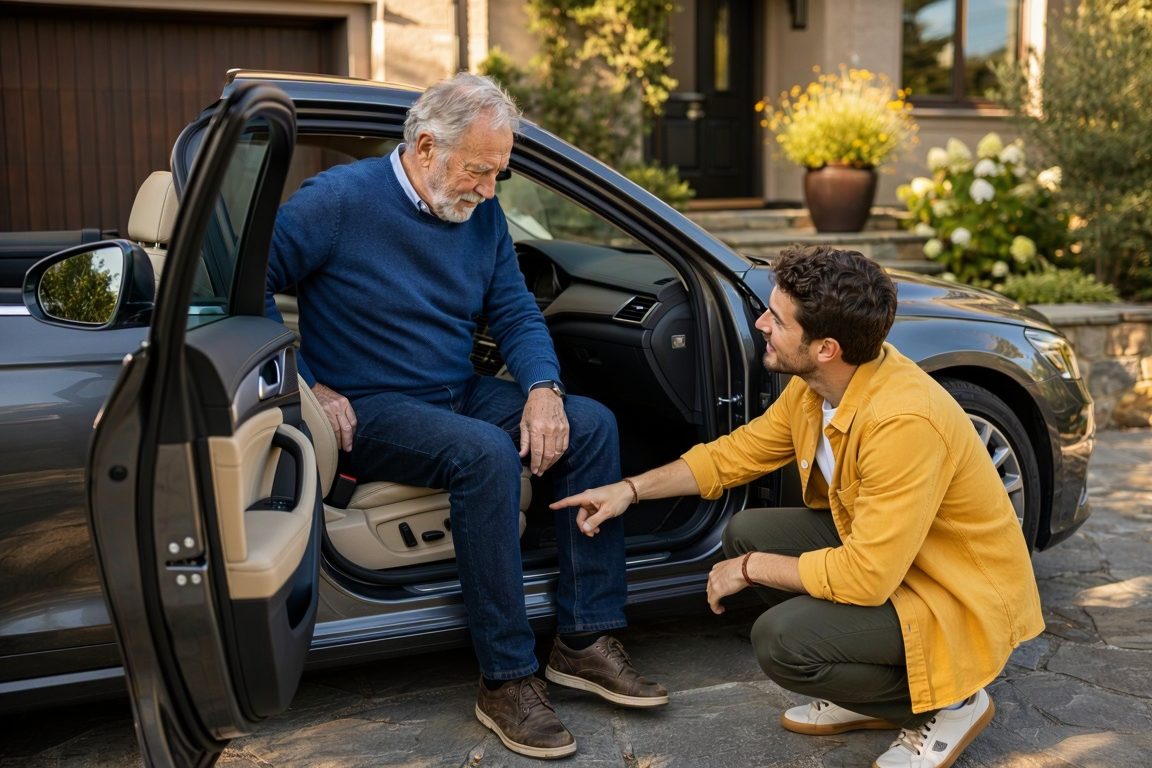
Step by step
What not to do
- Do not pull them by the arms or hands from the front. It can injure their shoulder and makes them lean forward into a fall. Support from the side or back instead, guiding the whole body.
- Do not rush or show frustration, even silently. If they are slow or confused, take a breath and repeat the same simple instruction. Your calm sets the pace.
- Do not explain that they can't drive anymore as the reason for being a passenger, it usually starts an argument. Take the lead confidently and frame driving as your choice today.
- Do not leave the door half-open or the seatbelt dangling. A half-open door is a trip hazard, and a loose belt can tangle them. Fully open the door and secure the belt before they move.
- Do not try to physically lift them into the car if they are heavy or unsteady, you can hurt your back and frighten them. Use a swivel cushion, transfer board, or car support handle, and always have a plan for getting help.
- Do not assume they remember how to do this from last time. Each transfer is new to their brain, so use the same verbal and physical cues every trip for consistency.
- Do not leave them alone in the car while you walk around to the driver's side, especially if they are confused or restless. They may try to unbuckle, open the door, or panic. Use child locks if needed.
Key points
- Car transfers are hard because they require reversing a lifetime of driving movements. Be patient and use simple, consistent cues.
- Never tell them they cannot drive; instead, take the lead confidently and frame it as your choice to drive.
- Use the 'backward exit' method for people with stiffness or Parkinson's to reduce fall risk.
- Keep a swivel cushion and a seatbelt guide clip in the car to make transfers easier.
- Use distraction cards or a calm tone to reduce anxiety during stressful transfers.
- Always have a backup plan: a friend, a medical transport service, or a family member who can help if you are overwhelmed.
Videos
 Time with Teepa – Car Transitions Made EasierTeepa Snow demonstrates the exact physical and verbal techniques for helping someone get in and out of a car, including how to reverse the driver's seat movements.
 Care Partner Support Tips: Getting In and Out of the CarA practical, step-by-step guide for caregivers, showing how to position yourself and use simple cues to make transfers safer.
 How to stop your loved one with dementia from drivingOffers strategies for taking the keys away without conflict, including the 'VIP chauffeur' script and using a kill switch.
 Debra Dementia Live!A simulation that helps caregivers understand the confusion and fear a person with dementia may feel during car transfers.
2 more videos
 Providing Support When Mobility Rules Are Not Regarded | Teepa's ClipsTeepa discusses how to handle a person who resists or does not follow safety rules, offering gentle redirection techniques.
 When Should a Person with Dementia Stop DRIVING? ~ ABCs of Dementia FAQsExplains the stages of dementia and when driving becomes unsafe, plus tips for having the conversation without conflict.
Background
Why Car Transfers Become So Hard
When you help someone with dementia get into a car, you are asking them to reverse every movement and sequence they have used for a lifetime if they were the driver. As Teepa Snow explains, getting in on the passenger side is fundamentally different from getting in on the driver's side: you have to turn your body the opposite way, position your feet differently, and even fasten the seatbelt with the opposite hand. This is not just a minor inconvenience; it is a complete reprogramming of a deeply ingrained motor skill, and for a brain that is struggling with new learning, it can be overwhelming and confusing.
The Emotional and Cognitive Load
Beyond the physical challenge, there is an emotional and cognitive layer. The person may feel a loss of control, especially if they were the driver and now must be a passenger. They might not understand why they cannot drive, and any hint of being told they are unsafe can lead to arguments or resentment. As one expert notes, it is better to take the lead confidently, as if you are the natural driver, and avoid directly saying they are no longer safe. Instead, frame it as a treat: 'I really want to drive today' or 'I want to chauffeur you around like a VIP.' This approach reduces conflict and makes the transition feel like a positive choice rather than a loss.
The Risk of Injury and Fear
When a person with dementia resists or is confused, they may lean away, grab the door frame, or try to sit down too early, increasing the risk of falls or injury. Rushing or using force can escalate anxiety and lead to what experts call 'transfer trauma', a deep emotional distress that can last for weeks. The goal is to work with the person's remaining abilities, not against them. By slowing down, using clear and simple language, and offering physical support in a gentle way, you can help them feel safe and cooperative.
Practical tools
4
The 'VIP Chauffeur' Script
A short phrase to defuse the 'I want to drive' moment: 'I really want to drive today. Let me chauffeur you around like a VIP.' Deliver it warmly and confidently so it feels like a treat, not a correction. Practice until it sounds natural.
Seatbelt Guide Clip
A small clip that attaches near the buckle to keep the belt from retracting out of reach. Makes fastening easier and prevents twisting. Look for one online or at auto-parts stores.
Swivel Seat Cushion
A rotating cushion placed on the car seat that lets the person turn their whole body without twisting at the waist. Choose one with a non-slip base and a carry handle for extra stability.
Car Door Support Handle
A portable grab bar that hooks into the door latch or rests against the frame, giving the person something sturdy to grip as they lower into the seat or push up to stand. It also saves your back from bearing their full weight.
Different situations
Early-stage dementia (still able to drive but not safe)
Use the 'VIP Chauffeur' script to take the lead without confrontation. Keep the car keys out of sight and consider a kill switch installed by a mechanic to prevent them from driving when you are not there. Do not argue about their ability; instead, focus on your desire to drive.
Middle-stage dementia (confused, may resist transfers)
Use the 'backward exit' method if they are stiff. Keep a swivel cushion in the car. Use distraction cards to redirect anxiety. If they refuse to get out of the car at the destination, try a calm, firm approach: 'We are here. Let me help you out.' If they still refuse, wait a few minutes and try again, or offer a reward like a snack.
Late-stage dementia (limited mobility, may be in a wheelchair)
Use a transfer board or a Hoyer lift if needed. Always have two people to assist. Consider a wheelchair-accessible vehicle or a medical transport service. Discuss with your clinician about the safest method for your specific situation, as falls are a high risk.
Lewy body dementia or Parkinson's (rigidity, balance issues)
Use the 'backward exit' method exclusively. Avoid sudden movements. Use a gait belt for extra support. Always have a plan for a fall: keep a phone nearby and know how to call for help. Discuss with your clinician about using a transfer belt or other equipment.
Spouse vs. adult child caregiver
Spouses may have a harder time being the 'enforcer' of driving rules. It can help to have a doctor or a neutral third party (like a friend) explain the need to stop driving. Adult children can take the lead more easily, but should still use the 'VIP' script to avoid resentment. In both cases, having a backup plan (e.g., a sibling or friend to help with rides) reduces stress.
Common questions
1
How do I safely transfer a loved one who is losing the ability to sit upright or bear weight?
Use a transfer board or a swivel cushion to slide them from the wheelchair to the car seat, supporting their head and torso with your arm as you guide them slowly into position.
For the doctor
5
- Ask your doctor or occupational therapist about the best transfer technique for your loved one's specific mobility and cognitive level.
- If your loved one has a history of falls or fractures, discuss whether a transfer belt or a Hoyer lift is appropriate for car transfers.
- For a person with Lewy body dementia or Parkinson's, ask about medications that might affect balance or rigidity, and how to time transfers around medication peaks.
- If you are considering a kill switch for the car, discuss with your clinician or a driving rehabilitation specialist to ensure it is done safely and legally.
- Ask about local resources for medical transport or volunteer driving programs if you need a break or if your loved one needs to go somewhere without you.