Step by step
What not to do
- Do not approach from the side or behind. This can startle the person because they didn’t see you coming, leading to fear or agitation.Instead, always approach from the front, within their visual field, and announce yourself verbally.
- Do not speak loudly or rapidly. Speaking too loudly can be perceived as aggression, and rapid speech overwhelms comprehension.Instead, speak slowly and softly, with clear enunciation.
- Do not use complex sentences or ask multiple questions at once. For example, avoid ‘Do you remember when we went to the beach and you loved the sand?’ This overloads their processing.Instead, say one thing at a time: ‘Here is a shell. It is smooth.’
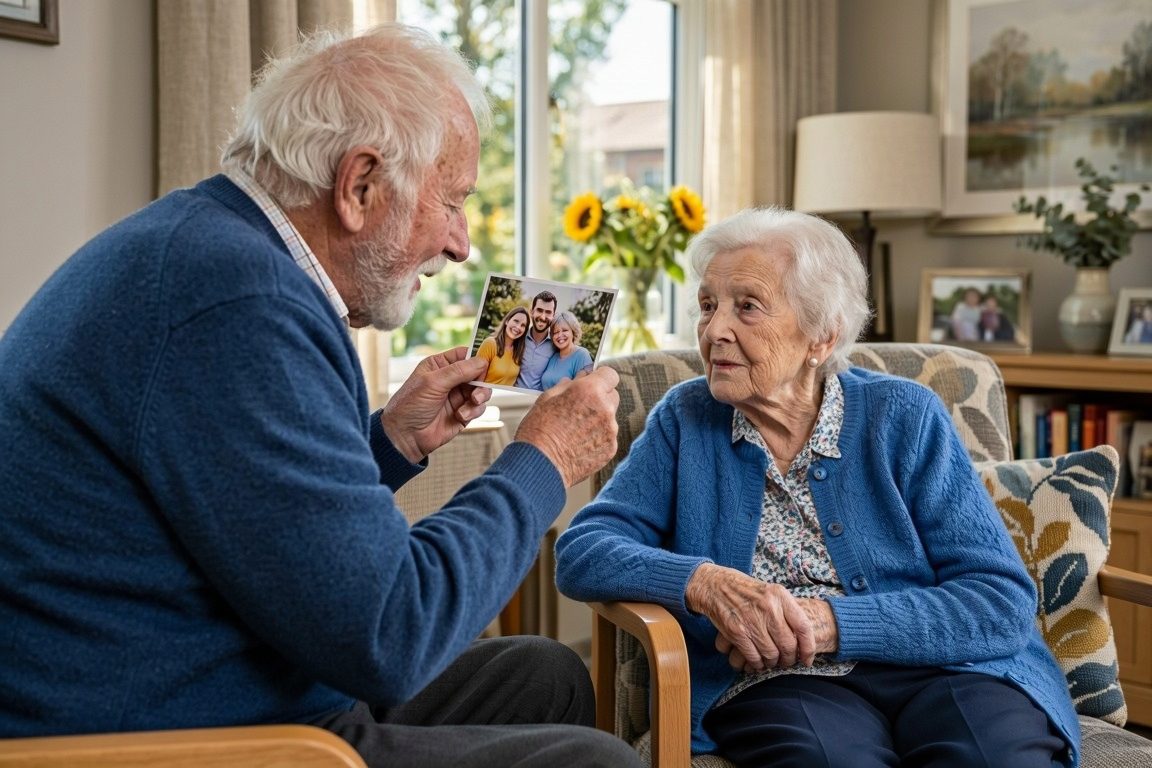
- Do not bring too many objects or activities at once. A cluttered table or multiple photos can cause visual confusion.Instead, present one item at a time, and remove it before introducing the next.
- Do not force eye contact if the person looks away. Forcing eye contact can feel confrontational.Instead, follow their lead, if they look down, you can look down too, or gently redirect with a sound or touch.
- Do not ignore the person’s schedule or energy level. Visiting during a busy activity time or when they are tired can lead to frustration.Instead, learn their routine and visit during free time when they are most alert.
Key points
- Always approach from the front, at eye level, within 20–30 cm, to stay in their narrow visual field.
- Use one bright, contrasting object as a visual anchor; avoid clutter.
- Speak slowly, with one idea per sentence, and pair words with simple gestures.
- Keep activities short (3–5 minutes) and sensory-focused (touch, music, single photo).
- Reduce background noise and distractions to help them focus on you.
- If they become agitated, stop talking and use gentle touch and calm presence.
Videos
 Ep. 297: Can I Experience Dementia Without Actually Having It?This video helps you understand what a narrow visual field feels like, building empathy and guiding your approach.
 Providing Support When Mobility Rules Are Not Regarded | Teepa's ClipsTeepa Snow demonstrates how to use visual cues and positioning when a person cannot see well, directly relevant to this topic.
 Ask Teepa Anything! Live on YouTube September 1Teepa answers caregiver questions about visual field issues and offers practical tips for engagement.
 The Baffled Brain: Demystifying Dementia Episode 13 February 20, 2021This episode covers sensory changes in dementia, including vision and hearing, and how to adapt communication.
2 more videos
 Posterior Cortical Atrophy Lecture Series with Karen HookstadtFocused on PCA, where visual field narrowing is a hallmark, this video provides specific strategies for engagement.
 Alzheimer's Answers About AgingOffers general tips on using visual and auditory cues during visits, reinforcing the techniques in this article.
Background
What a Narrow Visual Field Means for Connection
A person with a narrow visual field, common in conditions like posterior cortical atrophy (PCA) or advanced Alzheimer’s, can only take in a small slice of their surroundings at a time. They may not see you approach from the side, or they might miss the chair you’re pointing to because it’s outside their limited cone of vision. As Teepa Snow explains, vision is the primary way we take in data, so if they can’t see what you’re showing them, they may become confused or startled. This isn’t about them ignoring you; their brain simply cannot process the full picture. Understanding this helps you adjust your approach with patience and creativity.
Why Auditory Cues Become Even More Important
Dementia doesn’t typically affect hearing, but it can greatly affect comprehension. Background noise, rapid speech, or unclear consonants can make it hard for the person to understand what you’re saying. When their visual field is narrow, they rely more on what they hear to make sense of the moment. Using clear, slow speech with simple words, and pairing it with visual cues like gestures or a bright object, helps bridge the gap. As one source notes, using signs and gestures can be very helpful because the person may understand your actions even if they don’t grasp every word. This dual-channel approach (visual + auditory) gives them the best chance to engage.
The Role of Touch and Proximity
Touch can be a powerful connector, but it must be introduced carefully. Because the person may not see you coming, a sudden touch can startle them. Always give a verbal cue first, like “I’m going to put my hand on your arm,” and approach from the front within their visual field. Once they are aware, a gentle touch can convey warmth and safety. As one caregiver noted, human warmth and touch is key, even if the person doesn’t give much feedback. This tactile cue, combined with visual and auditory cues, creates a fuller experience for someone who cannot rely on sight alone.
Practical tools
6
The ‘Special Object’ Script
A simple phrase to use when you enter: ‘I was thinking of you, so I brought this special thing.’ Then hold up a single, bright object (like a red scarf, a smooth stone, or a flower). This gives the person a visual anchor and a positive emotional cue. Keep the object simple and contrasting against your clothing.
The ‘Front-and-Center’ Positioning Checklist
Before you speak, check:
This ensures you are in their narrow visual field and not startling them.
The ‘One-Sentence’ Rule
Use only one idea per sentence. For example: ‘I am your friend, Sarah.’ Pause. ‘I brought a photo.’ Pause. ‘It is a picture of a dog.’ This gives the person time to process each piece of information without overload.
A Bright, High-Contrast Object (e.g., a red cup or yellow scarf)
Use an object that stands out against the background (e.g., a red cup on a beige table). This helps the person focus their narrow visual field on one thing. You can also use it to guide their gaze: slowly move it left to right while saying, ‘Look at the red cup.’
The ‘Lighthouse Scanning’ Technique
If the person needs to find something in a room (like a chair or a door), use a bright object as a ‘lighthouse.’ Slowly sweep it across their visual field from one side to the other, and say, ‘Follow the red scarf, see where it goes?’ This helps them practice scanning without frustration.
A Short, Familiar Song or Sound
Play a short clip of a song they loved (e.g., 30 seconds of ‘You Are My Sunshine’). Music can bypass visual and verbal difficulties and create an immediate emotional connection. Use it as a bridge before introducing a visual cue.
Different situations
Posterior Cortical Atrophy (PCA) or Lewy Body Dementia
For PCA, visual field narrowing is often severe and early. Use even larger, simpler visual cues (e.g., a bright red plate instead of a small flower). Avoid complex visual scenes like crowded photos. One-on-one visits are best; groups may be overwhelming. Use auditory cues more heavily, describe what you are doing in simple words before you do it.
Late-stage Alzheimer’s
In late stages, the person may have very limited visual field and comprehension. Focus on touch and tone of voice. Use the ‘special object’ script but expect no verbal response. A gentle hand-hold or a soft humming can be enough. Keep visits very short (2–5 minutes) and watch for signs of agitation (turning away, tensing).
Spouse vs. Adult Child Visitor
A spouse may feel more comfortable using touch and familiar routines (e.g., holding hands, humming a lullaby). An adult child might need to reintroduce themselves each time: ‘Hi, Dad, it’s your son, Mark.’ Both should avoid bringing up painful memories or asking ‘Do you remember?’ Focus on the present moment.
Visiting in a Facility vs. at Home
In a facility, reduce distractions by closing the door and asking staff to hold interruptions. At home, you have more control over lighting and noise. In both settings, use the same front-and-center positioning. At home, you can also use familiar objects (e.g., their favorite cup) as visual anchors.
When the Person is Easily Agitated or Anxious
Slow down even more. Use a soft, low voice. Avoid sudden movements. If they seem overwhelmed, stop talking and just sit quietly with a gentle touch on their hand. Let them initiate any interaction. The goal is safety, not engagement.
For the doctor
3
- If the person has a sudden change in vision (e.g., new blind spots or double vision), discuss with their doctor to rule out a stroke or other medical issue.
- If the person becomes consistently agitated during visits despite using these techniques, ask their clinician about possible pain, infection, or medication side effects.
- If you are considering using a bright light or magnifying device to help with visual cues, consult an occupational therapist or low-vision specialist first.