Step by step
What not to do
- Don't argue or try to reason with them about what they're seeing. If they think they see a stranger in the mirror, saying 'That's you!' will only confuse and upset them.Instead, acknowledge their feeling ('That looks confusing, doesn't it?') and change the subject or cover the mirror.
- Don't suddenly change the environment without warning. Moving furniture or rearranging rooms can be deeply disorienting. If you need to make a change, do it slowly, one thing at a time, and keep familiar items in their usual spots.
- Don't assume the behavior is 'just dementia' and ignore it. Always check for physical causes first, pain, infection, constipation, or medication side effects. A new behavior can be a sign of a medical issue that needs attention.
- Don't try to force a change when you're stressed or rushed. If you're already overwhelmed, your loved one will pick up on that tension and resist more. Step away, take a few deep breaths, and come back when you're calmer.
- Don't leave the TV or radio on all day 'for company.' Constant noise can be overstimulating, especially if they can't follow the content. Use it intentionally, soft music or a nature program for short periods, and turn it off when it's not being actively watched.
- Don't forget to consider your own needs. If you're exhausted, you can't be a calm presence. Take breaks, ask for help, and find a support group. Your well-being is part of the environment too.
Key points
- The environment is a direct cause of many unhealthy coping behaviors, changing it can prevent problems before they start.
- Start with physical needs (pain, hunger, bathroom) before changing the room.
- Reduce noise, improve lighting, cover mirrors, and declutter to create calm.
- Your own stress is part of the environment, take a breath before you act.
- Use a behavior log to find patterns and make targeted changes.
- What works today may not work tomorrow, stay flexible and patient.
Videos
 How to Manage Repetitive Behaviors in Alzheimer's DiseaseShows how to use environmental changes to reduce repetitive questions and actions.
 Simple Approach to Difficult Dementia BehaviorsOffers a step-by-step method for assessing and modifying the environment.
 Time with Teepa - Unhealthy Coping Strategies and Brain ChangeExplains why the brain struggles with the environment and how to adapt.
 How to Manage Anger and Aggression in Alzheimer's DiseaseCovers environmental triggers for anger and how to de-escalate.


Background
Why the Environment Matters So Much
For a person with dementia, the brain struggles to make sense of what the senses take in. A cluttered room, a loud TV, or a shadowy corner can feel confusing or even threatening. When the brain can't connect the dots, it tries to fill in the gaps, sometimes with hallucinations or delusions. This confusion often leads to behaviors like yelling, pacing, or repetitive questions. The environment isn't just a backdrop; it's a direct cause of stress. As one expert put it, if the brain doesn't understand what's going on, it will try to connect those dots in ways that can be scary or upsetting. That's why changing the environment is one of the most powerful tools you have, it addresses the root cause, not just the symptom.
How Unhealthy Coping Shows Up and What Triggers It
Unhealthy coping behaviors can look like your loved one calling out every few minutes, wandering toward the door, refusing to eat, or becoming agitated at certain times of day. These aren't 'bad' behaviors; they're expressions of distress. Common environmental triggers include: too much noise (especially from TV or multiple conversations), poor lighting that creates confusing shadows, clutter that makes it hard to move or find things, reflective surfaces like mirrors where they don't recognize themselves, and rooms that are too hot or too cold. Even the number of people in the room matters, a quiet home suddenly filled with 25 family members can cause anxiety. The key is to think like a detective: what in the space is overwhelming or confusing right now?
The Caregiver's Role: You Are Part of the Environment
Your own stress and body language are part of the environment too. If you're rushed, tense, or frustrated, your loved one picks up on those cues and may respond with more agitation. Before you try to change anything else, check in with yourself. Are you calm enough to approach this? If not, take a few deep breaths, literally suck in air through your nose and blow it out fully to get fresh oxygen to your brain. Sometimes the best first step is to step away for a few minutes, let both of you cool down, and then come back with a different approach. Remember: what worked this morning may not work this afternoon. Flexibility is your superpower.
Practical tools
6
The 'Calm Corner' Setup
Designate one room or corner as a low-stimulation zone. Use soft, warm lighting (a lamp with a dimmer), a comfortable chair, and minimal clutter. Keep a few familiar objects like a photo or a soft blanket. When your loved one seems agitated, gently guide them there and sit with them quietly. Say something like, 'Let's sit here for a minute and rest.'
The 'Mirror Check' Tool
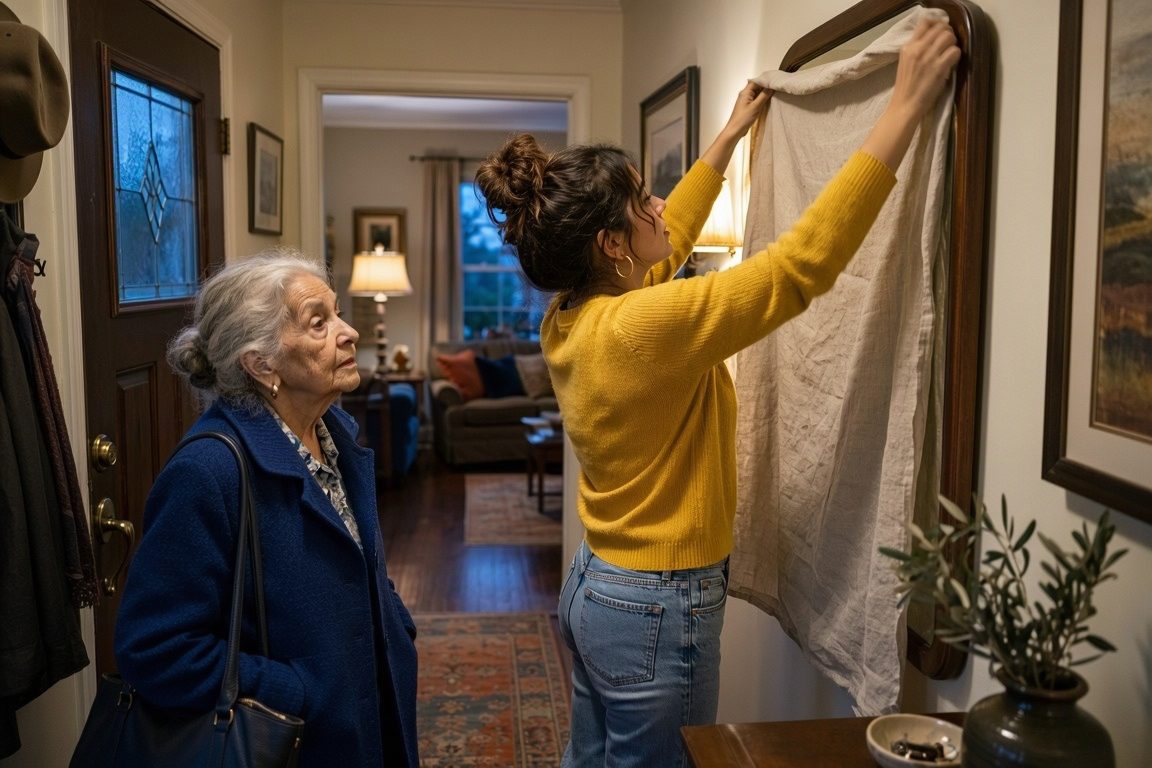
Walk through your home and look at every reflective surface, mirrors, windows at night, shiny appliances. Ask yourself: could this confuse or scare my loved one? If yes, cover it with a cloth, reposition it, or remove it. For windows, use sheer curtains or blinds to reduce reflections.
The 'Evening Wind-Down' Checklist
Print this and keep it handy:
The 'Behavior Log' Template
Create a simple chart with columns: Date/Time, What Happened (behavior), What Was Going On (environment, noise, people, lighting), What I Did, What Helped. Fill it out for 3-5 days. Look for patterns, like always happening after 4 PM or when the kitchen is busy. Use that to make targeted changes.
The 'Door Disguise' Kit
Use a removable wallpaper mural (like a bookshelf or garden scene) to cover the door. Or hang a curtain that matches the wall. You can also paint the door the same color as the wall. This makes the exit less obvious and reduces wandering. For safety, also use a childproof doorknob cover or a simple slide bolt high up.
The 'Sensory Check' Card
Write on an index card: '
' Keep it in your pocket. When a behavior starts, pull it out and check each item quickly.
Different situations
For Lewy Body Dementia (LBD)
People with LBD are especially sensitive to visual hallucinations and changes in lighting. Shadows and reflections can be very distressing. Use even, soft lighting everywhere, avoid dim corners or bright spots. Cover mirrors completely. Also, be aware that they may have extreme sensitivity to temperature, so keep the room consistently comfortable. Discuss any medication changes with the clinician, as some drugs can worsen symptoms.
For Late-Stage Dementia
In late stages, the person may be less mobile but still sensitive to the environment. Focus on comfort: soft bedding, gentle lighting, and quiet. Reduce clutter to prevent falls. Use familiar objects like a favorite blanket or photo. Keep the room at a steady temperature. If they're bedbound, change their position regularly and offer soothing touch or music. Always prioritize safety, remove any sharp or hard objects nearby.
For Spouse vs. Adult Child Caregiver
As a spouse, you may feel more emotionally tied to the home's current setup. It's okay to make changes gradually. Explain to your loved one in a calm voice, 'I'm just moving this lamp so you can see better.' As an adult child, you might be more objective but also face resistance from the parent. Frame changes as 'helping you be more comfortable' rather than 'fixing a problem.' Both roles benefit from taking breaks and joining a support group.
If Your Loved One Lives in a Facility
You can still modify their personal space. Bring familiar items from home: a favorite chair, photos, a soft blanket. Ask staff to keep the room well-lit and clutter-free. If sundowning is an issue, request that evening activities be calm and that the TV be turned off in common areas. You can also suggest that staff use the 'calm corner' approach in their room. Work with the care team to share what you've learned about their triggers.
For Mild Cognitive Impairment (MCI)
At this stage, the person can still participate in decisions. Involve them in changes: 'I noticed you seem more relaxed when the lights are softer, should we try that?' Keep the environment organized and predictable. Use labels on drawers or cabinets to help them find things. Reduce clutter to prevent overwhelm. Encourage them to spend time in natural light during the day and to have a consistent evening routine.
For the doctor
5
- If your loved one's agitation or aggression is severe or dangerous, ask your doctor about non-drug approaches first, but also discuss whether medication might be needed temporarily.
- If you suspect a new medication is causing or worsening behaviors (like restlessness or confusion), talk to the prescriber before making any changes.
- If your loved one has a history of falls, ask about safe ways to prevent wandering (like bed alarms or low-height beds) without using restraints.
- If sundowning is severe and not improving with environmental changes, ask about melatonin or other sleep aids, but only under medical supervision.
- If you notice sudden changes in behavior, vision, or mobility, consult the clinician to rule out infection, pain, or other medical issues.