Step by step
What not to do
- Do not play music loudly or suddenly. A loud, unexpected sound can startle and agitate a dementia-affected brain.Instead, start with very soft volume and gradually increase if they seem to enjoy it.
- Do not test them by asking, 'Do you remember this song?' or 'What's the name of this one?' This creates pressure and can lead to frustration or shame.Instead, simply play the song and observe their response. Let the music speak for itself.
- Do not correct them if they sing the wrong words or hum a different tune. The goal is connection, not accuracy. If they sing 'Twinkle, Twinkle' to the tune of 'Amazing Grace,' just hum along with them. Correcting them can break the moment and make them feel criticized.
- Do not force them to participate if they seem uninterested or agitated. If they turn away, close their eyes, or become tense, stop the music and try again later with a different song or a different time of day. Respect their 'no' as a valid form of communication.
- Do not talk about them as if they are not there while music is playing. Even if they cannot respond verbally, they may still be aware of your words. Always include them in the moment. For example, instead of saying to a visitor, 'She used to love this song,' say directly to your loved one, 'I remember how you used to dance to this. It makes me smile.'
Key points
- Music reaches parts of the brain that language cannot, making it a powerful tool for connection when words are gone.
- Start with familiar, emotionally positive songs from your loved one's youth or early adulthood.
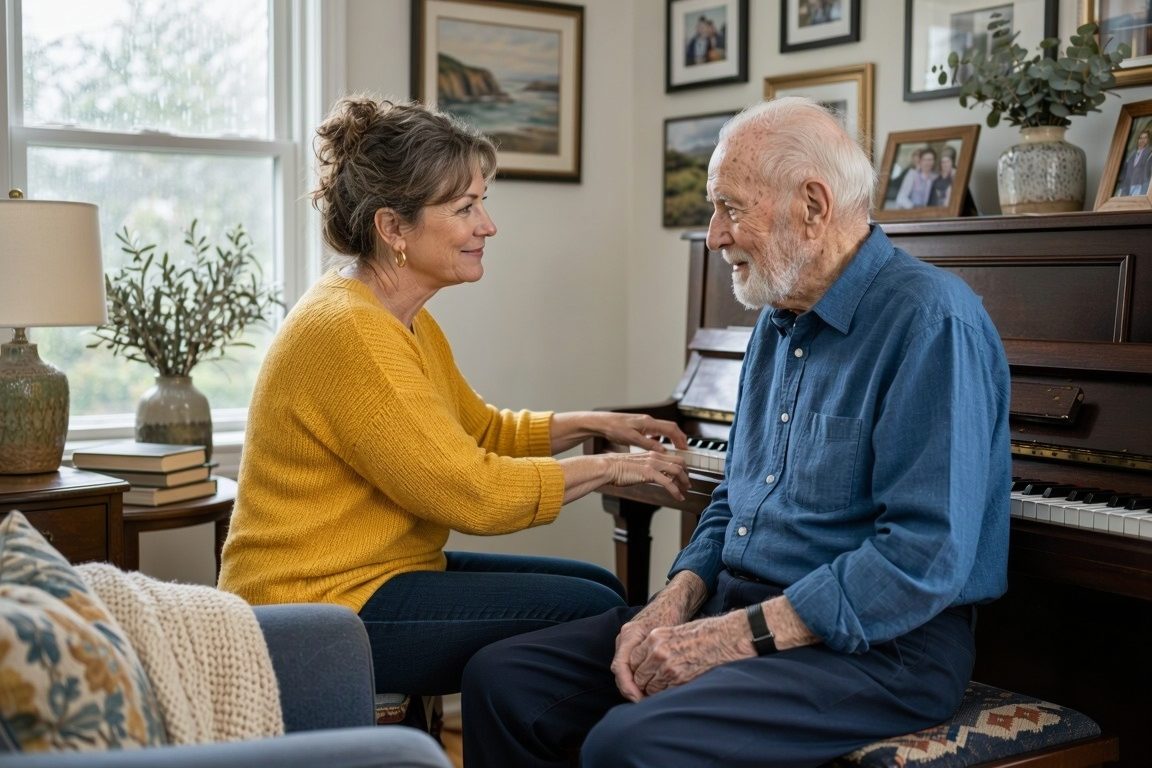
- Use a calm, slow approach: sit at eye level, hum softly, and follow their cues rather than leading.
- Combine music with gentle touch or movement to deepen the sensory experience.
- Do not test or correct; the goal is shared presence, not performance.
- Create a consistent playlist and use it at predictable times to build comfort and routine.
- Adapt the approach for different stages and diseases: slower and softer for late-stage, grounding for Lewy body hallucinations.
Videos
 Ask Teepa Anything! June 3, 2020Teepa Snow explains how music, poetry, prayer, and counting can engage the right temporal lobe and free up words in the left temporal lobe. She also discusses the concept of 'incomplete grief' when language is lost.
 PAC 10 at 5 - Language on the Left...Rhythm on the RightThis video visually demonstrates the brain regions involved in language vs. rhythm, helping you understand why music remains accessible when speech fails.
 Music and Alzheimer's DiseaseA clear, compassionate explanation of how music can trigger memories and emotions, with real-life examples of nonverbal individuals singing along to familiar songs.
 How to Talk to Someone with Dementia (without Arguing)While focused on verbal communication, this video teaches the 'acknowledge, validate, redirect' technique that pairs beautifully with music-based connection.
2 more videos
 Top 5 Indoor Activities for Seniors with Dementia (For Free)Includes practical, low-cost music activities like karaoke and dancing that you can adapt for nonverbal connection.
 The Caregiver's Journal Lance A. Slatton with Cindy -PT & Christina -ST 'Finding Care' Chapter 6Features a speech therapist discussing how music can be used as a communication tool even when verbal skills are severely impaired.
Practical tools
6
The 'You and Me' Song Approach
Instead of commanding ('Let's listen to music'), use partnership language: 'Let's listen to our song together.' This reduces pressure and creates a sense of safety. For example, say, 'Let's sit and hear that old hymn you loved. I'll hum it with you.' This turns the activity into a shared experience rather than a task.
The 'Rhythm Bridge' Technique
When your loved one is agitated or withdrawn, use a slow, steady rhythm to ground them. You can tap your own chest gently in a 4/4 beat, or use a soft drum or shaker. Match their breathing if possible. Then gradually introduce a familiar song in the same tempo. This can help them transition from a state of distress to one of calm connection.
The 'Sensory Playlist'
Create a playlist of 5-10 songs that are deeply familiar and emotionally positive. Include songs from their teenage years, wedding, or early parenting. Play it at consistent times, like during morning care or before bed. Over time, the brain associates the music with safety and comfort, making transitions easier. Use a simple MP3 player or a smartphone with a locked screen to avoid confusion.
The 'Mirror and Match' Script
When your loved one makes a sound, a hum, a groan, a single word, mirror it back to them with the same pitch and rhythm. Then slowly shift to a familiar tune. For example, if they hum a low note, hum it back, then add a few notes of 'You Are My Sunshine.' This validates their communication and gently guides them toward a shared musical moment.
The 'Five Senses' Connection Kit
Combine music with another sense to deepen connection. For example, play a song while handing them a soft fleece blanket, or while offering a favorite scent like lavender. The combination of music and touch or smell can create a powerful, calming experience that bypasses language entirely.
The 'Closed Loop' Song
If your loved one is stuck in a repetitive loop of anxiety or hallucination, use a song that has a clear beginning, middle, and end. The structure of a complete song can help their brain 'close the loop' and move on. After the song ends, gently redirect to a new activity, like offering a drink or looking at a photo album.
Different situations
For Lewy Body Dementia (LBD)
In LBD, visual hallucinations and fluctuating cognition are common. Music can be especially helpful for grounding during hallucinations. If your loved one is seeing something frightening, try playing a familiar, upbeat song and gently swaying with them. The rhythm can help their brain shift focus from the hallucination to the music. Avoid music that is too complex or has sudden loud changes, as LBD brains can be sensitive to sensory overload. Also, be aware that LBD often affects movement, so dancing may be limited to gentle rocking or tapping.
For the doctor
4
- If your loved one becomes extremely agitated or aggressive during music, discuss with their doctor whether this could be a sign of pain, discomfort, or a medication side effect.
- If your loved one has a history of seizures, ask their neurologist if certain types of music (e.g., very fast tempos or flashing lights in music videos) could trigger a seizure.
- If your loved one has hearing loss or uses hearing aids, ask their audiologist how to optimize the music experience, for example, using headphones vs. speakers, or adjusting the volume to avoid distortion.
- If your loved one is on medications that affect heart rate or blood pressure, discuss whether vigorous dancing or sudden movements during music could be risky.