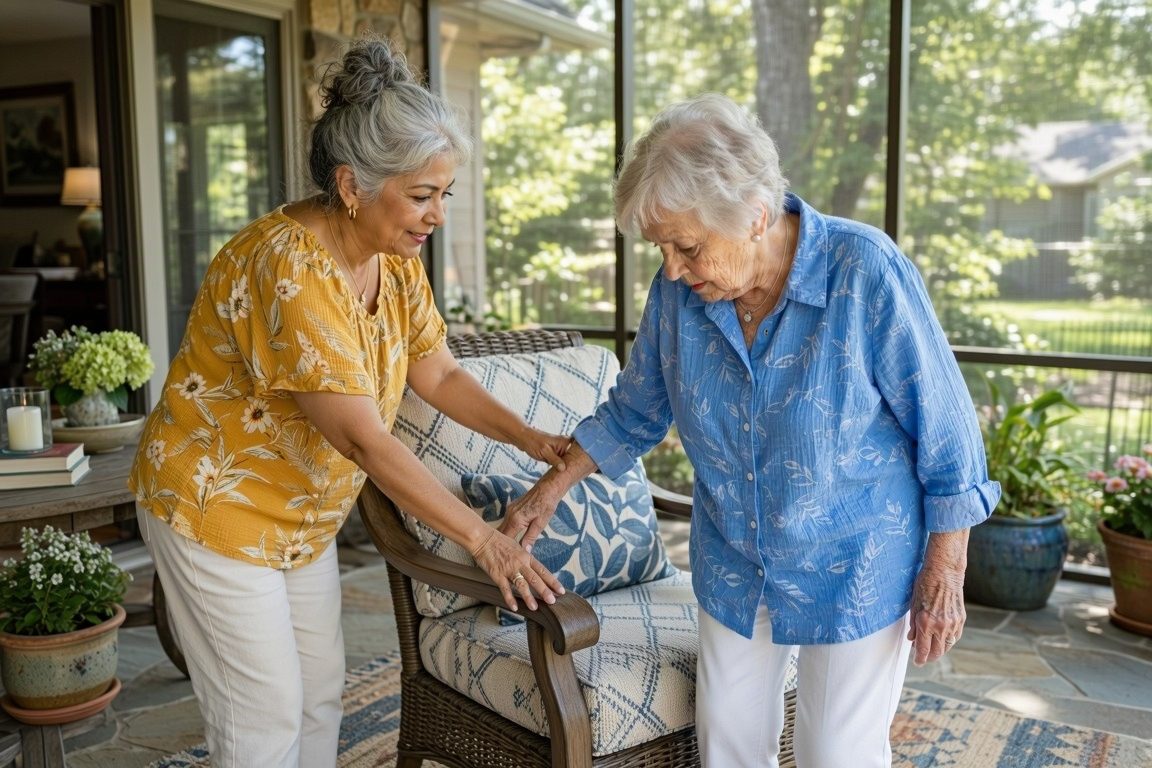
Step by step
What not to do
- Do not grab them under the armpits or pull them up from the front. This can cause them to panic, stiffen, and resist, increasing fall risk.Instead, use the side approach with hand on the back, guiding them forward.
- Do not give multiple instructions at once. Saying 'Turn around, bend your knees, and sit down' overwhelms their brain. Break it into single steps: 'Turn around.' Wait. 'Bend your knees.' Wait. 'Sit down.'
- Do not rush or show impatience. If you sigh, tap your foot, or speak sharply, they will mirror your stress and become more anxious. Take a deep breath, center yourself, and move slowly. Your calm presence is a powerful tool.
- Do not touch them without warning or without asking first. A surprise touch can be perceived as a threat, especially in Lewy body dementia where visual-spatial processing is impaired. Always approach from the front, make eye contact, and ask permission before touching.
- Do not try to lift them or bear their full weight. If they cannot stand or sit with minimal assistance, you need a mechanical lift or more help. Pushing or pulling can injure both of you. Call for a physical therapy evaluation for safe transfer techniques.
- Do not use a chair that is too low, too soft, or without armrests. Low chairs are hard to get out of, and soft chairs can cause them to sink and feel unstable. A firm chair with armrests at a height where their hips are slightly higher than their knees when standing is ideal.
Key points
- Always use the sequence: visual cue first, then verbal, then touch, never skip to touch.
- Touch should be gentle, supportive, and only after asking permission; avoid surprise touches.
- Guide the person to lean forward before sitting; never tip them backward.
- Use a wide base of support and bend your knees, not your back, to protect yourself.
- Wait 10-20 seconds after each cue for the person to process and respond.
- Choose a firm chair with armrests at the right height; avoid low or soft chairs.
Videos
 Live on TikTok | The Importance of Giving Visual and Verbal Cues When Providing CareDemonstrates the visual-verbal-tactile sequence in real time, showing how to use your own body as a cue before touching the person.
 The Baffled Brain: Demystifying Dementia Episode 13 February 20 , 2021Explains why the brain in dementia struggles with sequences like sitting, and how to break tasks into single steps.
 How to get someone living with dementia to sit down when visual and verbal cues aren't working.Shows the specific touch cue on the back of the knee and how to support the back during the sit.
 How to communicate with a dementia patientCovers general communication strategies that apply to giving cues, including the importance of waiting for a response.
2 more videos


Practical tools
6
The 'Lean Forward' Verbal Script
Use these exact phrases in order: 'Let's sit down now.' (pause 10 seconds) 'See this chair?' (point) 'Turn around toward me.' (pause) 'Good. Now feel the chair behind your legs.' (pause) 'Lean forward a little. I've got your back.' (pause) 'Bend your knees. I'm right here.' (pause) 'You're sitting. Great job!'
The 'Touch on the Back of the Knee' Cue
This is a specific tactile cue: while supporting the person's back with one hand, use the fingertips of your other hand to gently touch the tendon behind their knee. This often triggers a reflexive knee bend. Do not push or pull; just a light touch. If they do not respond, do not repeat it forcefully; instead, try guiding their knee forward with your hand on their shin.
Wide Base of Support Stance
Before you begin, stand with your feet shoulder-width apart or wider, with one foot slightly in front of the other. Bend your knees, not your back. This protects your spine and gives you a stable platform to support the person. If they start to fall, you can lower them safely by bending your knees further, not by straining your back.
The 'Touch Yourself First' Technique
If the person is resistant to touch, model the action on your own body first. For example, touch your own knee and say, 'Bend your knee like this.' Or touch your own back and say, 'Lean forward like this.' This gives them a visual and verbal cue without invading their space. It also builds trust because they see you doing the same thing.
Chair Selection Checklist
Use a chair that:
Avoid rocking chairs, swivel chairs, or chairs on wheels.
The '10-Second Rule' for Response Time
After giving a verbal or visual cue, wait at least 10 seconds (count slowly in your head) before repeating or adding a new cue. People with Lewy body dementia often need 10 to 20 seconds to process and respond. Do not fill the silence with more words. Use a timer on your phone if needed to remind yourself to wait.
Different situations
Lewy body dementia with significant Parkinsonism (stiffness, tremors)
The person may have a forward-leaning posture (camptocormia) or difficulty initiating movement (freezing). Use a chair with a higher seat to reduce the distance they need to lower. Before sitting, encourage them to rock gently side to side to 'unfreeze' their legs. The touch cue on the back of the knee may be less effective if they have rigidity; instead, gently guide their knee forward with your hand on their shin. Always have a second person nearby if possible.
Late stage (ruby/amber gem states) with severe cognitive decline
The person may not understand verbal cues at all. Rely almost entirely on visual cues and gentle touch. Use a gait belt (with clinician guidance) to provide a secure handhold on their waist. Do not expect them to follow multi-step instructions. Your goal is to keep them safe, not to have them 'help.' Use a mechanical lift if they are unable to bear weight. Always consult a physical therapist for safe transfer techniques.
Spouse caregiver vs. adult child caregiver
A spouse may have more emotional intimacy and the person may be more accepting of touch, but the spouse may also be physically smaller or have their own health issues. Use the wide base of support and bend your knees, not your back. An adult child may need to establish trust first, use more visual cues and touch to yourself before touching the parent. Both should ask permission before touching: 'May I help you?'
In a facility (nursing home, assisted living)
Staff should be trained in the visual-verbal-tactile sequence and use consistent cues. The person's room should have a familiar chair from home if possible. Use a bed-to-chair transfer sheet or a mechanical lift if needed. Document the person's preferred cues and any history of falls. Ensure the call light is within reach after sitting. Family can share this article with the care team.
Person has hallucinations or delusions (common in Lewy body)
If the person is agitated or hallucinating, do not try to sit them down immediately. First, validate their feelings: 'I see you're upset. Let's take a breath.' Use a calm, reassuring tone. Do not argue about the hallucination. If they believe someone is behind them, do not approach from behind. Always approach from the front, within their line of sight. Use a favorite object or photo to redirect their attention before attempting the sit.
For the doctor
5
- Ask your doctor or physical therapist: 'Is my loved one safe to transfer with minimal assistance, or do we need a mechanical lift or a gait belt?'
- Discuss with the pharmacist: 'Are any of my loved one's medications (especially antipsychotics or Parkinson's drugs) increasing their risk of falls or orthostatic hypotension?'
- Ask an occupational therapist: 'What specific chair height and armrest design would be safest for my loved one's body and stage of dementia?'
- If the person has frequent falls or near-falls, ask: 'Should we consider a hip protector or a fall alarm?'
- If the person has severe rigidity or freezing, ask: 'Are there any exercises or medications that could improve their ability to initiate movement?'