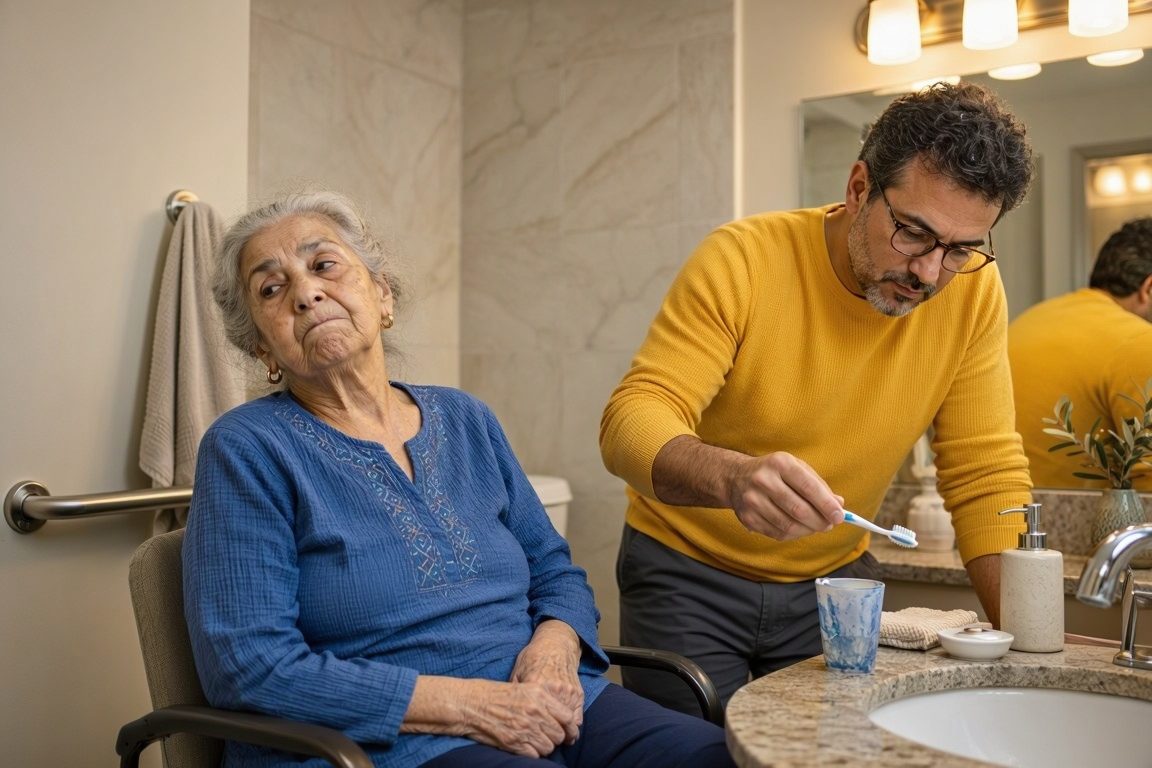
Step by step
What not to do
- Don't use the words 'no' or 'you need to.' These trigger defensiveness and a power struggle.Instead, redirect with a positive statement: 'Let's get your smile ready for the day.'
- Don't force the toothbrush into their mouth if they clamp shut. This can cause pain, fear, and a lasting aversion to mouth care.Instead, step back, take a breath, and try a different approach, like a swab or a rinse, later.
- Don't argue or explain why they need to brush. They may not understand the reasoning, and arguing only escalates frustration.Instead, use distraction or a simple, cheerful request: 'Can you help me with this?'
- Don't assume they're being stubborn. Always rule out physical causes first: pain, ill-fitting dentures, or a mouth infection. As one source notes, 'The difficult behavior you see may actually be your loved one's attempt to keep control and maintain a sense of autonomy.'
- Don't skip mouth care entirely because it's hard. Poor oral hygiene can lead to infections, difficulty eating, and even pneumonia. Even if you only manage a quick swab with a moist cloth, it's better than nothing. Consistency matters, but so does flexibility.
- Don't use a toothpaste that could be harmful if swallowed. If there's a risk they might swallow it, switch to a baking soda-based toothpaste or just water. Avoid anti-plaque rinses unless you've checked with their doctor or dentist, as swallowing them can cause issues.
Key points
- Resistance to mouth care is usually about fear, confusion, or pain, not stubbornness. Always rule out physical causes first.
- Use gentle, positive language. Avoid 'no' and 'you need to.' Instead, offer choices and use cues like a colored washcloth or a cup of water.
- Stand on their dominant side and use hand-over-hand guidance to make the task feel cooperative, not invasive.
- If brushing is impossible, use a soft mouth swab or a damp cloth to clean gums and teeth. Something is always better than nothing.
- Music, mirror work, and familiar routines can reduce refusal and make mouth care a more pleasant shared activity.
- If family burnout is high, consider bringing in a neutral helper like a home health aide or a mobile dental hygienist.
Videos
 Assisting with Activities of Daily Living in Dementia CareDemonstrates practical hand-over-hand techniques and how to position yourself to reduce resistance during mouth care.
 What to do when a person with dementia refuses care: 6 simple strategiesOffers six concrete strategies including sticking to habits, using a neutral helper, and the power of routine, all applicable to dental hygiene.
 Is Your Aging Parent With Dementia Refusing Help? Do This!Explains how to identify the belief behind the refusal and how to respond without power struggles, which is key for mouth care resistance.
 Oral Hygiene Concerns and Options for GEMS States | Teepa's ClipsTeepa Snow shows how to adapt mouth care for different stages of dementia, including using mirrors and gentle cues.
2 more videos
 An Interview with Dr. Joy Poskozim on the Importance of Dental Care for SeniorsA dentist explains why dental care matters for overall health and offers tips for caregivers dealing with resistance.
 Quick Tips: Caring for a Loved One and Dealing with ResistanceShort, actionable tips for handling resistance in the moment, including redirection and calming techniques.
Background
Why They Resist: It's Not About You
When a person with dementia refuses mouth care, it's rarely about being difficult. From their perspective, a toothbrush coming toward their face can feel invasive, confusing, or even threatening. They may not understand what you're trying to do, or they may feel a loss of control over their own body. As one expert notes, unless you've had someone else brush your teeth while you couldn't move or see, you don't truly know how vulnerable it feels. The resistance is often a way of saying, 'I'm scared,' 'I don't understand,' or 'I need to feel in charge of something.'
The Brain Changes Behind the Behavior
Dementia affects the parts of the brain that process sensory information, memory, and decision-making. Your loved one may not remember that they just brushed their teeth five minutes ago, or they may not recognize the toothbrush as a familiar object. They might also have physical issues like sore gums, ill-fitting dentures, or an undiagnosed cavity that makes mouth care painful. As Dr. Camille Sinclair explains, disorientation and confusion are key drivers of refusal, they literally cannot process what you're asking them to do in the way they used to. Always consider pain first: arthritis in the jaw, a cracked tooth, or even thrush can make brushing unbearable.
Your Approach Sets the Tone
How you communicate matters more than what you do. Experts emphasize that people with dementia remember how you make them feel long after they forget the task itself. If you approach with frustration or a 'you need to do this' attitude, you'll trigger a power struggle. Instead, aim to connect before you correct. Use a calm, warm voice, and avoid words like 'no' or 'you have to.' A simple shift, like saying 'Let's freshen up together' instead of 'Time to brush your teeth', can change the entire mood. The goal is to make mouth care feel like a shared activity, not a demand.
Practical tools
6
Easy-Grip Toothbrush
Wrap a washcloth around the toothbrush handle to make it thicker and easier to hold. Or buy a toothbrush with a built-up, ergonomic handle. This helps if they have arthritis or a weak grip, and the familiar texture of the cloth can be calming.
Mouth Swabs (Toothettes)
These small, sponge-tipped swabs are less intimidating than a toothbrush. Dip them in water, a fluoride rinse, or a dry-mouth product like Biotene. They're gentle on gums and can be used even if the person keeps their mouth partially closed. Great for late-stage dementia.
The 'Two-Plate' Choice
When offering mouth care, present two options visually. For example, hold up two toothbrushes (one blue, one green) and ask, 'Which one would you like to use today?' This gives a sense of control and reduces the chance of a flat refusal. The same works for toothpaste flavors or cups of water.
Mirror Work
Stand in front of a mirror together while you brush. Many people with dementia respond well to seeing their own reflection, it can cue them to participate. You can also brush your own teeth at the same time, so they see what to do. This taps into mirror neurons and makes it a shared activity.
Music or Familiar Sounds
Play a song they loved from their younger years during mouth care. Research shows music reduces refusal behaviors. It can also be a distraction, hum along, tap your foot, and keep the mood light. The goal is to make the task feel less clinical and more like a pleasant routine.
Dry-Mouth Products
If your loved one has dry mouth (common with dementia and many medications), use a product like Biotene mouthwash or spray. It's swallowable and won't interfere with medications. It can be used alone or after brushing to keep the mouth moist and reduce discomfort.
Different situations
Late-stage dementia
In late stages, the person may not be able to hold a toothbrush or understand verbal cues. Focus on comfort: use only soft swabs or a damp cloth to gently clean the mouth. Prioritize preventing infections over perfect brushing. Always check for pain or mouth sores. You may need to do mouth care while they're lying down or in a reclined position, with their head turned to the side to prevent choking.
Lewy body dementia or Parkinson's
These conditions often cause rigidity, tremors, and difficulty swallowing. Use a toothbrush with a very soft head and a small amount of toothpaste. Be extra gentle, as they may have jaw clenching or involuntary movements. Consider a fluoride rinse instead of brushing if tremors make it unsafe. Always consult their doctor about swallowing risks before using any mouthwash.
Spouse vs. adult child caregiver
Spouses may find it harder to be 'the enforcer' because of their long history. If you're a spouse, try to frame mouth care as a team effort: 'Let's do this together, just like we always have.' Adult children may need to step back and let a home health aide take over if the parent resists their help. The emotional dynamic is different, sometimes a neutral helper is more effective.
In a facility or with hired caregivers
If your loved one is in a facility, ask to see their oral care plan. Use the language of 'oral care' rather than 'dental care' when speaking with staff. If you notice missing teeth or signs of poor care, bring it up gently: 'I noticed Mom seems to be missing a tooth, can you tell me about her dental care routine?' Advocate for regular dental visits, but be aware that some facilities require quarantine after outside dental work.
Medicaid or low-income situations
If cost is a concern, focus on low-cost alternatives: a soft washcloth wrapped around a finger works as a gentle gum cleaner. Baking soda and water can replace toothpaste. Many community health centers offer sliding-scale dental care. Check if your local Area Agency on Aging has resources for free or low-cost dental services for seniors.
For the doctor
4
- If your loved one has trouble swallowing, ask their doctor or a speech therapist for a swallowing evaluation before using any mouthwash or toothpaste.
- If you suspect a dental infection (e.g., abscess, broken root, thrush), ask the dentist about treatment options that are safe for someone with dementia, especially if sedation is needed.
- If your loved one is on blood thinners or other medications, ask their doctor if any mouth care products (like certain mouthwashes) could interact.
- If your loved one consistently refuses all mouth care and you're worried about their health, ask the doctor about a referral to a geriatric dentist or a mobile dental service that can come to the home.