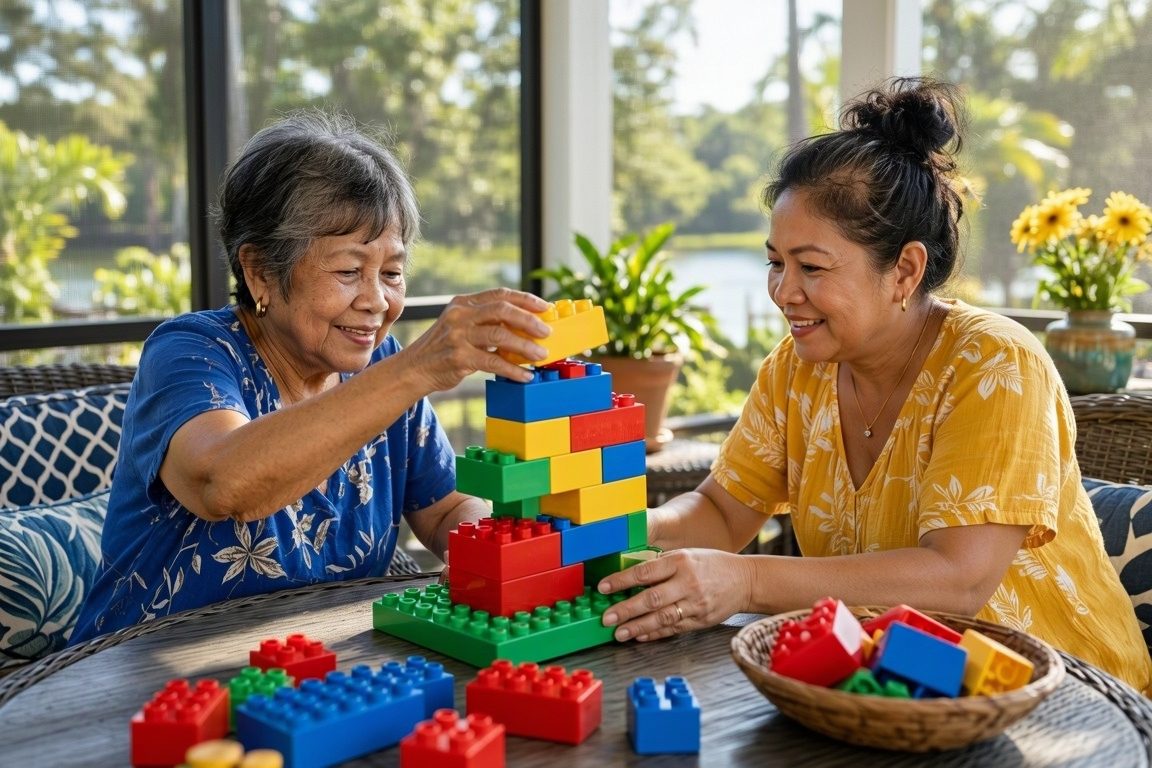
Step by step
What not to do
- Do not correct or criticize how they handle the bricks.
- Do not expect a specific outcome (pattern or recognizable build).
- Do not overwhelm with many bricks; start with 5–6 of two colors.
- Do not give multi-step instructions; use one short phrase at a time.
- Do not take disengagement personally; try another time or activity.
- Do not leave mid-session; stay beside them even if they play alone.
Key points
- The goal is connection and agency, not a finished product. Celebrate the process, not the outcome.
- Start with just a few bricks and use simple, one-step instructions. Less is more.
- Follow their lead. If they want to knock down a tower, let them. If they want to sort by color, join in.
- Use a calm, positive mood. Your emotional state sets the tone for the interaction.
- Keep sessions short (5–15 minutes) and end on a positive note, before they become tired or frustrated.
- Adapt the activity to their current abilities and interests. What worked last month may need to be simplified today.
Videos
 Patty Sherin & Laura Herman, Co-Authors of 'Brick by Brick Bonding Tools for Family Care'This video directly introduces the 'Brick by Brick' concept and explains how using Duplo can restore a sense of agency and create lasting joy, even when memory fails.
 How to keep a dementia patient busyOffers practical ideas for keeping a person with dementia engaged, including the principle of assigning simple jobs like sorting, which can be applied directly to Duplo activities.
 Grandpa, Do you Know who I am? (Dementia Tips)Provides strategies for connecting with a loved one who may not recognize you, which is essential when using Duplo as a bonding tool.
 The Baffled Brain: Demystifying Dementia Episode 22 April 24 ,2021Explains the cognitive changes in dementia, helping caregivers understand why simple, sensory activities like Duplo can be so effective.

Practical tools
6
Invitation Script
Exact lines to reframe the activity: 'I found these interesting blocks. I could use your help. Would you mind?' or 'Look at these, want to see what we can do?'
Two-Brick Start
Click two bricks together slowly, then hand one over with 'You try yours. I'll do mine.' This models the action without demanding imitation.
Gentle Hand-Over-Hand Prompt
When they cannot grasp, ask 'May I help?' then place your hand softly over theirs to guide pressing bricks together. Preserves their sense of doing it.
Sorting Station
Two small bowls with mixed red and blue bricks. Say 'Let's put red in this bowl, blue in that.' Offers a clear, achievable goal.
Build-and-Knock Game
Stack 3–4 bricks into a tower, tap it over playfully with 'Uh oh, it fell!' The cause-and-effect often sparks laughter and reaching.
Memory Box Companion
Keep the same bricks in a dedicated box in a visible place. Bringing it out becomes a familiar ritual signaling 'special time together.'
Different situations
Late-stage or non-verbal person
Focus entirely on sensory and rhythmic aspects. Place a brick in their hand and gently squeeze their fingers around it. Tap two bricks together near their ear. Use a slow, steady rhythm. Watch for eye contact, a slight smile, or a relaxed hand as a sign of connection. Do not expect any stacking or sorting. Your presence and gentle touch are the activity.
Person with Lewy body dementia (fluctuating cognition, visual hallucinations)
Keep the environment very calm and well-lit. Avoid busy patterns on the table or bricks. Use only one or two bricks at a time. If they seem confused or frightened by the bricks, stop immediately and try a different sensory activity like folding cloths. Their cognition can vary hour to hour; what worked in the morning may not work in the afternoon.
Spouse caregiver vs. adult child caregiver
As a spouse, you may have a long history of shared activities. Use that to your advantage. Say, 'Remember when we used to build things with the kids? These remind me of that.' As an adult child, you may need to be more gentle in introducing the activity, as your parent may feel infantilized. Frame it as 'I need your help with this' rather than 'Let's play.'
In a memory care facility
Invite another resident or a staff member to join. This takes the focus off just the two of you and can foster new social connections. Use a lap tray if the person is in a wheelchair. Keep the bricks in a communal area so others can join. Be mindful of other residents who may wander by and want to participate.
Person with frontotemporal dementia (behavioral variant)
This group may have more difficulty with social cues and may become fixated on repetitive actions. If they want to stack the same two bricks over and over, let them. Do not try to redirect them to a 'better' activity. The repetition can be calming. If they become agitated, remove the bricks and try a different calming activity like listening to music.
For the doctor
3
- If your loved one has a history of swallowing non-food items, ask your doctor if Duplo bricks are safe to use, or if a larger, completely sealed object would be better.
- If your loved one has severe arthritis or hand pain, ask an occupational therapist for advice on how to modify the grip or if a different type of sensory object would be more comfortable.
- If your loved one becomes unusually agitated or aggressive when presented with the bricks, discuss this behavior with your healthcare provider to rule out pain, infection, or other medical causes.