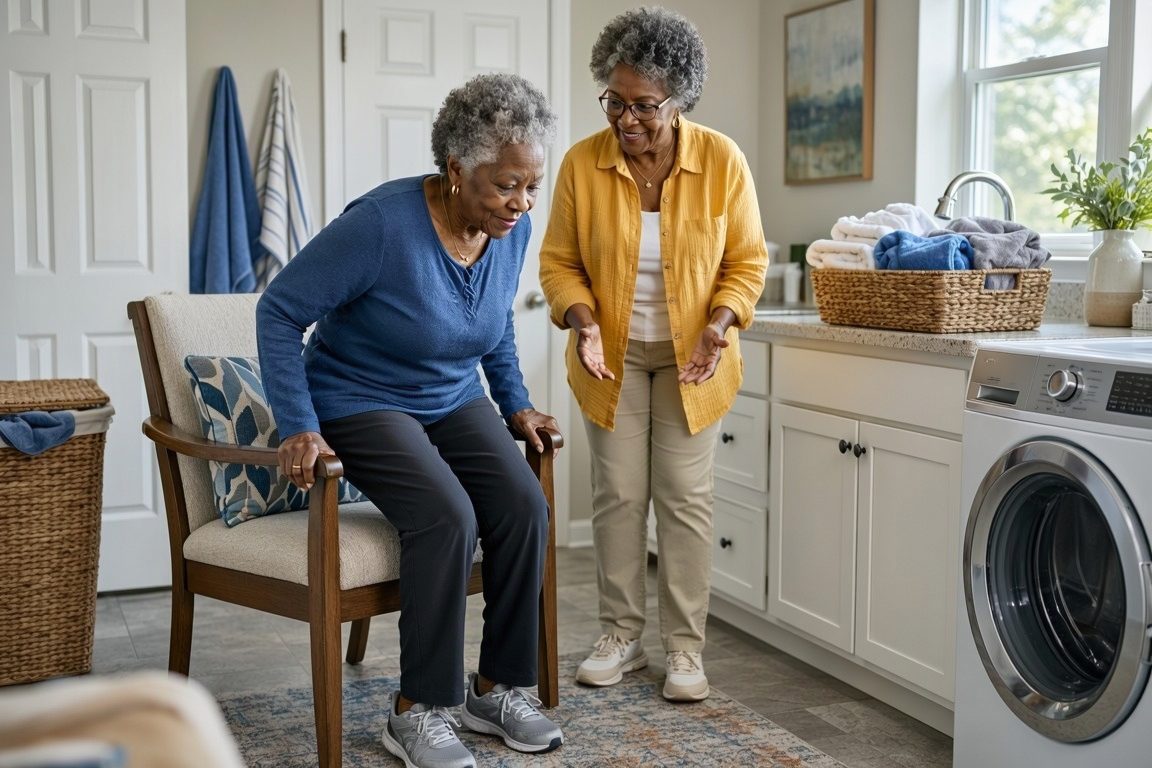
Step by step
What not to do
- Do not push the person to exercise when they are tired, agitated, or in pain. This can lead to frustration, resistance, and even injury.Instead, try again later or at a different time of day when they are more rested and calm.
- Do not use complex instructions or expect them to remember a sequence.Instead, demonstrate each movement and use simple, one-step commands like 'Lift your arm' or 'Stand up now.' Avoid saying 'Do this exercise' without showing them first.
- Do not focus only on aerobic exercise (like walking) and neglect strength training. Both are needed for functional independence. Walking alone does not build the muscle strength needed for standing from a chair or carrying groceries.
- Do not expect the person to exercise alone or self-motivate. They may forget the routine or lack the initiative. Always exercise together or provide direct supervision and encouragement. Your presence is the most powerful motivator.
- Do not use exercise as a punishment or a chore. Frame it as a positive, shared activity: 'Let's do our exercises together so we can both stay strong.' Avoid saying 'You have to do this' or 'The doctor said you need to exercise.'
Key points
- The most effective exercise for daily function combines strength training (once or twice a week) with aerobic activity like walking (150 minutes per week). The benefits are independent and add together.
- Strength training directly improves the ability to perform daily tasks like standing from a chair, carrying groceries, and climbing stairs. Even once a week can improve cognition by 11%.
- For people with mild to moderate dementia, regular exercise helps maintain functional abilities longer and improves performance compared to no exercise.
- Start with seated exercises and progress slowly. Use household items as weights. Always prioritize safety with a clear space, good lighting, and support nearby.
- Frame exercise as a shared, positive activity. Use concrete, simple instructions and demonstrate each movement. Praise effort and celebrate small wins.
- Adapt the routine to the person's condition: for MS, focus on seated exercises and avoid overheating; for Lewy body dementia, be extra cautious with balance; for osteoporosis, avoid twisting and bending.
Videos
 Discover the Cranium Crunches Workbook by Activity Connection with Co-Author Dr. Rob WinninghamThis video demonstrates cognitive and physical activities that can be integrated into daily routines, offering practical ideas for combining mental and functional exercise.
 Cognitive Activities for Dementia and Older AdultsProvides examples of structured activities that engage both mind and body, which can be adapted for functional exercise sessions at home.
 Caring for Someone with Alzheimer's - Family Caregiver Webinar SeriesCovers the importance of physical activity in Alzheimer's care, including tips for motivating and supporting exercise in daily life.
 The 'Magic Pill' for Brain Health: A Behavioral Neurologist Explains | Dr. Khushboo VermaExplains the science behind how aerobic exercise protects the brain, including the role of BDNF and hippocampal growth, reinforcing why functional exercise matters.
2 more videos
 Sleep and DementiaDiscusses how physical activity improves sleep quality, which is often disrupted in dementia and MS, and how better sleep supports daily function.
 HELP! Why Wont The Doctor Diagnosis Dementia?Addresses common frustrations in the diagnostic process, which can affect motivation for exercise; understanding the diagnosis helps tailor functional exercise approaches.
Practical tools
6
The 'Functional Exercise' Script
Use this exact language when starting: 'I'm going to show you a few moves that will make it easier to get up from the couch and walk to the kitchen. Let's try them together. First, sit tall in your chair. Now, place your hands on the armrests. On the count of three, push up to standing. Ready? One, two, three, stand up. Great! Now slowly sit back down. Let's do that five times.' This script is concrete, positive, and task-oriented.
Household Weight Substitutes
If you don't have hand weights, use items from the kitchen: a 16-ounce can of vegetables (about 1 pound), a 2-pound bag of rice, or a 5-pound bag of flour. For leg exercises, you can use ankle weights (available at drugstores for $10-20) or simply have the person practice lifting their leg while seated. The key is to start light and gradually increase weight as strength improves.
The 'Chair-to-Chair' Walk Setup
Place two sturdy chairs about 10 feet apart in a hallway or open room. Have the person walk from one chair to the other, then sit and rest. This provides a clear, short-distance goal and a safe place to rest. As endurance improves, increase the distance or add a third chair. This directly builds the stamina needed for walking to the bathroom or from room to room.
Daily Task Integration Checklist
Print or write this list and check off each activity as it's done:
This turns exercise into a concrete, trackable routine that both you and the person can follow.
The 'One More Rep' Encouragement Phrase
When the person wants to stop, say: 'You're doing so well. Let's try just one more, and then we'll take a break. I'll do it with you.' This gentle nudge often helps them complete a set without feeling pressured. Always follow through with the break to build trust.
Safety Setup for Home Exercise
This prevents falls and makes the person feel secure.
Different situations
For someone with Multiple Sclerosis (MS) in early-to-mid stage
Focus on exercises that can be done seated or with support, as fatigue and balance issues are common. Use shorter sessions (10-15 minutes) with frequent rest breaks. Avoid overheating: exercise in a cool room, use a fan, and offer cold water. Emphasize gentle stretching and range-of-motion exercises to prevent stiffness. Walking may be difficult, so consider stationary cycling or seated marching. Always consult the person's neurologist or physical therapist before starting a new routine, as MS symptoms can fluctuate.
For someone with Lewy body dementia (LBD)
Be extra cautious with balance exercises, as LBD often causes parkinsonism (tremor, rigidity, shuffling gait). Use a chair or wall for support at all times. Avoid rapid changes in position (e.g., standing up quickly) to prevent falls. Keep sessions short (10-15 minutes) and in a calm, quiet environment to avoid overstimulation. Monitor for fluctuations in alertness and stop if the person becomes confused or agitated. Walking with a companion is often safer than solo walking.
For an adult child caregiver vs. a spouse caregiver
Adult children may need to frame exercise as a way to 'help Mom/Dad stay independent longer' to gain buy-in. Spouses may benefit from doing the exercises together as a shared activity. Adult children should be mindful of not sounding bossy; use phrases like 'Let's try this together' rather than 'You need to do this.' Spouses can use familiar routines like 'Let's take our morning walk like we used to.' Both should schedule exercise at a consistent time each day to build habit.
For someone in mid-stage dementia (moderate cognitive decline)
Simplify exercises to one or two steps. Use hand-over-hand guidance if needed. Expect that the person may forget the purpose of the exercise; just focus on the movement itself. Use music or a familiar song to cue the start and end. Keep sessions to 10-15 minutes, twice a day. Celebrate small successes with praise and a favorite snack or activity afterward. If the person resists, try again later or on a different day, consistency over time matters more than any single session.
For someone with a history of falls or osteoporosis
Prioritize balance and core-strengthening exercises done while seated or holding onto a stable surface. Avoid twisting or bending at the waist. Use a weighted vest or backpack (with doctor approval) to add resistance safely. Focus on exercises that strengthen the back muscles and upper legs, which are crucial for fall prevention. Always have a spotter nearby. Discuss any new exercise with the person's doctor or physical therapist first.
For the doctor
5
- Ask the doctor: 'Is it safe for my loved one to start a strength training program with light weights? Are there any exercises they should avoid due to their specific condition?'
- Ask the doctor: 'Given their diagnosis (dementia/MS/other), what is the recommended frequency and intensity of aerobic exercise? Should we aim for 150 minutes per week or a lower target?'
- Ask the doctor: 'Are there any medications that could affect their balance, heart rate, or energy levels during exercise? Should we monitor anything specific?'
- Ask the doctor: 'Can you refer us to a physical therapist or occupational therapist who can design a personalized functional exercise program for home?'
- Ask the doctor: 'If my loved one has osteoporosis, what exercises should we avoid to prevent fractures? Is a weighted vest safe for them?'