Step by step
What not to do
- Do not ask 'Do you remember me?' or 'Which one am I?' This puts your loved one on the spot and makes them feel like a failure.Instead, introduce yourself: 'Hi Mom, it's Allison, your daughter.'
- Do not say 'I already told you that' or 'Don't you remember?' This triggers shame and defensiveness because they genuinely do not remember.Instead, repeat the information calmly and kindly.
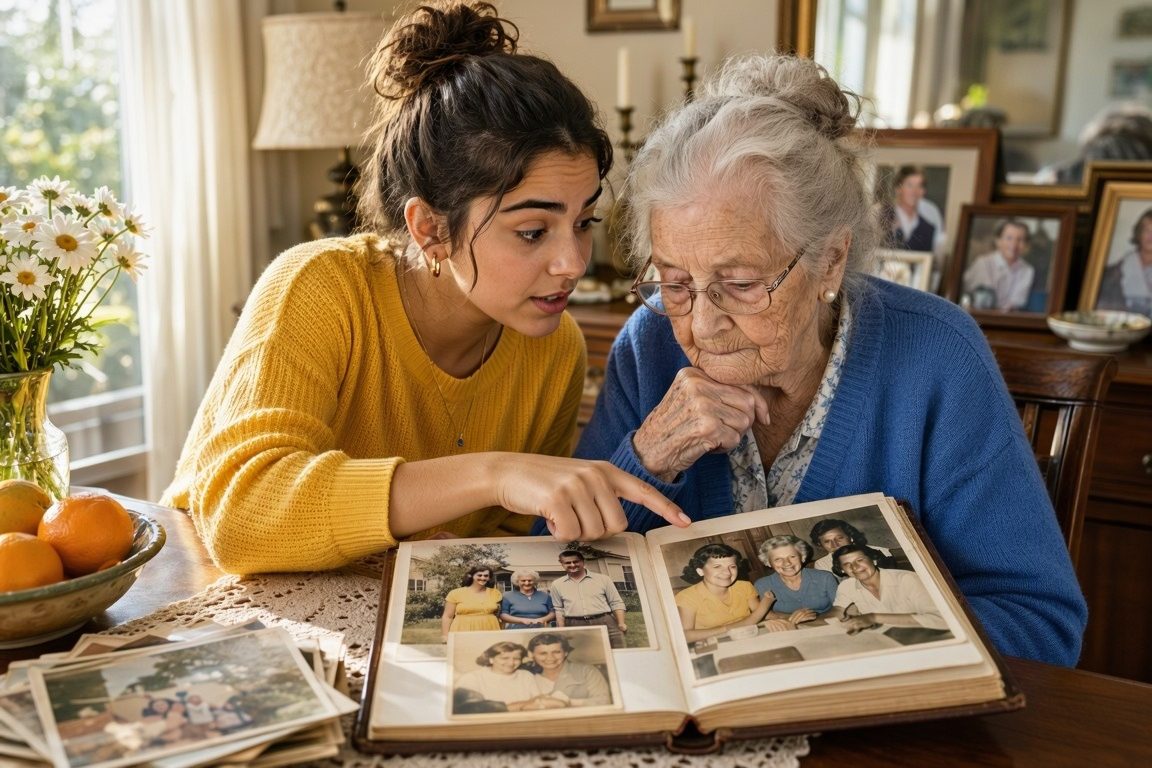
- Do not quiz them on names in photos. This is a test they cannot pass.Instead, name the person in the photo and let them enjoy the image without pressure.
- Do not ask 'What did you eat today?' or 'What did you do yesterday?' These questions rely on recent memory, which is often gone.Instead, talk about something you know they enjoy, like the weather or a favorite song.
- Do not use baby talk or a condescending tone, even if they need help with feeding or dressing. Adults deserve to be spoken to as adults. Say 'Here's your spoon' rather than 'Here comes the airplane.'
- Do not correct them when they say something false unless safety is at risk. For example, if they say 'I saw my mother yesterday,' do not argue.Instead, say 'That's nice. She was a wonderful woman.' Choose kindness over truth.
Key points
- Never ask 'Do you remember?' or any memory-testing question. It creates shame and anxiety without any benefit.
- Replace questions with statements: 'Let's have coffee' instead of 'Do you want coffee?'
- When looking at photos, name the person first. Do not ask 'Who is this?'
- Answer repetitive questions as if for the first time, every time. Do not say 'I already told you.'
- Use visual cues like whiteboards and labeled photo albums to reduce the need for questions.
- Focus conversations on distant past memories, which are often more intact and bring joy.
- Choose kindness over truth when the truth causes pain. A therapeutic fib is a compassionate tool.
- Treat your loved one as an adult with dignity. No baby talk, no condescension.
Videos
 What Not To Do When Caring For Someone With Dementia?This video directly addresses the harm of quizzing and gives clear alternatives, including the powerful advice to 'stop quizzing her. Cut it out.'
 What To Avoid When Caring For Dementia PatientsCovers the emotional impact of quizzing and the importance of not correcting memory, with practical tips for caregivers.
 The BIGGEST dementia advice for YOUExplains why quizzing is the top piece of advice to avoid, and introduces the concept of choosing kindness over truth.
 Peter Berry & Deb Blunt, Authors of 'Slow Puncture, Living Well with Dementia' & Dementia AdvocatesPeter, who lives with dementia, shares how frustrating it is to be quizzed and offers a firsthand perspective on what helps.

Background
The Quizzing Trap: Why It Hurts More Than It Helps
When you ask a person with dementia 'Do you remember who this is?' or 'What did you eat yesterday?', you are essentially giving them a pop quiz on their own life, a test they cannot pass. Their brain has lost the ability to store or retrieve recent memories, so they genuinely do not remember. But they still feel the pressure of being put on the spot. As one expert explains, 'If they knew who that was in the picture, they would tell you.' Quizzing proves nothing and solves nothing; it only creates a painful moment of failure for your loved one and frustration for you.
The Emotional Memory That Lingers Long After the Fact
Even if your loved one forgets the quiz itself, they will remember how it made them feel. Emotional memory often lasts longer than factual memory in dementia. So when you say 'Don't you remember? I already told you,' you trigger shame, embarrassment, or defensiveness. They may lash out, withdraw, or become anxious, not because they are being difficult, but because they feel criticized for something they cannot control. As one care expert puts it, 'They don't realize they are forgetting the thing. That's why they are asking you again.' The correction feels like a scolding, and it damages trust.
The Respect Factor: Treating Adults Like Adults
Quizzing also strips away dignity. People with dementia are adults with a lifetime of experience, and they deserve to be treated with the same respect you would give anyone else. Using baby talk or testing their memory treats them like a child. Experts in dementia care rarely compare caring for an adult with dementia to caring for a child, because adults do not want to be treated like children. Instead of quizzing, you can offer information freely, 'Mom, it's me, Allison', which gives them the answer without making them feel foolish for not knowing.
Practical tools
6
The 'Statement Instead of Question' Script
Keep a mental list of common questions you tend to ask and rewrite them as statements. For example: 'Do you want a bath?' becomes 'Let's get you a nice warm bath.' 'Do you remember your granddaughter?' becomes 'Your granddaughter Emily is here to see you.' Practice this shift until it becomes automatic.
Visual Cue Whiteboard
Place a large whiteboard in a central location (kitchen or living room). Write the date, day of the week, and a simple schedule (e.g., 'Breakfast at 8, lunch at 12, daughter visits at 3'). Use large, clear letters. This answers many repetitive questions before they are asked and reduces anxiety.
Photo Album with Labels
Create a photo album where each picture has a simple label underneath: 'Your brother, John, at the beach, 1985.' When you look at the album together, read the label aloud. This gives your loved one the information without quizzing. It also sparks positive memories from their past.
The 'Therapeutic Fib' Cheat Sheet
Write down common painful questions your loved one asks (e.g., 'Where is Mom?', 'When can I go home?') and prepare a gentle, non-truthful but kind response. For example: 'Mom is out shopping' or 'We'll go home after a nice rest.' Keep this list handy so you can respond without hesitation or guilt.
The 'Redirect to Past' Conversation Starter
Have a list of topics from your loved one's early life that bring joy: their first car, a favorite vacation, a childhood pet, their wedding day. When you feel the urge to quiz, pivot to one of these topics. Say 'Tell me about the time you got your first bicycle' instead of 'What did you have for breakfast?'
Simple Clock with Date Display
Purchase a digital clock that shows the day of the week, date, and time in large, easy-to-read numbers. Place it in the room where your loved one spends the most time. This reduces questions like 'What day is it?' and provides a sense of orientation without testing.
Different situations
Early-stage dementia (still aware of memory loss)
In early stages, your loved one may still be aware they are forgetting. Quizzing can be especially devastating because they know they should remember but cannot. Use even more gentle statements. If they ask 'What day is it?', you can say 'It's Tuesday, and we have a doctor's appointment later.' Avoid any hint of 'You should know this.'
Late-stage dementia (limited verbal ability)
In late stages, your loved one may not understand questions at all. Do not ask any questions. Use only simple, positive statements and physical cues. For example, instead of 'Do you want water?', hold a cup to their lips and say 'Here's some water.' Use your facial expressions and tone to convey warmth and safety.
Lewy body dementia (with hallucinations or fluctuations)
Quizzing can be especially confusing for someone with Lewy body dementia because their awareness fluctuates. They may be lucid one moment and confused the next. Never test their memory during a confused episode. Instead, validate their experience. If they see something that isn't there, say 'I see you are concerned. Let's sit together.'
Spouse vs. adult child caregiver
Spouses may feel a stronger urge to quiz because they want their partner to 'come back' to them. If you are a spouse, remind yourself that your partner's brain has changed, they are not choosing to forget you. Use the same statement-based approach, and add affectionate touch: 'It's me, your husband, Tom. I love you.' Adult children may need to resist the temptation to correct out of habit. Practice saying 'Hi Mom, it's Sarah' instead of 'Don't you recognize me?'
In a facility or with professional caregivers
If your loved one is in a facility, share this article with the staff. Ask them to avoid quizzing and to use statements instead. You can also create a 'communication card' for their room that says 'Please do not ask me questions about my memory. Just tell me what I need to know.' This ensures consistent, respectful care.
For the doctor
3
- If your loved one becomes extremely agitated or aggressive after being quizzed, discuss with their doctor whether medication adjustment or a behavioral health consult is needed.
- If you are unsure whether your loved one's memory loss is due to dementia or another condition (e.g., delirium, depression), ask their clinician for a full evaluation before changing your communication approach.
- If your loved one repeatedly asks about a deceased person and becomes distressed despite your best redirection, ask a dementia care specialist or social worker for additional strategies tailored to your situation.