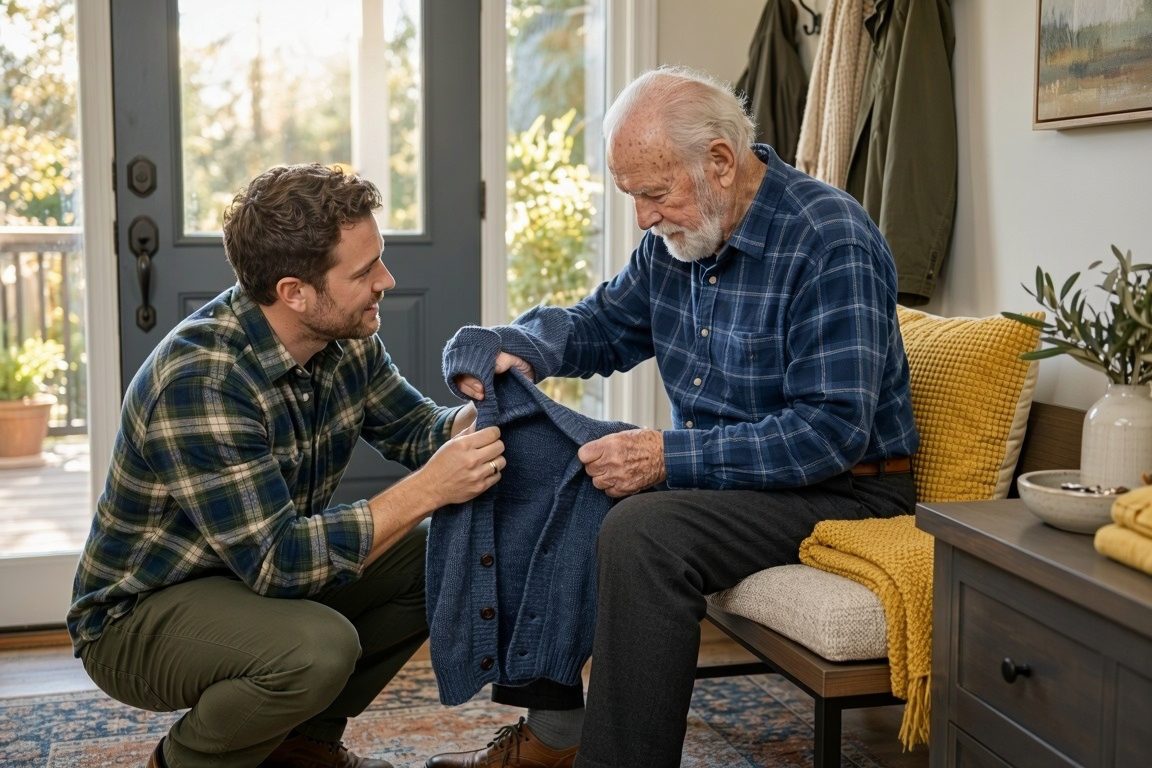
Step by step
What not to do
- Don't say 'You need to get dressed now.' This sounds like a command and can trigger a power struggle.Instead, frame it as a request for help: 'I could use your help with this shirt.'
- Don't rush or show frustration if they move slowly. Rushing increases anxiety and resistance. Take deep breaths, smile, and allow extra time. The goal is cooperation, not speed.
- Don't use complex sentences or multiple steps at once. For example, avoid 'Let's get your pants on, then your shirt, and then we'll go to breakfast.' This overwhelms the brain. Break it into one step at a time.
- Don't argue or correct if they say something inaccurate (e.g., 'I already dressed').Instead, redirect: 'Oh, I see. Could you help me with this belt anyway? I can't get it to work.'
- Don't force physical contact if they pull away. Forcing can escalate into aggression.Instead, step back, give space, and try a different approach or come back later.
- Don't use baby talk or a condescending tone. Even if their comprehension is limited, they can sense disrespect. Speak as you would to a peer: warm, clear, and respectful.
Key points
- Frame dressing and movement as a request for help, not a command, this reduces resistance and preserves dignity.
- Use simple, one-step requests and give plenty of time for the person to process and respond.
- Always approach from the front, at eye level, with a warm tone and gentle touch.
- Praise every small success with genuine gratitude to reinforce their sense of purpose.
- Be flexible, if one help request fails, try a different one or take a break and come back later.
- Personalize your approach based on the person's stage, relationship to you, and any physical or cognitive limitations.
Videos
 Dementia Care Masterclass | Working with Someone in an Amber GEMS® StateThis video explains how to engage someone who is in a more resistant or confused state, which is exactly when help requests can be most effective.
 How to Help a Person Living with Dementia to Get Dressed and UndressedDemonstrates step-by-step dressing techniques, including how to use help requests and hand-over-hand guidance.
 How to Ask for Help, Part 2: what to say when people offer help! (it’s simple!)Teaches how to accept and redirect help offers from others, which can be adapted to asking the person with dementia for help.
 How to keep someone with dementia active when they don't want to do anythingOffers practical strategies for engaging a reluctant person, including using help requests to initiate movement.
2 more videos
 The Baffled Brain Demystifying Dementia Episode 30 June 26 2021Covers the brain changes that make direct commands difficult, reinforcing why help requests work better.
 Understanding the signs of paranoia, hallucinations and delusional behaviors w/ Lucy Barylak Sept 12Helps caregivers recognize when paranoia or hallucinations might be interfering with cooperation, and how to adjust help requests accordingly.
Background
Why Asking for Help Works
A person with dementia often retains a deep-seated need to feel competent and valued. When you directly tell them to get dressed or move, their brain may interpret it as a command or criticism, sparking anxiety, confusion, or outright refusal. However, if you ask for their help with a related task, like holding a shirt, buttoning a sleeve, or walking to the kitchen to 'help' you with coffee, you bypass that defensive reaction. They shift from being a passive recipient of care to an active contributor, which can reduce agitation and increase cooperation. This technique is especially effective in early to middle stages when verbal comprehension and social habits are still relatively intact.
The Brain Science Behind the Strategy
Dementia damages the frontal lobes, which handle reasoning, initiation, and impulse control. When faced with a complex sequence like dressing, the brain may freeze or react with distress. By breaking the task into a single, simple request for help, 'Can you hold this for me?', you reduce cognitive load. The person can focus on one step without feeling overwhelmed. Additionally, the act of helping triggers positive social emotions and memories of being a capable adult, which can override the fear or confusion that often accompanies care tasks. This is not manipulation; it's meeting the person where they are and using their remaining strengths.
When to Use This Approach
This method is most effective when the person is calm but hesitant, or when they show early signs of resistance (like turning away, saying 'no,' or becoming still). It works well for dressing, moving from one room to another, or even bathing if framed as 'helping you get things ready.' Avoid using it when the person is already highly agitated, paranoid, or in pain, in those cases, address the underlying distress first. Also, be aware that some individuals with Lewy body dementia may have fluctuating attention and may not respond consistently; for them, timing and environment matter even more.
Practical tools
6
The 'Help Me' Phrase Bank
Keep a mental list of simple, polite requests: 'Could you hold this for me?', 'I need a hand with this button.', 'Would you mind carrying this to the bedroom?', 'Can you help me choose which shirt?', 'I'm a little dizzy, could you walk with me?' Practice these phrases so they come naturally.
The Two-Shirt Strategy
Lay out two shirts (or two pairs of pants) and ask, 'Which one do you think looks better on me? I can't decide.' This engages their opinion and reduces the feeling of being told what to do. Once they choose, say, 'Great, let's try it on you first to see how it looks.'
The 'Carry This' Prompt for Movement
Hand them a lightweight object (a folded towel, a book, a cup) and say, 'Could you take this to the kitchen for me? I'll follow.' This gives them a purpose and a destination, making walking feel like a helpful errand rather than a chore.
The 'Mirror' Technique
Stand beside them in front of a mirror and start dressing yourself (or pretend to). Say, 'I'm putting on my sweater, can you show me how you do yours?' Mirroring can trigger imitation and reduce self-consciousness.
The 'One Step at a Time' Checklist
Write or mentally note the dressing sequence:
Check off each step as you go, and celebrate each completion with a 'thank you.' This keeps you focused and calm.
The 'Distraction Object'
Keep a small, interesting object nearby (a smooth stone, a soft scarf, a photo) that you can hand them while you guide the dressing. For example, 'Could you hold this for me while I fix your sleeve?' The object occupies their hands and reduces fidgeting.
Different situations
Early-stage Alzheimer's (still verbal and cooperative)
Use more complex help requests like 'Can you help me sort these socks?' or 'Would you mind timing me while I get dressed?' They may still enjoy being a 'helper' in a meaningful way. Keep the tone light and collaborative.
Middle-stage Alzheimer's (increased confusion, possible agitation)
Simplify requests to one or two words: 'Hold this.' 'Walk with me.' Use more hand-over-hand guidance. If they resist, step back and try a different help request (e.g., 'Could you hold this cup?' instead of dressing). Be patient and willing to pause.
Lewy body dementia (fluctuating attention, visual hallucinations)
Be extra cautious with requests that involve movement, they may have balance issues. Use a calm, low-stimulation environment. If they seem paranoid, avoid direct eye contact and speak softly. Frame help requests around safety: 'I need you to hold my arm so I don't fall.'
Late-stage or non-verbal
Focus on movement rather than dressing. Use gentle touch and simple, one-word requests like 'Help' or 'Come.' You may need to physically guide them while saying 'Let's walk together.' The goal is comfort and safety, not independence.
Spouse vs. adult child caregiver
Spouses may have more success with intimate, familiar requests ('Honey, could you help me with this button?') while adult children may need to use more formal, respectful language ('Dad, I could really use your help with this, would you mind?'). Adjust tone to fit your relationship.
For the doctor
4
- Ask your doctor or occupational therapist if the person has any physical limitations (e.g., arthritis, pain, balance issues) that might make certain help requests unsafe or uncomfortable.
- Discuss any medications that might cause drowsiness, dizziness, or confusion, as these can affect their ability to respond to help requests.
- If the person has a history of falls, ask about safe transfer techniques and whether using a gait belt or walker is appropriate when asking them to walk with you.
- Consult with a dementia care specialist if the person consistently refuses all help requests, there may be an underlying medical issue (e.g., infection, pain, depression) that needs attention.