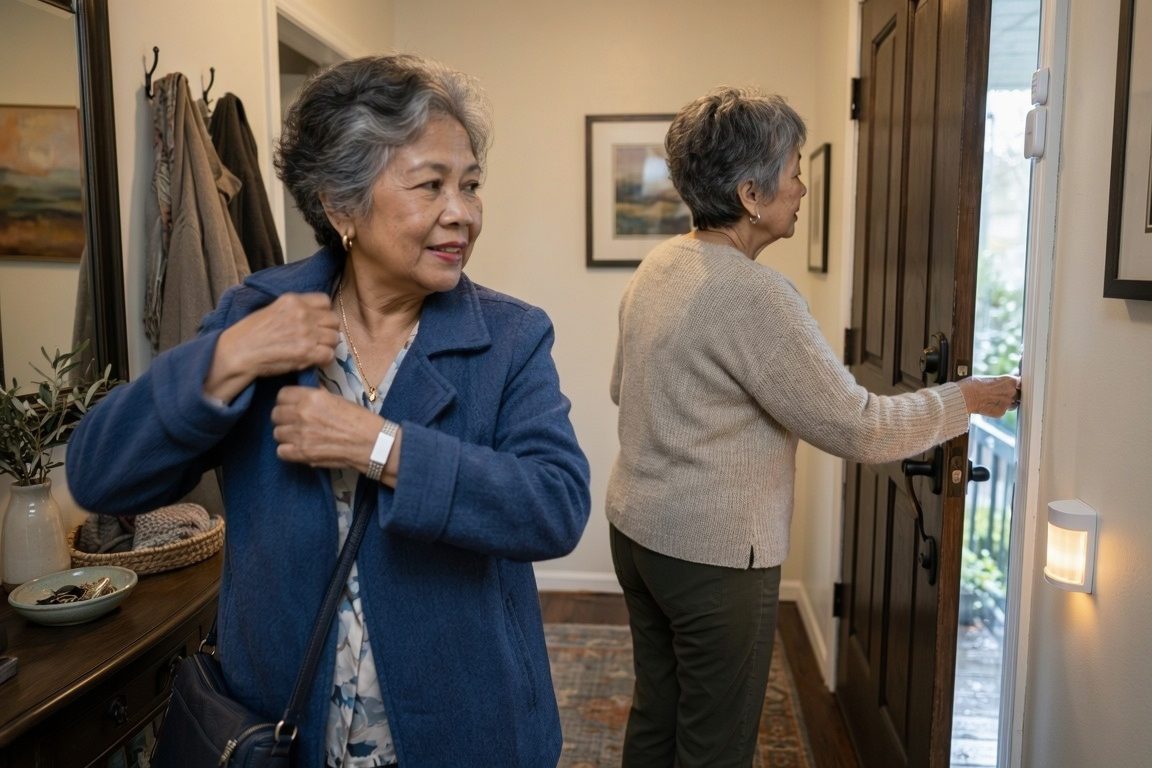
Step by step
What not to do
- Do not rely on a single lock or alarm. If your loved one figures out one lock, they may be out the door before you realize it.Instead, use multiple types of barriers (physical, visual, and auditory) so that even if one fails, another is in place.
- Do not confront or argue with your loved one about why they can't leave. This can cause agitation, fear, and a power struggle.Instead, use simple, calm redirection: 'Oh, let's go see what's in the garden first' or 'I need your help with something in here.' Keep your explanations short and avoid overwhelming them with reasons.
- Do not hide your safety measures in a way that feels deceitful. If your loved one discovers a hidden lock or a camera, they may feel tricked or paranoid.Instead, install things openly and explain them simply: 'This is to help us both feel safe' or 'This is so I know when you're heading out.' Honesty, even if simplified, preserves trust.
- Do not forget to address the underlying needs behind wandering. If your loved one is wandering because they need to use the bathroom, are in pain, or are bored, no amount of locks will solve the problem. Always check for physical needs first, offer a bathroom break, a snack, or a comforting activity. This layer of care can prevent wandering before it starts.
- Do not assume that once you've set up safety measures, you're done. As dementia progresses, your loved one's abilities change. What worked last month may not work today. Reassess every few weeks: Are they still confused by the stop sign? Have they figured out the door knob cover? Adjust your layers accordingly.
Key points
- Redundancy means using multiple, overlapping safety measures so that if one fails, another catches.
- Start with physical barriers (locks, alarms), then add visual cues (stop signs, stickers), then community layers (neighbors, police).
- Always address the underlying needs behind wandering, pain, boredom, bathroom, before adding more locks.
- Reassess safety layers every few weeks as dementia progresses; what works today may not work tomorrow.
- Involve your loved one in safety decisions when possible to preserve trust and reduce agitation.
- You are not alone: use community resources, neighbors, and local programs to build a safety net.
Videos
 5 Cheap Safety Devices for At-Home Alzheimer's Dementia CareThis video shows affordable, practical devices that can be used as layers of protection, including door alarms and pressure mats.
 How Do I Keep Someone From Touching Everything? A Teepa Snow and PAC Team Discussion.Teepa Snow offers insights on using environmental cues and redirection to manage wandering and unsafe behaviors without confrontation.
 Amy Shaw, PA-C Founder of Better DementiaAmy Shaw discusses practical strategies for home safety, including the importance of layering protections and involving the care team.
Background
Why Redundancy Matters in Dementia Care
Dementia affects a person's judgment, problem-solving, and memory in unpredictable ways. What worked yesterday, like a simple lock on the front door, might not work today because your loved one's brain is processing information differently. They might suddenly figure out a lock, or forget why they wanted to leave, or become agitated by a single barrier. That's why relying on just one safety measure is risky. As one expert explains, you need to 'make the exit harder' in multiple ways, so that even if your loved one gets past one layer, another is there to slow them down or alert you.
The Goal: Safe Wandering, Not Restriction
The redundancy approach isn't about trapping your loved one inside. It's about creating a safe environment where they can move around without harming themselves or leaving unsupervised. Think of it like childproofing: you don't lock a toddler in a room; you put covers on outlets, gates on stairs, and latches on cabinets. Similarly, for dementia, you layer protections, door alarms, GPS trackers, neighbor awareness, so that if your loved one does wander, they are found quickly and returned safely. This approach respects their need for autonomy while keeping them secure.
How Redundancy Reduces Caregiver Stress
When you have multiple safety layers, you can step away to use the bathroom, answer the door, or prepare a meal without constant worry. As one source notes, the goal is to make it 'less likely that your loved one will injure himself while the caretaker has to use the bathroom or answer a phone call.' Redundancy buys you time and reduces the panic of a sudden escape. It also helps you avoid the guilt of feeling like you're 'locking them in', because you're using gentle, varied strategies that feel less restrictive.
Practical tools
6
The 'Stop Power' Plug Lock
This is a lock that goes over an electrical plug, preventing your loved one from unplugging appliances or using dangerous devices. You plug the appliance into the lock, then lock it with a key. It's useful for things like lamps, fans, or kitchen appliances that could be a hazard. Available online or at hardware stores.
Pressure Mats for Doorways
These are thin mats that you place in front of a door. When stepped on, they trigger a chime or a loud alarm. They are inexpensive and easy to set up. Place one at the front door and one at the back door. This gives you an immediate alert if your loved one is heading out. You can find them at home safety stores or online.
The 'Indie Lift' or Transfer Lift
If your loved one falls and you cannot lift them, a transfer lift (like the Indie Lift) can be a lifesaver. It looks like a dolly: you slide it behind them, secure a belt, and press a button to lift them to standing or chair height. This prevents you from injuring yourself and avoids calling 911 for a simple fall. Discuss with your clinician if this is appropriate for your loved one's stage.
GPS Tracking Watch or Pendant
These devices allow you to track your loved one's location in real time from your phone. Many are designed for dementia patients and have a simple interface. They are a critical backup layer if your loved one manages to leave the house. Look for ones with a long battery life and a comfortable, non-removable band.
The 'Two-Person Lift' Technique
If you have help, use a two-person lift to safely move your loved one in and out of the house or up steps. One person stands on each side, each takes an arm, and they lift together. This is especially useful for getting someone into a car or over a curb. Practice this with a family member or caregiver to avoid injury.
Simple Door Alarms (Magnetic or Chime)
These are small, battery-powered alarms that attach to the door and frame. When the door opens, they sound a chime or a loud alarm. They are cheap and easy to install. Place them on all exterior doors, including the garage door. This layer alerts you immediately, giving you time to redirect your loved one.
Different situations
Lewy Body Dementia or Parkinson's Dementia
These conditions often involve visual hallucinations and fluctuating cognition. Avoid using visual cues like stop signs or stickers that might be misinterpreted as part of a hallucination. Instead, rely more on physical barriers (locks, alarms) and routines. Also, be aware that these individuals may have more difficulty with balance, so focus on fall prevention (clear paths, grab bars) as a key layer.
Late-Stage Dementia (Bedridden or Very Limited Mobility)
Wandering is less of a concern, but falls from bed or chairs are a risk. Use bed alarms or pressure mats to alert you if they try to get up. Focus on layers that prevent injury: padded bed rails, low beds, and non-slip flooring. Also, ensure that identification is still on them (medical bracelet) in case of a fall outside the home.
Spouse vs. Adult Child Caregiver
Spouses may find it harder to impose safety measures because they feel like they are 'taking away freedom' from their partner. It can help to frame it as 'we both need this to stay safe together.' Adult children may need to be more assertive, but should still involve the parent in decisions when possible. Both should remember that safety is a form of love, not control.
Living in a Facility (Assisted Living or Memory Care)
Even in a facility, you can add layers. Ask staff about their wandering prevention protocols. You can still use a GPS tracker on your loved one, and ensure they have identification. Work with the facility to create a safe wandering path (e.g., a circular hallway) and to have a consistent routine. Your role shifts to monitoring and advocating for additional safety measures.
Medicaid or Low-Income Household
Many safety devices are inexpensive. Use DIY solutions: a wooden dowel in a sliding door track, a simple hook-and-eye lock at the top of the door, or a bell tied to the door handle. Check with your local Area Agency on Aging or Alzheimer's Association for free or low-cost safety equipment. You don't need expensive gadgets to create effective layers.
For the doctor
4
- Ask your loved one's doctor: 'Given their current stage, what are the most common safety risks we should prepare for?' This helps you prioritize which layers to add first.
- If your loved one has a history of falls, ask: 'Would a transfer lift or a bed alarm be appropriate for our home setup?' This ensures you use the right equipment safely.
- If your loved one is still driving, ask: 'How do we assess when it's time to stop driving, and what alternatives can we offer?' This is a critical safety layer that requires professional guidance.
- If your loved one is on medications that affect balance or cognition, ask: 'Could any of these medications be contributing to wandering or fall risk?' Adjusting meds might reduce the need for some physical barriers.