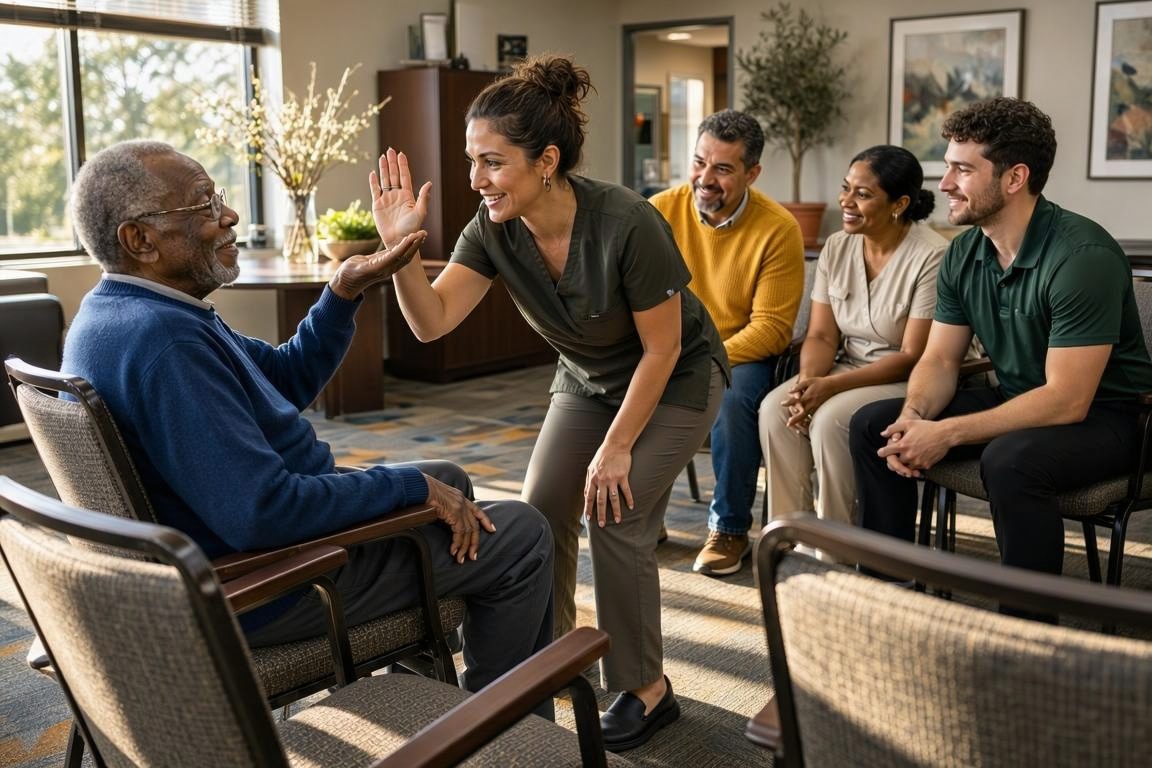
Step by step
What not to do
- Do not try to train everyone at once in a single all-staff meeting. This overwhelms staff, and most will forget the content within days.Instead, use the 'mini university' approach, start with a small group and let the skills spread organically through practice and peer modeling.
- Do not make PAC training a one-time event with no follow-up. Without ongoing practice and reinforcement, staff will revert to old habits.Instead, build in weekly practice sessions, monthly skill spotlights, and regular check-ins to keep the skills alive.
- Do not expect staff to learn by watching a video alone. Passive learning does not change behavior.Instead, combine video watching with hands-on practice and real-time coaching. For example, watch a 2-minute clip of Teepa demonstrating a technique, then have staff pair up and try it on each other.
- Do not punish staff for struggling with new skills. This creates fear and resistance.Instead, normalize mistakes as part of learning. Say, 'It is okay if this feels awkward at first. We are all learning together. Let's try it one more time.'
- Do not assume that only direct care staff need PAC training. Housekeeping, dining, front desk, and maintenance staff also interact with residents. Include them in the training and practice. For example, a housekeeper can use the positive physical approach when entering a resident's room to clean.
- Do not skip the step of getting buy-in from leadership. If the executive director or department heads are not visibly using PAC skills, staff will see it as optional.Instead, have leaders attend the same training and practice alongside everyone else. Let them be the first to share a success story.
Key points
- Start small: train a few champions first, then let the skills spread organically through practice and peer modeling.
- Lead by example: if leaders do not use PAC skills, no one else will. Be the first to practice and share your successes and struggles.
- Make practice regular and low-pressure: weekly 15-minute sessions are more effective than a single all-day workshop.
- Celebrate small wins publicly to build momentum and show that PAC is valued.
- Include all staff, not just direct care , in training and practice.
- Partner with other organizations and use free resources to stretch your budget and build a wider learning community.
Videos
 How Carlton Senior Living Incorporated PAC Training Throughout Their OrganizationThis video shows a real-world example of a senior living organization that successfully rolled out PAC across multiple sites. Watch to see their step-by-step approach, including how they got leadership buy-in and handled challenges.
 Recognizing the Value of Care Planning Paired with Dementia EducationThis video explains how PAC training fits into broader care planning. It is useful for understanding how to connect the skills you are teaching to the actual care plans for residents, making the training more relevant and practical.
 PAC Live @ 5 - Care Partner Perspective: Brenda RobertsBrenda Roberts shares her personal journey of becoming PAC-certified and how she uses the skills in her daily work. This is a great video to show staff as inspiration, it makes the training feel real and achievable.
 The Colorado Older Adults Financial Justice CoalitionWhile not directly about PAC, this video highlights the importance of building coalitions and partnerships across organizations. Use it as a model for how to connect with other agencies in your area to support your PAC rollout.
Background
Why a Full Rollout Matters, and Why It Feels Hard
When you decide to bring Positive Approach to Care into your senior living community, you are not just adding a new training module. You are shifting the entire culture of how your team interacts with residents living with dementia. The challenge is that staff come from different backgrounds, have different comfort levels with change, and may already feel overwhelmed by their daily duties. Without a structured rollout, the training can feel like just another checkbox, something staff attend but quickly forget.
The key insight from organizations that have succeeded is that PAC is not something you teach once and expect to stick. It becomes part of who you are as a team. As one care partner who earned multiple PAC certifications put it, 'If I teach something, I learn it.' That is the heart of the rollout: you are not just delivering information; you are creating a community of learners who practice together, make mistakes together, and grow together. The goal is to make PAC skills so embedded that they become second nature , like a reflex when a resident is struggling.
The Power of Leading by Example and Building a Learning Community
One of the most effective ways to roll out PAC is to start with yourself and a small group of champions. As Teepa Snow emphasizes, you have to 'lead by example.' If managers and supervisors are not practicing the techniques in their own interactions, with residents, with staff, with families , then no amount of training will convince the rest of the team to adopt them. Staff watch what their leaders do far more than they listen to what they say.
From there, you create a 'mini university' within your organization. This might look like a weekly 'PAC Tuesday' or 'Teepa Thursday' where a small group gathers to practice one specific skill , like the hand-under-hand technique or a particular way of offering choices. Over time, this group becomes your internal experts. They can model the skills for others, answer questions in the moment, and help new hires get up to speed. The goal is to make learning PAC a continuous, social process rather than a one-and-done event.
Practical tools
5
The 'PAC Practice Tuesday' Template
A simple 15-minute agenda for a weekly practice session:
Print this template and post it in the break room.
The 'PAC Skill of the Month' Poster
Create a simple poster with these elements:
Post it in the break room, by the time clock, and in the staff bathroom.
The 'PAC Buddy' Checklist for New Hires
A one-page checklist for the buddy to use during the first two weeks:
This turns onboarding into a PAC learning experience.
The 'PAC Success Story' Form
A simple half-sheet form that staff can fill out in 2 minutes:
Collect these forms weekly and read one aloud at a staff meeting. This builds a culture of sharing and celebration.
The 'PAC Quick Reference' Card
A laminated card that fits in a pocket, with 5 key skills:
Give one to every staff member. Encourage them to pull it out when they feel stuck.
Different situations
For a large organization with multiple buildings or campuses
Start with one pilot building. Train a core team there first, let them practice for 2-3 months, and document what worked. Then use that team to train the next building. This prevents spreading too thin and allows you to refine your approach based on real feedback. Also, create a 'PAC coordinator' role at each site to ensure consistency.
For an organization with high staff turnover or many part-time staff
Focus on making PAC part of the very first orientation. Create a 30-minute 'PAC Basics' module that every new hire completes before they ever interact with a resident. Use the buddy system (see tools) for the first two weeks. For part-time staff who may miss weekly practice sessions, offer a monthly 'catch-up' session or a short video they can watch on their own time.
For an organization serving residents with different dementia types (e.g., Alzheimer's, Lewy body, frontotemporal)
Tailor the PAC skills to the specific challenges of each type. For example, for Lewy body dementia, emphasize the 'slow down' approach and avoiding visual clutter. For frontotemporal dementia, focus on redirecting with a concrete task rather than relying on emotional validation. Include a brief module in your training that covers these differences, and encourage staff to ask, 'What type of dementia does this resident have?' as part of their care planning.
For an organization with limited budget for external training
Leverage free resources: Teepa Snow's free videos on YouTube and social media (Facebook, Instagram) are a great starting point. Have your PAC champions watch these together and discuss. You can also partner with a local Area Agency on Aging or Alzheimer's Association chapter, they may offer free or low-cost PAC workshops. Consider applying for a grant from a community foundation to fund certification for a few key staff.
For an organization that has tried training before and it did not stick
Acknowledge the past openly with staff: 'We know we have tried training before and it did not last. This time, we are doing it differently.' Then, focus heavily on the 'lead by example' step. Have leadership visibly use PAC skills every day for a month before asking staff to do the same. Start with just one skill, like the positive physical approach , and master it before adding more. Celebrate every small success publicly.
For the doctor
3
- If a resident has a history of falls or physical aggression, discuss with the clinical team how PAC techniques like the positive physical approach should be adapted for safety. For example, approaching from the front may need to be modified if the resident has a known trigger for certain movements.
- If a resident is on medications that affect their cognition or movement (e.g., antipsychotics, sedatives), talk with the prescribing clinician about how these might interact with PAC strategies. For instance, a resident on a sedative may need even slower approaches and more time to respond.
- If a resident has a known history of trauma (e.g., PTSD from military service or abuse), discuss with a social worker or psychologist how to adapt PAC techniques to avoid triggering. For example, the hand-under-hand technique may need to be introduced very slowly, or with verbal permission first.