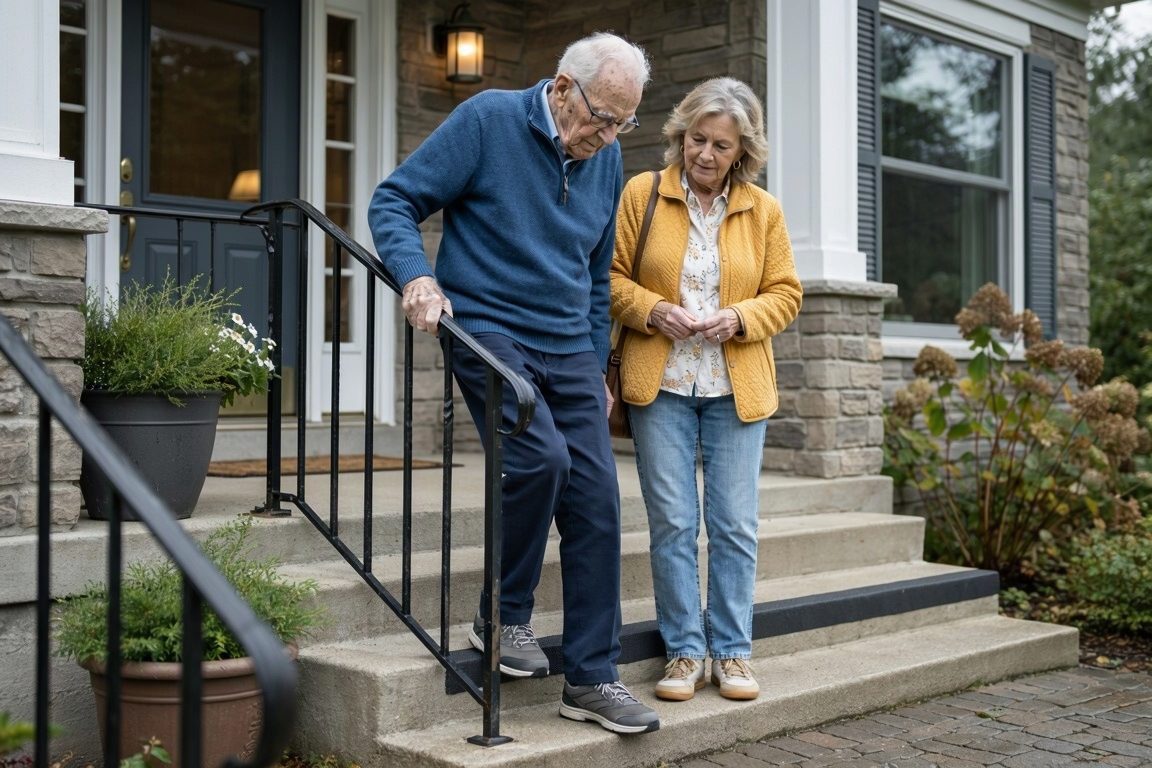
Step by step
What not to do
- Do not paint everything the same color. A monochromatic room (all white, all beige) is invisible to someone with depth-perception loss. They cannot tell where the wall ends and the floor begins.Instead, use high contrast between walls, floors, and fixtures.
- Do not rearrange furniture frequently. People with dementia rely on visual landmarks. Moving a chair or table can create confusion and increase fall risk. Keep the layout consistent.
- Do not use glossy or reflective floors. Shiny surfaces can look wet or like a mirror, causing hesitation or missteps. Use matte finishes on floors and avoid large mirrors that can create confusing reflections.
- Do not assume the person can see obstacles you see. If you point and say, 'The toilet is right there,' they may not see it.Instead, guide them physically: take their hand and place it on the grab bar or the toilet seat, and say, 'Here it is.'
- Do not rush them. Hurrying increases anxiety and reduces the brain’s ability to process visual information. Allow extra time for every transition: getting up, walking, sitting down. Use a calm, slow pace yourself.
- Do not ignore signs of a fall. If you see new bruises, a limp, or sudden confusion, check for a fall. The person may not remember or tell you. Look for hand or arm bruises (from trying to catch themselves), head bumps, or a change in walking pattern.
Key points
- Depth-perception loss makes the world look flat and narrow, like looking through binoculars. The person cannot judge distances or see changes in level.
- Use high-contrast colors everywhere: on steps, toilet seats, grab bars, and furniture edges. This is the single most effective intervention.
- Remove all area rugs and clutter from walkways. They are invisible trip hazards.
- Improve lighting to eliminate shadows, which can look like holes or steps.
- Keep everyday items within easy reach to prevent bending or reaching.
- Slow down transitions and use physical guidance, not just verbal cues.
- Do not assume the person can see what you see. Guide them with touch and simple words.
- Falls are a leading cause of hospitalization in dementia. Prevention is possible and worth the effort.
Videos
 What is Orthostatic Light Headedness?Explains how blood pressure changes when standing can cause dizziness, compounding depth-perception issues. Use the pause-before-walking strategy.
 Quick Tips: Fall Prevention Tips for SeniorsOffers simple, visual tips for home safety that are easy to implement immediately.
 Home Safety and Dementia: Module 1Walks through a home room by room, showing specific hazards and how to fix them for someone with dementia.
 7 Reasons People With Dementia Fall (and how to help)Directly addresses depth-perception loss as a cause of falls and gives practical caregiver strategies.
2 more videos
 Steady Steps: Practical Strategies for Managing Falls in DementiaProvides a comprehensive overview of fall prevention, including environmental and physical strategies.
 Caregiver Training: Refusal to BatheBathroom falls are common. This video offers techniques to reduce resistance and improve safety during bathing.
Background
What Is Happening with Their Vision?
In dementia, the brain’s ability to combine images from both eyes into a single, three-dimensional picture breaks down. Instead of seeing depth and distance, the person may see the world as if through a pair of binoculars, narrow, flat, and without clear separation between objects. This is not a problem with the eyes themselves; it is a problem with how the brain interprets what the eyes see. As one expert explains, by mid-stage dementia, a person’s usable visual field shrinks to about 12 inches in diameter, and the brain may eventually stop using input from one eye entirely, creating true monocular vision. This means that judging where a step ends, where a chair is, or how far away the toilet seat is becomes extremely difficult. The person may appear hesitant, reach out for walls, or miss the edge of a seat when sitting down. This is a direct result of brain damage, not a lack of effort or attention.
Why Does This Increase Fall Risk?
Without depth perception, every change in surface level becomes a potential hazard. A step up into a room, a rug edge, a threshold, or even a change in flooring color can look like a drop or a wall. The person may freeze, step too high or too low, and lose balance. Additionally, because their field of vision is narrowed, they cannot scan the room for obstacles. They may not see a chair leg, a pet, or a toy until they are right on top of it. This is compounded by the fact that the brain’s motor cortex and balance centers are also damaged, making it harder to recover from a misstep. Falls are not random; they are a predictable outcome of these combined changes. But you can intervene by designing the environment to make depth and distance obvious, and by using cues that help the person’s remaining vision work effectively.
Practical tools
6
Contrast Tape Kit
Buy rolls of high-contrast tape (yellow, red, or black) from a hardware store. Use it to mark the edges of steps, the front of toilet seats, the edges of furniture, and door thresholds. Apply it in a straight line for best visibility.
Motion-Sensor Nightlights
Place these in the bedroom, bathroom, and hallway. They turn on automatically when the person gets up at night, providing immediate light without fumbling for a switch. Choose warm, soft light to avoid glare.
Grab Bars with Color Contrast
Install grab bars that are a different color from the wall. For example, a white bar on a dark wall, or a dark bar on a light wall. This makes the bar visible and easy to grasp. Have a professional install them securely into studs.
Non-Slip Shoes with Good Fit
Look for shoes with rubber soles, a closed back, and a snug fit. Avoid slip-ons, high heels, or shoes with smooth leather soles. Brands like Skechers, New Balance, or orthopedic shoes work well. If the person refuses shoes, try non-slip socks with rubber grips on the bottom.
Visual Cue Phrases to Say
When guiding the person, use simple, concrete language. Instead of 'Watch your step,' say: 'There is a step here. I will put my hand on your back. Lift your foot high.' Instead of 'Sit down,' say: 'The chair is right behind you. I will guide you to it. Feel the seat with the back of your legs.'
Clear Floor Path Checklist
Different situations
Lewy body dementia (LBD) or Parkinson’s disease dementia
These conditions often involve more severe visual hallucinations and fluctuations in vision. The person may see things that are not there, which can cause them to step away or trip. Use the same contrast and lighting strategies, but also reduce visual clutter and avoid patterns that could be misinterpreted (e.g., busy wallpaper). If hallucinations are frequent, discuss with a clinician whether medication adjustments are needed. The person may also have more severe balance issues, so use a walker or cane if prescribed, and ensure the walker has contrasting color tips.
Late-stage dementia
In late stages, the person may have very limited mobility and may be bedbound or use a wheelchair. Focus on preventing falls during transfers: use a transfer belt, ensure the bed is at the right height, and use a slide sheet. The person may not be able to follow verbal cues, so rely on physical guidance and environmental safety. Remove all clutter from the floor around the bed and chair. Use a bed alarm if the person tries to get up unsupervised.
Spouse vs. adult child caregiver
A spouse may be more likely to downplay the fall risk or feel they can 'catch' the person. It is important to accept that you cannot prevent every fall by being faster. Instead, invest in environmental modifications. An adult child may feel guilt about making changes to the parent’s home. Frame changes as safety upgrades, not as taking away independence. Say, 'This will help you stay in your home longer and safer.'
Living in a facility (assisted living or nursing home)
Advocate for the same modifications in the person’s room and bathroom. Ask staff to use contrasting colors on the toilet seat and floor. Ensure the room is well-lit at night. Provide non-slip shoes and ask staff to help the person wear them. If the person wanders, ask for a low bed and a floor mat to cushion a fall. Report any falls immediately and ask for a fall risk assessment.
Medicaid or limited budget
You do not need expensive products. Use painter’s tape for contrast marking. Use a nightlight from a dollar store. Use a sturdy chair as a grab bar substitute (place it next to the toilet). Ask local Area Agency on Aging for a home safety assessment, many offer free or low-cost grab bar installation. Use a walking stick or a sturdy umbrella as a temporary balance aid.
For the doctor
5
- Ask the doctor if the person’s vision loss is due to dementia or a separate eye condition (e.g., cataracts, glaucoma) that might be treatable.
- Discuss whether any current medications could be causing dizziness or affecting balance, and if any can be adjusted.
- Ask about a referral to an occupational therapist for a home safety assessment and personalized fall prevention strategies.
- If the person has had a fall, ask the doctor to evaluate for hidden injuries (e.g., hip fracture, head injury) even if they seem fine.
- Discuss whether a walking aid (cane, walker) is appropriate, and if so, what type is safest given the depth-perception loss.