Step by step
What not to do
- Don't rely on a brief office screen (Mini-Mental State Exam, Mini-Cog) alone, it can miss subtle changes, and a normal result does not rule out a problem.
- Don't dismiss significant changes as 'just normal aging'; treatable conditions such as depression, medication side effects, and vitamin deficiencies can mimic dementia, and early diagnosis improves outcomes.
- Don't spring the evaluation on your loved one without preparation; use gentle framing.
- Don't overlook medications as a cause; anticholinergic drugs (some bladder medications, antihistamines, antidepressants), benzodiazepines, and sleep aids can mimic dementia, bring a full list of prescriptions, OTCs, and supplements.
- Don't try to help, coach, or give hints to your loved one during the testing, it invalidates the results.
- Don't call the office repeatedly for results; instead ask the referring doctor's office up front when to expect follow-up.
- Don't expect a diagnosis in a single visit, scoring and interpretation take time, and that thoroughness ensures accuracy.
Key points
- A neuropsychological evaluation is a deep, hours-long assessment of memory, language, problem-solving, attention, and processing speed, far more detailed than a quick office screen.
- The hands-on tests are administered and scored by a psychometrist; the neuropsychologist interprets the full picture, and the final report takes weeks to complete.
- It can differentiate Alzheimer's, vascular dementia, Lewy body dementia, depression, and reversible causes with high accuracy (nearly 90% for Alzheimer's vs. nondementia).
- The evaluation provides a baseline to track changes over time, guides treatment decisions, and documents cognitive status for safety and legal planning (driving, finances, guardianship).
- Prepare your loved one emotionally as a way to get help, not a test to pass; bring glasses, hearing aids, snacks, medications, and your list of concerns, and do not coach them beforehand.
- Use the detailed report to build a care plan with your medical team, and do not ignore your own health as a caregiver, ask for respite and support.
Videos
 Why Getting a Dementia Diagnosis Is So Hard (And How to Make It Easier)This video explains the common barriers to getting a diagnosis, including fear, denial, and lack of access, and offers practical strategies to overcome them, which directly supports the steps in this article.
 How Do People Get Tested For Dementia?This video walks through the typical testing process, from primary care screening to specialist referral, giving you a clear roadmap of what to expect.
 4 Most Common Types of Dementia in AgingUnderstanding the different types of dementia helps you interpret the neuropsychological evaluation results and tailor care to your loved one’s specific condition.
 Get Your Aging Parent's Memory EvaluatedThis video offers a caregiver’s perspective on how to initiate the conversation about memory testing with an aging parent, including scripts and tips for reducing resistance.
6 more videos
 Inside a Dementia Clinic: What REALLY Happens? Invited talk by Dr. Khushboo VermaThis video gives an insider’s view of a dementia clinic visit, including the roles of different specialists and what actually happens during a neuropsychological evaluation.
 How to Get Someone Living with Dementia to See a Health Care Professional When They Don't Want to GoThis video provides specific, compassionate techniques for persuading a resistant loved one to attend medical appointments, which is often the hardest part of getting an evaluation.
 Optimal Dementia Care Path: From Early Diagnosis to the Right SupportThis video outlines an ideal care pathway, emphasizing the importance of a thorough assessment, including neuropsychological testing, for proper care planning.
 PCALECTURE with UCSD neurologist Dr. Douglas GalaskoThis lecture from a leading dementia expert provides in-depth clinical context on how neuropsychological testing fits into the diagnostic workup for conditions like Alzheimer's and Lewy body dementia.
 What Are The Behavioral Symptoms Of Vascular Dementia?This video discusses the behavioral and cognitive symptoms specific to vascular dementia, which can be better understood through targeted neuropsychological testing.
 Dementia in the Context of Serious Mental IllnessThis video addresses the unique challenges of diagnosing dementia in people with pre-existing serious mental illness, where neuropsychological testing is especially critical.
Background
Understanding the situation
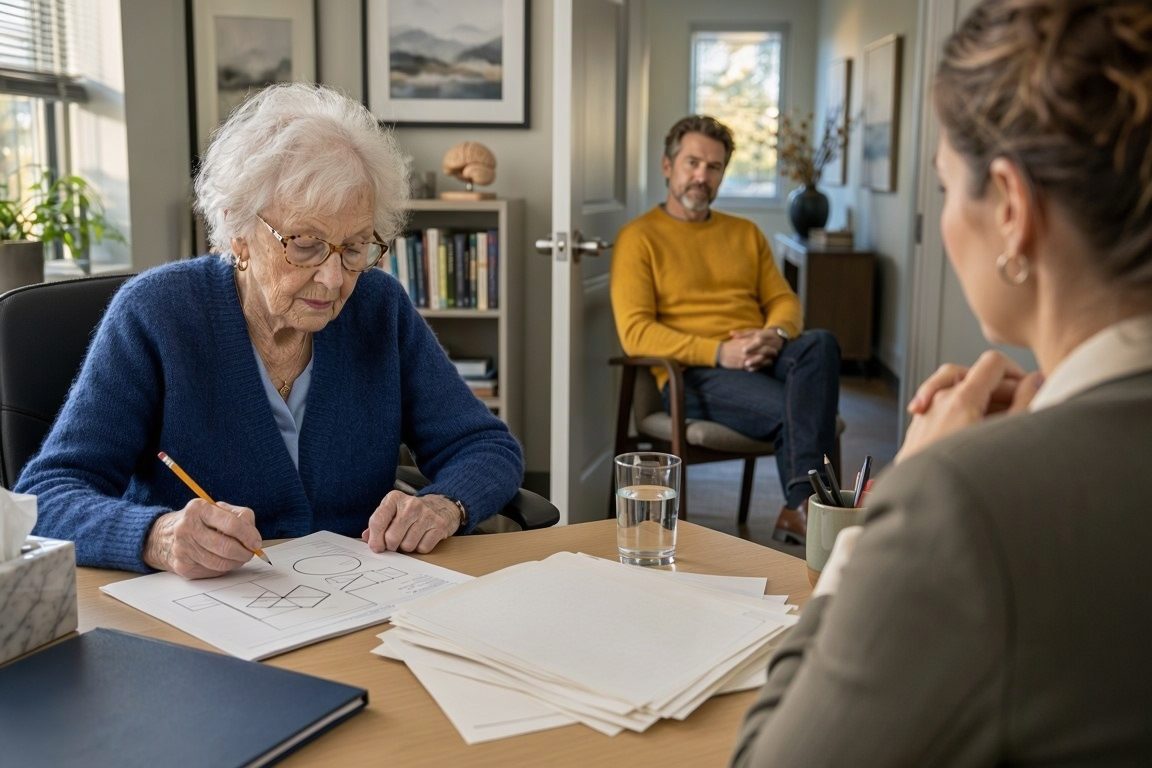
When a family doctor asks your loved one to recall three words or draw a clock, that is a screening, useful as a first step but limited. A neuropsychological evaluation goes much deeper. Over several hours (often split across two or three sessions), the testing measures many cognitive domains: memory, attention, language, visual-spatial skills, executive functions like planning and reasoning, processing speed, and mood. Scores are compared against healthy people of the same age, education, and, when possible, cultural and language background, and that comparison is what gives the evaluation its power to catch subtle changes a brief screen would miss. The pattern of strengths and weaknesses helps differentiate Alzheimer's disease, vascular dementia, Lewy body dementia, and frontotemporal dementia from one another, and from depression or reversible causes such as medication side effects, infections, or vitamin deficiencies (the sources note testing can differentiate Alzheimer dementia from nondementia with nearly 90% accuracy). Importantly, the hands-on tests are usually administered and scored by a specially trained professional called a psychometrist (psychometrician) following strict standardized procedures; the neuropsychologist then interprets those scores together with the medical history, brain imaging, a clinical interview, and your caregiver observations. This is why results are never given the same day, scoring, comparison to normative data, and report-writing take time, and that thoroughness is what makes the conclusions accurate.
Practical tools
6
Symptom Observation Log
Before the appointment, write down specific, concrete changes
with dates and examples. Share it with the primary care doctor and bring it to the neuropsychologist.
Caregiver Interview Notes
Prepare concrete real-life examples of changes in memory, problem-solving, behavior, and personality to share during the separate caregiver interview. The neuropsychologist relies on this firsthand picture of how your loved one functions at home.
Day-of Evaluation Checklist
Pack
Complete Medication List Template
List every prescription drug, over-the-counter medicine, and supplement with dosages and prescribing doctors. This helps identify anticholinergic or other cognition-impairing medications that can mimic or worsen symptoms.
Feedback Session Question List
Bring a notebook and a trusted family member. Ask: 'What are the main cognitive strengths and weaknesses?', 'What is the most likely diagnosis?', 'What does this mean for daily life?', 'What treatments or supports are recommended?', plus questions about driving safety, finances, daily routines, the need for a neurologist, and eligibility for clinical trials.
Expected-Timeline Question (instead of calling for results)
At or before the testing session, ask the referring doctor's office exactly when the report will be ready and when the feedback appointment will be. This sets expectations so you don't call repeatedly chasing results that take weeks to finalize.
Different situations
Early-stage Alzheimer's disease: Expect significant memory impairment for recent events with relatively preserved language and social skills early on. Use results to establish a baseline, plan driving safety, and discuss cholinesterase inhibitors with the clinician. Build a daily routine with memory aids (whiteboards, labeled drawers, consistent schedule) and decide when to start in-home help.
Vascular dementia: The profile is often patchy, with more difficulty in executive function (planning, organizing, problem-solving) and processing speed, while memory may be less affected. Focus on managing cardiovascular risk factors (blood pressure, cholesterol, diabetes, smoking), discuss whether heart medications are needed, and prioritize fall prevention and supervision during complex tasks like cooking or finances.
Lewy body dementia: Look for fluctuating attention, visual hallucinations, daytime sleepiness, and movement problems (stiffness, tremor); memory may be relatively better early on. Tell the neuropsychologist about hallucinations, sleep issues (acting out dreams), and movement changes. Sessions may need to be shorter or split across two days due to fatigue. People with LBD are very sensitive to antipsychotics, discuss any medication changes carefully with the clinician.
Depression or anxiety mimicking dementia: Depression typically causes slow thinking, poor concentration, and low motivation, but memory is usually intact when the person is engaged, a different pattern from dementia. If depression is primary, therapy and/or antidepressants (per clinician) can dramatically improve cognition; the evaluation can guide whether to treat depression first.
Late-stage dementia: Full-length testing is often not appropriate or possible because the person may be unable to follow instructions or complete tasks. The evaluation will rely more heavily on the clinical interview with you, the caregiver, and on shorter, focused assessments of basic functioning. The goal shifts from diagnosis to symptom management and care planning.
Adult child caregiver vs. spouse caregiver: An adult child often notices changes a spouse has normalized (unpaid bills, missed appointments) and can describe decline observed from a distance, while a spouse may be more attuned to subtle shifts in personality and daily routine. Both perspectives are valuable; the neuropsychologist will usually want to interview whoever has the most contact with the patient.
Different cultural or language background: Standardized tests may not be valid for people with limited formal education, different primary languages, or different life experiences. Ask the neuropsychologist about experience with cross-cultural assessment, less culturally biased tests, testing in the primary language, or qualified interpreters, advocate for this, as it's essential to an accurate result.
History of serious mental illness (e.g., schizophrenia): Cognitive impairment can be a feature of the mental illness itself, making new dementia hard to distinguish. Bring all psychiatric records and a full list of psychotropic medications, plus a detailed history of onset and course; testing can help determine whether the cognitive decline is a new change or a long-standing stable feature.
Common questions
7
Reframe the day for your loved one: this is not a test you can fail, it's a way to understand how the brain is working so the care team can help.
The psychometrist who runs the hands-on tasks is trained to handle anxiety and frustration; your job is to stay supportive and let them lead the session.
Build in recovery time, plan a quiet, low-demand afternoon after testing and acknowledge how hard your loved one worked.
Both an adult child's and a spouse's observations matter; if more than one family member spends time with the patient, share both perspectives with the neuropsychologist.
Keep the report as a permanent reference for future doctors, legal planning, and to compare against follow-up testing every 6–12 months.
If your loved one is in late-stage dementia, expect the focus to shift away from lengthy testing toward your caregiver interview and care planning.
Take care of yourself too, relief, grief, and anxiety are all normal, and respite or a support group keeps you well enough to keep caregiving.
For the doctor
1
- Confirm all medical and medication questions with your clinician, never adjust medications on your own. Helpful questions include: Based on the results, should we consider a medication such as donepezil (Aricept) or memantine (Namenda), and what are the benefits and side effects for my loved one's specific type of dementia? Are any current medications, especially anticholinergics, benzodiazepines, or sleep aids, causing or worsening cognitive problems, and should they be tapered or switched? Are there risks or downsides to the testing given my loved one's age and health, or any reason to delay it (untreated infection, recent surgery, recent medication change)? How will the results change the treatment plan? How do you account for education, cultural background, and primary language when interpreting scores? Is it safe for my loved one to keep driving, and should we get a formal driving evaluation from an occupational therapist? What are the legal implications, should we update advance directives, power of attorney, or consider guardianship, and can the report support this? Are there clinical trials my loved one might be eligible for? How often should we repeat the evaluation to monitor progression?