Step by step
What not to do
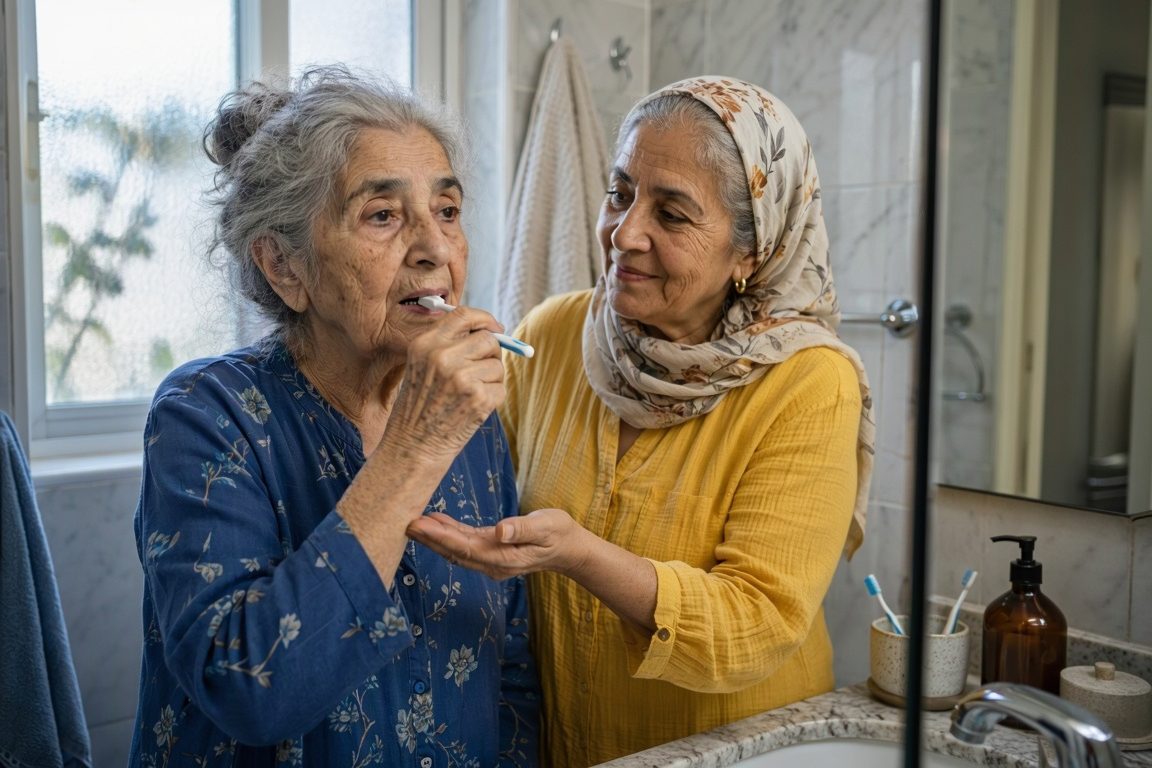
- Do not grab the person's hand from above (hand-over-hand). This triggers a reflex to pull away and makes them feel controlled.Instead, slide your hand under theirs to guide gently.
- Do not try to brush all surfaces at once if the person is overwhelmed. If they only tolerate the front teeth, that is a win. You can try the sides later or at the next session. Forcing all 36–42 steps at once leads to resistance and stress for both of you.
- Do not use a hard-bristled adult toothbrush. It can hurt sensitive gums and increase resistance. A child's soft-bristled brush is smaller, gentler, and easier to maneuver in a small mouth.
- Do not ask 'Do you want to brush your teeth?' if you know they will say no.Instead, make it a non-negotiable part of the routine: 'Time to brush our teeth. Let's do it together.' Use a cheerful, matter-of-fact tone.
- Do not rush or show frustration. If you feel stressed, take a deep breath and try again in 10 minutes. Rushing makes the person feel pressured and less cooperative. Consistency and calmness build trust over time.
- Do not assume that because the person has no teeth, they do not need mouth care. Gums, tongue, and palate still need gentle cleaning to prevent infections and discomfort. Use a soft swab or brush on gums and tongue.
Key points
- Hand-under-hand brushing preserves the person's sense of control and taps into procedural memory, making mouth care less stressful.
- Adjust your approach based on the GEMS state: Sapphire/Diamond need cues; Emerald needs hands-on guidance; Amber/Ruby need swabs or very gentle brushing.
- Never grab the person's hand from above, it triggers a reflex to resist. Always slide your hand under theirs.
- Use a child's soft-bristled toothbrush and non-fluoride toothpaste if swallowing is a concern.
- If the person resists, pause, change location, or try a different time of day. Forcing leads to long-term resistance.
- Consistency in caregiver and routine builds trust and reduces anxiety over time.
Videos
 Oral Hygiene Concerns and Options for GEMS States | Teepa's ClipsTeepa Snow demonstrates how to adjust mouth care for different GEMS states, including hand-under-hand techniques and what to do when a person resists.
 Problem Solving with PACThis video shows real-life problem-solving for mouth care challenges, including how to use hand-under-hand when the person is confused or agitated.
 Teeth Brushing & Dementia || HOW Many STEPS does it Take to Brush YOUR Teeth?A clear explanation of the 36–42 steps involved in brushing teeth, helping caregivers understand why the task is so hard for someone with dementia.
 Oral Care Tips for Loved Ones with DementiaPractical tips for setting up the environment, choosing tools, and using hand-under-hand to make oral care easier and more comfortable.
2 more videos
 Assisting with Activities of Daily Living in Dementia CareCovers a range of ADLs including mouth care, with a focus on preserving independence and using hand-under-hand for brushing.
 Zinnia Caregiver Support - Eating and DementiaWhile focused on eating, this video demonstrates the hand-under-hand technique in action, which can be adapted for mouth care.
Background
Why mouth care becomes so hard in dementia
Brushing teeth is not a simple, single action, it is a complex sequence that requires recognizing the need to brush, gathering supplies, squeezing toothpaste onto a brush, moving the brush through dozens of wrist and hand shifts to clean all surfaces of teeth and tongue, then rinsing and drying. For someone with dementia, the brain's ability to plan, sequence, and execute these steps is progressively damaged. What used to be automatic now feels foreign, and the person may resist because they do not understand what is being asked or feel invaded when someone tries to take over. Hand-under-hand brushing works because it bypasses the damaged parts of the brain and taps into procedural memory, the deep, automatic movements stored in the cerebellum. When you place your hand under theirs and guide the brush together, you are not forcing them; you are reactivating a familiar pattern they have done for decades.
How GEMS states change the approach
The GEMS model (by Teepa Snow) describes dementia progression using gemstone names: Sapphire (early, independent), Diamond (still fairly high-functioning but needing cues), Emerald (moderate, needs more hands-on help), Amber (late, very limited ability), Ruby (end-stage, often bedbound). For mouth care, the key is to match your help to the person's current ability. In Sapphire and Diamond states, you might only need to set out supplies and give verbal reminders. In Emerald, you will likely need to do hand-under-hand brushing for most of the process. In Amber and Ruby, the person may not be able to hold a brush at all, so you will use mouth swabs or a very soft brush with gentle guidance. The goal is always to let them do as much as they can for as long as possible, once you take the brush fully out of their hand and brush for them, they rarely regain that skill.
Why hand-under-hand is different from hand-over-hand
Many caregivers instinctively use hand-over-hand, gripping the person's hand from above to control the brush. But this triggers a reflex: when someone grips the back of your hand, you naturally want to pull away or resist. It feels controlling and uncomfortable. Hand-under-hand, on the other hand, places your hand underneath theirs, so you are supporting and guiding rather than gripping. This feels safer and more collaborative. The person still has a sense of control because their hand is on top, and your gentle pressure from below helps them move the brush to the right spots. It also allows you to feel their movements and adjust your guidance in real time.
Practical tools
6
Hand-under-hand setup phrase
Say: 'I'm going to help you hold the brush. Let's do it together.' Then place your hand under theirs, palm up, and curl your fingers around the handle. This gives them the sensation of holding the brush while you control the movement.
Child's soft-bristled toothbrush with a long handle
A child's brush is smaller, softer, and easier to grip. Look for one with a long, thick handle (or add a foam tube to make it easier to hold). This reduces the number of wrist shifts needed and feels less invasive.
Baking soda toothpaste or non-fluoride paste
If the person tends to swallow toothpaste, switch to a baking-soda-based paste or just water. Fluoride can upset the stomach if swallowed. Always consult their dentist or doctor before changing toothpaste, especially if they have swallowing difficulties.
Mouth swabs (Toothette) for Amber/Ruby states
These are small foam swabs on a stick, pre-moistened or dipped in water. Use them with hand-under-hand: place the person's hand on top of yours as you gently swab gums, cheeks, and any teeth. They are less threatening than a brush and can be used even if the person cannot open wide.
A towel and a bowl for spitting
Place a towel over the person's chest to catch drips. Offer a small bowl for spitting. If they cannot spit, just let the toothpaste foam drip into the bowl or onto the towel. Avoid using the sink if it causes confusion or anxiety.
A consistent routine and same caregiver
Try to have the same person help with mouth care each time. Consistency reduces anxiety. Share notes with other caregivers about what works and what doesn't. If possible, do mouth care at the same time each day (e.g., after breakfast and before bed).
Different situations
Lewy body dementia (LBD) or Parkinson's disease dementia
People with LBD often have fluctuating attention, visual hallucinations, and sensitivity to touch. Use very gentle hand-under-hand guidance, and avoid sudden movements. If they see something scary in the mirror, cover the mirror or move to a different room. Also, they may have trouble with swallowing, use a non-fluoride toothpaste and consult a speech therapist.
Late-stage (Amber/Ruby) dementia
The person may not be able to hold a brush at all. Use mouth swabs or a very soft brush with hand-under-hand, but your hand will do most of the work. Focus on comfort: moisten the swab with water or a non-alcohol mouth rinse. If they resist, try a different time of day or after a meal when they are more relaxed.
Spouse vs. adult child caregiver
A spouse may feel more comfortable being direct and using familiar routines ('Honey, let's brush like we always do'). An adult child may need to be more gentle and avoid a parent-child dynamic. Both should use hand-under-hand to maintain dignity. If the person is resistant to the child, try having the spouse do the care, or use a neutral third party (home health aide).
In a facility (nursing home or assisted living)
Staff may not have time for lengthy hand-under-hand guidance. Advocate for the person by showing staff how to use the technique. Provide a labeled toothbrush and paste, and ask that the same aide helps each time. If the person is bedbound, use a mouth swab and a small basin. Remind staff to never force the brush.
Medicaid or limited resources
You do not need expensive tools. A child's toothbrush costs a few dollars. Use a washcloth instead of a towel. Baking soda mixed with water can serve as toothpaste. If you cannot afford mouth swabs, use a clean, damp washcloth wrapped around your finger (with hand-under-hand) to wipe gums.
For the doctor
4
- If the person has a history of swallowing difficulties or choking, ask their doctor or speech therapist if it is safe to use toothpaste or mouth rinse, and whether a non-fluoride paste is recommended.
- If the person has bleeding gums, sores, or signs of infection (redness, swelling, pus), consult a dentist before continuing any mouth care routine.
- If the person is on blood thinners (e.g., warfarin, apixaban), ask their doctor if gentle gum brushing is safe, as it may cause bleeding.
- If the person has dentures that do not fit well or cause pain, see a dentist for an adjustment before trying to clean them.