Step by step
What not to do
- Do not assume that because they have dementia, they cannot do anything. This leads to doing everything for them, which robs them of purpose.Instead, break tasks into small steps and let them do what they can, even if it’s just holding the spoon while you stir.
- Do not leave the TV on all day as background noise. This can cause overstimulation and increase confusion.Instead, use TV intentionally, for a short, engaging program like Memory Lane TV that is designed for people with dementia, and then turn it off and do something active together.
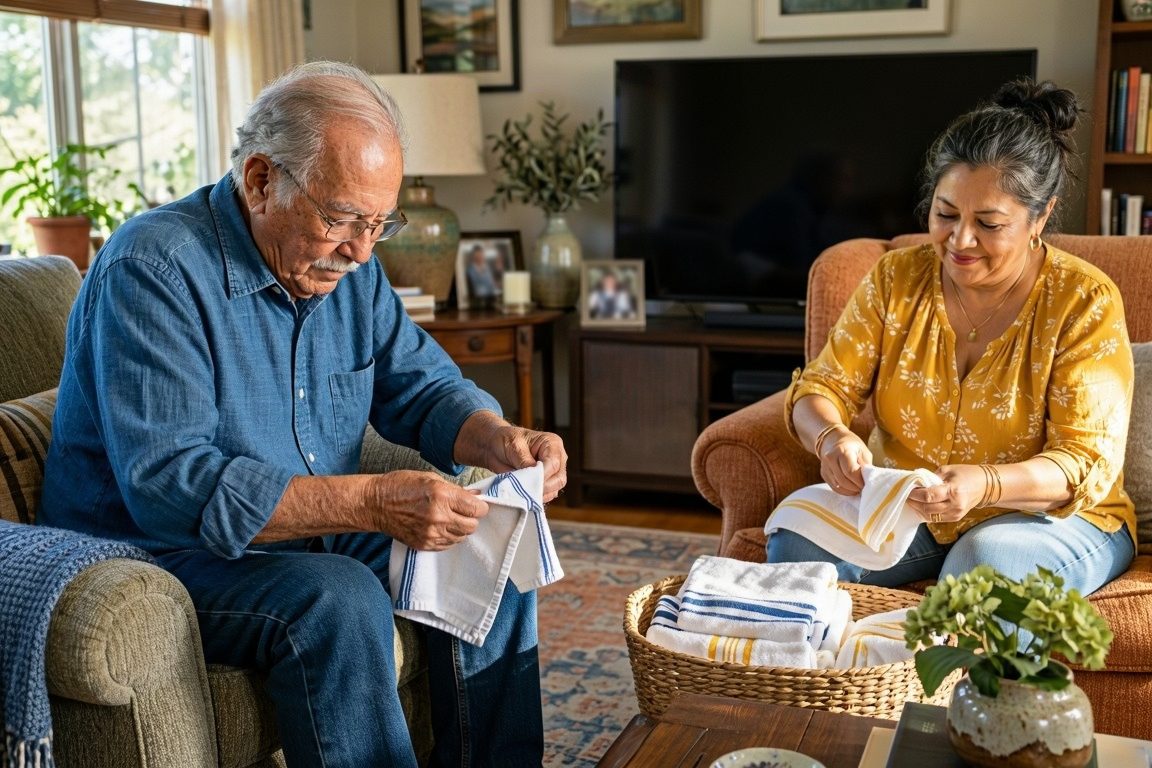
- Do not correct them if they do an activity ‘wrong.’ If they fold a towel into a ball, let it go. The goal is connection, not perfection. Correcting them can make them feel like a failure and cause them to withdraw.
- Do not push an activity if they are not interested. Forcing engagement can lead to agitation or refusal.Instead, try again later with a different approach. The Alzheimer’s Association advises: if something isn’t working, it may be the wrong time of day or the activity may be too complicated.
- Do not use passive entertainment as a substitute for human interaction. A tablet game or a video can be a tool, but it should not replace face-to-face connection. Always pair screen time with conversation or a shared experience.
- Do not forget to celebrate small successes. Even if they only folded one towel, acknowledge it: ‘Thank you, that really helped me.’ This reinforces their sense of value and encourages future engagement.
Key points
- Meaningful engagement requires active participation, the person chooses, does, or contributes, while passive entertainment is something done to them.
- Engagement slows cognitive decline and reduces agitation; passive entertainment can accelerate decline if used excessively.
- Offer two simple choices to give a sense of control without overwhelming the brain.
- Focus on the process, not the finished product. The goal is connection and enjoyment, not completion.
- Use all five senses to deepen engagement, especially in middle and late stages.
- Always join in alongside them, model the behavior and make it a shared experience.
Videos
 Dementia Care Partner Talk Show Podcast: Ep. 88 - How to Engage with Someone in a Meaningful WayTeepa Snow explains the difference between offering an activity and achieving true engagement, with practical examples.
 Dementia Care Partner Talk Show Podcast: Ep. 92 - Engaging in a Meaningful WayContinues the conversation on engagement, emphasizing the person’s active role and how to adapt activities.
 How To Entertain Someone With Dementia At Home?Offers simple, low-cost activities that move beyond passive entertainment, with tips for different stages.
 How to increase activity for someone with dementiaDementia Careblazers provide troubleshooting for why a person might refuse activities and how to adapt.
2 more videos
 Dementia Care Partner Talk Show Podcast: Ep. 89 - The Importance of Activities in EngagementExplores why activities are not just ‘busy work’ but essential for emotional and cognitive health.
 How Do You Keep A Dementia Person Busy?Answers About Alzheimer’s shares the art of redirecting to an activity and why finishing is not the goal.
Background
What Is Meaningful Engagement?
Meaningful engagement means the person with dementia is actively participating, choosing, doing, or contributing, rather than just receiving. As Teepa Snow explains, engagement is not the same as an activity: an activity is something you offer, but engagement is what the person chooses to do with that offering. When they hold the banjo, sing along, or decide which song to play, they are engaged. When they simply listen, they are being entertained. The key is that engagement gives the person a role, a sense of control, and a feeling of being valued.
Why Passive Entertainment Often Falls Short
Passive entertainment, like watching television, scrolling through a tablet, or sitting in a room with music playing, can be calming for short periods, but it does not meet the deep human need to feel useful and connected. According to the Dementia Careblazers, people with dementia still need to feel productive, to contribute to their family or community, and to have a sense of purpose. When they are only passively entertained, that need goes unmet. Over time, this can lead to increased apathy, restlessness, or even agitation, especially in the late afternoon. The Alzheimer’s Association notes that activities that allow self-expression, like painting, music, or conversation, are far more beneficial than those that simply fill time.
The Brain Science Behind Active Participation
When a person with dementia engages in a task that uses their remaining abilities, like sorting socks, stirring a pot, or choosing between two shirts, they are activating neural pathways that support memory, coordination, and emotional regulation. The Dementia Success Path emphasizes that meaningful activities are those that make the person feel productive, even if the task is simple. This kind of engagement can slow functional decline and reduce behaviors like wandering or agitation. In contrast, passive entertainment does not challenge the brain in the same way and can actually accelerate the progression of dementia, as noted by All Home Care Matters: when you don’t engage someone, their dementia progresses faster.
Practical tools
6
The Two-Choice Script
Use this exact phrasing to offer a choice without overwhelming: ‘Would you like to [option A] or [option B]?’ Keep options simple and concrete. For example: ‘Would you like to water the plants or wipe the table?’ or ‘Would you like to listen to music or look at photos?’ This gives the person a sense of control and invites active participation.
The ‘Watch Me, Then You Try’ Method
When introducing a new activity, demonstrate it first while narrating what you are doing. For example: ‘Watch me: I’m going to put this puzzle piece here. See how it fits? Now you try.’ Then hand them the piece. This reduces anxiety and makes the task feel achievable.
The Sensory Engagement Checklist
Before starting an activity, ask yourself: Does this involve
For example, baking involves smell, touch, and taste; gardening involves touch and sight; folding laundry involves touch and smell. Aim to engage at least two senses for deeper connection.
The ‘One-Step-at-a-Time’ Setup
Prepare the activity so that only one step is visible at a time. For example, if you are making a simple snack, place the bread on the counter, then the peanut butter, then the knife. Do not put everything out at once, which can overwhelm. Guide them through each step verbally.
The ‘Pause and Reflect’ Log
Keep a small notebook or a note on your phone. After each engagement, jot down: date, activity, how they responded (e.g., smiled, participated for 10 minutes, became restless), and what you might try next. Over time, you will see patterns that help you choose the best activities for their current stage.
Memory Lane TV or Similar Purpose-Built Content
Memory Lane TV is a non-pharmacologic digital intervention designed for people with dementia. It uses multi-sensory stimulation, videos, music, sounds, and aromas, to create immersion without requiring a plot to follow. It can be used alone or with a caregiver, and it is designed to reduce anxiety and agitation. Use it as a tool for engagement, not as a babysitter.
Different situations
Early-stage dementia (mild cognitive impairment)
In early stages, the person can still participate in many of their previous hobbies with minor adaptations. For example, if they loved golf, they may need help scheduling or someone to drive the cart, but they can still swing the club. Focus on maintaining their existing skills and interests, and offer choices that feel familiar. Avoid passive entertainment entirely, they are still capable of deep engagement and may become bored or depressed if not challenged.
Middle-stage dementia (moderate)
At this stage, break activities into very small steps. For example, instead of baking a whole cake, have them stir the batter or sprinkle the topping. Use sensory-rich activities like sorting fabric squares, folding towels, or watering plants. Avoid activities that require sequencing or planning. The person may need more verbal cues and demonstration. Passive entertainment can be used sparingly for calming, but always pair it with interaction.
Late-stage dementia (severe)
In late stages, engagement may be non-verbal. Focus on sensory experiences: gentle hand massage with scented lotion, listening to familiar music, or looking at a photo album together. The goal is comfort and connection, not task completion. Even if they cannot respond verbally, they may show engagement through eye contact, a smile, or relaxed body language. Passive entertainment may be the only option at times, but even then, sit with them and talk about what you are seeing or hearing.
Lewy body dementia or Parkinson’s dementia
These conditions often involve movement difficulties, visual hallucinations, and fluctuating alertness. Avoid activities that require fine motor control or quick reactions. Use large, easy-to-grip objects (e.g., large-handled utensils, soft balls). Be prepared to stop abruptly if they become confused or frightened. Passive entertainment may be more useful here because it does not require motor planning, but still try to engage them with conversation or music that matches their mood.
Spouse vs. adult child caregiver
Spouses may find it harder to shift from a partner role to a caregiver role. They may feel guilty asking their loved one to ‘work’ (e.g., fold laundry). Remind them that engagement is not a chore, it is a gift of connection. Adult children may need to let go of the idea that their parent ‘should’ be able to do things the way they used to. Both roles benefit from using the ‘two-choice’ tool and focusing on the process, not the outcome.
For the doctor
4
- If your loved one shows sudden agitation or aggression during an activity, discuss with a doctor whether there may be an underlying medical cause (e.g., pain, infection, medication side effect).
- If you are considering using any new digital tool or app for engagement, ask the clinician if it is appropriate for your loved one’s specific stage and sensory needs.
- If your loved one has a history of falls, ask the clinician which physical activities are safe to try (e.g., chair yoga vs. walking).
- If you notice that your loved one is consistently refusing all engagement and seems withdrawn, discuss with a clinician whether depression or another condition might be contributing.