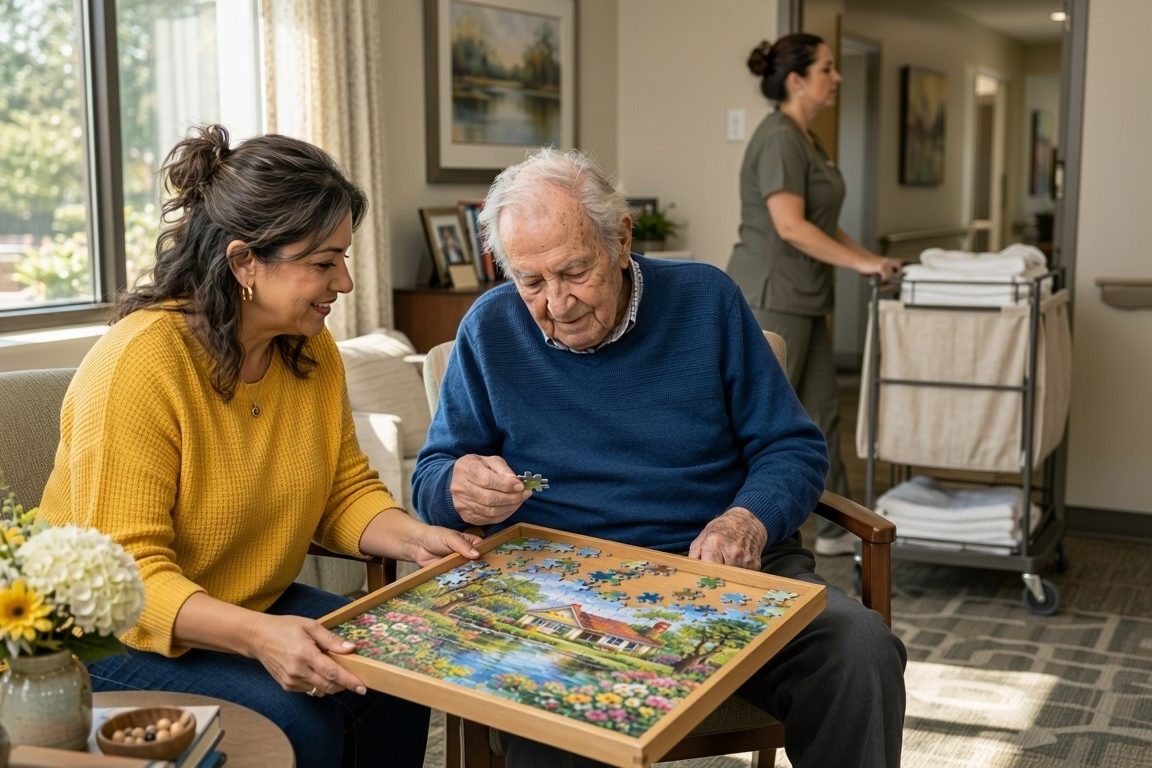
Step by step
What not to do
- Don't take over tasks staff are trained to handle, this confuses your loved one and strains relationships. Your role is connection, not doing.
- Don't correct your loved one when they get facts wrong.Instead, say 'I'm here with you' and gently redirect.
- Don't isolate yourself. Guilt often makes caregivers withdraw, but isolation deepens burnout. Reach out to a support group, friend, or therapist.
- Don't compare your journey to others. Every dementia progression is different; focus on what works for the two of you.
Key points
- Shift from 'doing for' to 'doing with' your loved one; this honors their dignity and reduces resistance.
- Let go of guilt by acknowledging you did your best in the home setting; your new role is equally valuable.
- Use the 'partnership phrase' card to invite collaboration, not command.
- Build a micro team of support for yourself; you cannot do this alone.
- Practice the visualization exercise daily to shape your care partner identity.
- Focus on presence over perfection; your loved one needs you emotionally available, not perfect.
Videos
 Unlocking Your Best Caregiver Self: 3 StepsThis video directly addresses the mindset shift from caregiver to care partner, offering a simple three-step visualization to help you become the person you want to be in this role.
 New Dementia Caregiver? Watch This!Dr. Camille Sinclair provides essential tips for new caregivers, including the importance of stopping the 'fixing' mindset and starting to support the changing brain.
 Ep. 266: When Helping Doesn't HelpThis episode explores the pitfalls of over-helping and how to shift to a partnership model, which is central to the care partner mindset.
 Connecting with the CaregiverThis video focuses on building trust and connection, which are foundational to a successful care partner relationship.
2 more videos
 "Real Talk with Real Caregivers" The Financial Impact Before, During, and After CaregivingUnderstanding the financial realities of caregiving can reduce guilt and help you make practical decisions about your role, including when to delegate tasks.
 When a Grandparent Moves InWhile focused on moving in, this video offers insights on easing transitions and building trust, which applies to shifting roles in a facility setting.
Background
Why the Shift Matters: From Doing To to Doing With
When your loved one moves into a facility, your role naturally changes. At home, you may have been a 'caregiver', someone who gives care, often doing tasks for your person because they couldn't do them alone. But in a facility, professional staff handle many of those daily tasks: bathing, dressing, medication management. If you continue to act as a caregiver in this new setting, you risk creating an unequal dynamic where you're always in charge and your loved one feels like a passive recipient. This can lead to resistance, arguments, and a strained relationship. As Teepa Snow explains, 'partnering is when you do something with someone not to or for someone.' The shift is about recognizing that your loved one, even with a changing brain, still has something to contribute to your relationship. They are not just a 'care receiver'; they are a partner in this journey.
The Guilt Trap: Why Letting Go Is Hard
Many family members feel guilty when they stop being the primary doer. You might think, 'If I'm not bathing them, am I still needed?' or 'I should be doing more.' This guilt is normal but can be destructive. As one source notes, caregivers who feel guilty often 'continue to do more and more to make up for feeling guilty,' which leads to burnout and compassion fatigue. The truth is, your role now is different but equally important: you are the emotional anchor, the historian, the advocate, and the partner. Letting go of the guilt doesn't mean you stop caring; it means you care in a way that is sustainable and respectful of your loved one's remaining abilities. Acknowledge that you did your best in the home setting, and now it's time to explore a new way of being together.
The Brain Is Changing: Patience Over Perfection
Your loved one's brain is changing due to dementia. This means they may not remember your past role as their primary caregiver, or they may resist help from anyone, including you. As Dr. Camille Sinclair reminds us, 'You are supporting a person whose brain is changing. That is going to take training and patience, not perfection.' When you shift to a care partner mindset, you stop trying to correct or fix their confusion. Instead, you stand alongside them and guide them through their experience. This requires a new skill set: learning to communicate in ways that reduce distress, validating their feelings, and finding activities you can enjoy together. It's not about being perfect; it's about being present.
Practical tools
4
The 'Partnership Phrase' Card
A small card with three phrases: 'Would you like to…?' 'Can you help me…?' and 'Let's figure this out together.' Practice them to shift from commanding to inviting.
The 'Three Things' Delegation List
Write down three tasks you still do that someone else could handle, e.g., grocery shopping, laundry. Ask someone to take over one. Freeing mental space lets you show up as a partner.
The 'Micro Team' Contact List
List three people you can call or text when guilt or frustration hits. Save it on your phone and reach out before acting on the feeling.
The 'Partnership Activity' Kit
A small bag with a photo album, simple puzzle, favorite music playlist, or soft blanket to fold. The activity is just a bridge; the real goal is being side by side.
Different situations
For a spouse in a memory care facility
Your partnership may include intimate moments like holding hands, sharing a meal, or sitting in silence. Focus on emotional intimacy rather than task completion. If your spouse forms a new relationship with another resident, as can happen in later stages, remember that this is part of the disease. Your role is to be a loving presence, not to control their social world.
For an adult child with a parent in long-term care
You may struggle with role reversal. Use the 'partnership phrase' card to invite your parent into decisions about their day, like 'Would you like to sit in the garden or the lounge?' This honors their adulthood. Also, set boundaries: you are not their parent; you are their partner in this stage of life.
For a person with Lewy body dementia
Fluctuations in alertness and hallucinations are common. Adjust your partnership activities to their current state. If they are confused, simplify your language and use gentle touch. If they are alert, engage in conversation. Always validate their reality, even if it seems strange to you.
For a late-stage dementia patient
Partnership may look like simply being present. Hold their hand, play soft music, or sit quietly. Your role is to provide comfort and familiarity. Use the 'partnership activity' kit with sensory items like a soft cloth or a familiar scent. Your presence is enough.
For a caregiver on Medicaid or with limited resources
Focus on free or low-cost partnership tools: library photo books, nature walks in the facility garden, or listening to music on a phone. Use the 'micro team' of family or friends who can visit and share the load. Remember, partnership doesn't require money; it requires intention.
Common questions
9
How should care partners adapt their approach when a person with dementia has anosognosia (lack of insight)?
When your loved one lacks insight, use the 'partnership phrase' to invite collaboration: 'Let's do this together' rather than telling them what's wrong, which can spark resistance and distress.
How can I treat caregiving as a partnership and stay flexible as abilities change?
Treat caregiving as a partnership by focusing on 'doing with' instead of 'doing for', for example, hand them their toothbrush and guide their hand, adapting step by step as abilities shift day to day.
What is the Care Partner Support Series and what does it teach?
The Care Partner Support Series is a practical program that teaches you tools like the partnership phrase and visualization exercises to shift from doing everything to doing things with your loved one.
How can I become a more effective care partner when medical orders are causing disorder?
When medical orders cause disorder, become a calm anchor by using your body language, lower your voice, slow your movements, and say, 'Let's figure this out together' to reduce their fear and resistance.
How can I view my caregiving role as a partnership to preserve my loved one's dignity?
Preserve dignity by inviting your loved one to participate in small tasks, like folding a towel or choosing their shirt, instead of doing it all for them, this honors their ability and reduces guilt in you.
What does it mean to be a care partner for someone with dementia?
Being a care partner means moving from 'doing for' to 'doing with', you guide, support, and collaborate, even in simple moments like walking together or sharing a snack at their pace.
What body positioning and attitude should I use when coaching a care partner?
Use a warm, open body posture, kneel or sit at their eye level, keep your shoulders relaxed, and smile gently; this signals safety and invites cooperation instead of command.
What does it mean to be a care partner rather than just a caregiver?
Being a care partner means sharing the task with your loved one, like holding their hand during a transfer instead of lifting them, which protects their dignity and reduces your physical strain.
What is the right mindset when helping a person with Alzheimer's with a task?
Approach tasks with a mindset of presence not perfection, say 'Let's try this together' and be okay if they only participate for a moment; your calm, loving company matters most.
For the doctor
4
- If your loved one shows signs of depression or anxiety that interfere with partnership activities, ask their doctor about a referral to a geriatric psychiatrist or counselor.
- If you experience persistent guilt, anxiety, or depression that affects your daily life, discuss with your own healthcare provider about therapy or support groups.
- If your loved one's behavior changes suddenly (e.g., aggression, withdrawal), consult the facility's nurse or doctor to rule out medical causes like infection or pain.
- If you are unsure about medication adjustments that might affect your loved one's mood or cognition, ask the facility's pharmacist or physician for guidance.