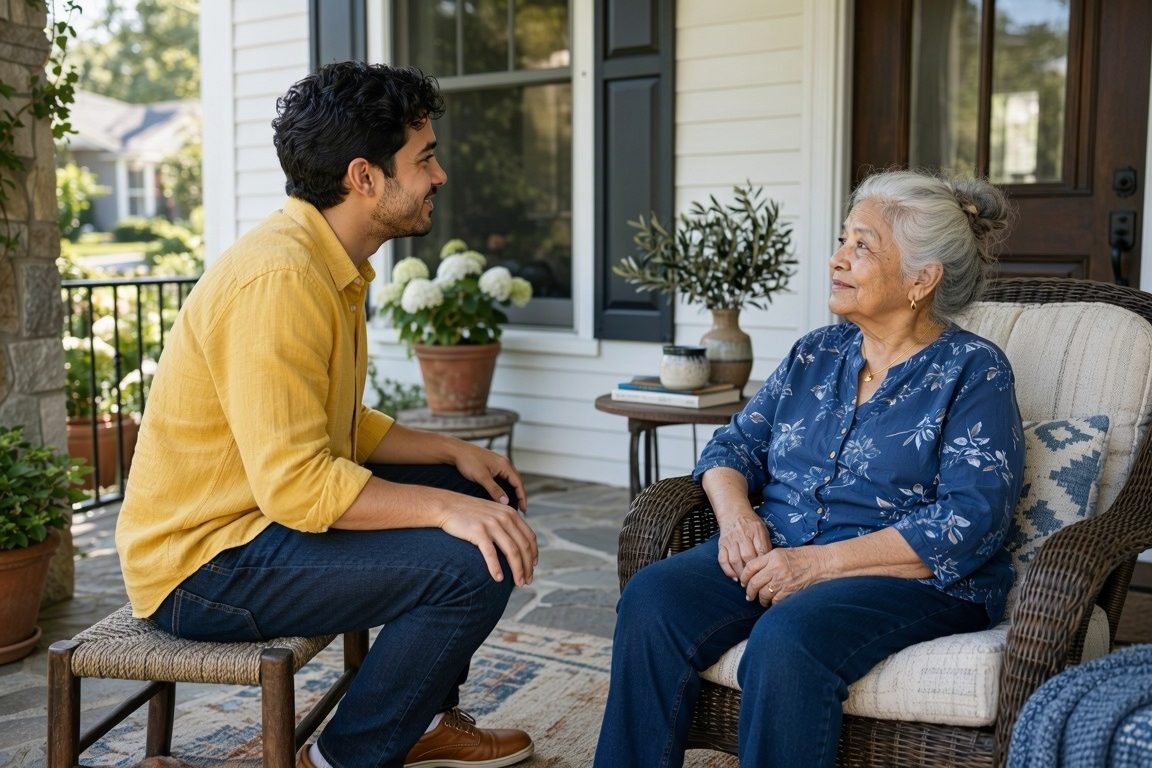
Step by step
What not to do
- Do not approach from behind or the side. This can startle them and trigger a fear response, leading to agitation or aggression.Instead, always approach from the front, at their eye level, and identify yourself by name.
- Do not use complex sentences or multiple instructions at once. This overloads their processing ability and leads to frustration.Instead, break everything into one-step commands: ‘Roll toward me’ rather than ‘I need you to roll over to the edge of the bed so I can help you sit up.’
- Do not ask ‘Do you want…?’ questions when you need a specific action. This can feel like a test, and ‘no’ is often the safer answer.Instead, use a statement: ‘Let’s have a cup of coffee’ rather than ‘Do you want coffee?’
- Do not rush or show impatience. If you sound panicked or hurried, they will pick up on that anxiety and may become more confused or resistant.Instead, speak slowly, pause, and give them time. Your calm pace sets the tone.
- Do not correct or argue if they say something inaccurate. This damages trust and creates negative feelings.Instead, focus on the emotion behind the words. If they say ‘I want to go home’ when they are already home, respond to the feeling: ‘You miss feeling safe. I am here with you.’
- Do not force touch if they pull away. Respect their boundaries. Forcing contact can feel invasive and increase agitation.Instead, try again later with a slower approach, or use other non-verbal cues like a warm smile or a gesture.
Key points
- Your body language, tone, and touch are more powerful than your words, use them intentionally.
- Center yourself before every interaction: take deep breaths and soften your face.
- Approach from the front, at eye level, and use gentle eye contact from a close distance.
- Use one-step commands paired with gestures; avoid questions that feel like tests.
- Give extra time for processing, wait at least 10 seconds before repeating.
- When words fail, switch to sensory connection: music, touch, familiar scents.
- Your calm presence can slow decline and improve quality of life.
Videos
 Assisting with Activities of Daily Living in Dementia CareDemonstrates how to use gentle touch and step-by-step gestures during personal care tasks, which is a key application of non-verbal connection.
 Communication & Dementia: Connecting with a Person living with Memory LossCovers the importance of eye contact, tone, and simple language, core elements of the body language approach.
 How to Help Someone With Dementia Accept HelpShows how to use mirroring and calm presence to reduce resistance, a direct application of the steps in this article.
 Grandpa, Do you Know who I am? (Dementia Tips)Illustrates how to connect emotionally when the person does not recognize you, using touch and familiar routines.
2 more videos
 Communicating with Elderly Loved OnesProvides practical tips on posture, eye contact, and simplifying speech for older adults with cognitive decline.
 COMMUNICATION TECHNIQUES FOR DEMENTIA CAREGIVERSOffers five essential techniques including simplifying language and using gestures, directly supports the steps in this article.
Background
Why Body Language Becomes the Primary Language
As dementia advances, the brain areas responsible for understanding and producing speech are increasingly affected. Your loved one may still feel emotions deeply, fear, comfort, joy, but cannot always process your words or find their own. Research shows that only about 7% of communication is verbal, even in people without cognitive decline. For someone with dementia, that percentage drops even further. They rely on your facial expressions, tone, posture, and gestures to interpret your intent and feel safe. If your face shows tension or frustration, they will mirror that distress, often leading to agitation or withdrawal. Conversely, a calm, open presence can soothe and invite cooperation.
Your Emotional State Sets the Stage
Before you even speak, your loved one is reading your emotional weather. If you have had a tough day, that stress is written on your face and in your shoulders. They will notice and may become anxious or defensive. Taking a few deep breaths to center yourself before approaching is not a luxury, it is a critical step. When you are calm, you project safety. When you are rushed or irritable, you project threat. This is not about being perfect; it is about being aware. If you feel yourself getting impatient, pause, step back, and reset. Your loved one’s behavior is not intentional; it is a symptom. A loving, supportive environment can actually slow the rate of decline, while isolation and stress can accelerate it.
The Power of Mirroring and Matching
People with dementia often unconsciously mirror the body language of those around them. You can use this to your advantage. If you approach with a gentle smile, relaxed shoulders, and slow movements, they are more likely to match that calm energy. If you stand over them with crossed arms and a tense jaw, they may become guarded. Skilled caregivers use mirroring intentionally: they observe the person’s posture and breathing, then subtly copy it. After a few moments, they slowly shift their own posture to a more relaxed or open one, and the person often follows. This creates a sense of harmony and trust without a single word.
Practical tools
6
The ‘Center and Smile’ Pre-Check
Before any interaction, take 10 seconds to do this: 1) Take three deep breaths. 2) Soften your face into a gentle smile. 3) Say to yourself: ‘I am here to connect, not to control.’ This resets your emotional state and projects safety.
The ‘One-Step Gesture’ Phrase Bank
Write down a few key phrases paired with gestures:
Keep this list visible. Use the same phrase and gesture each time for consistency.
The ‘Mirror and Shift’ Technique
When you first approach, subtly copy their posture and breathing rate for 30 seconds. Then, slowly shift to a more relaxed or open posture. They will often follow. This builds unconscious rapport and reduces resistance.
A Comfort Kit for Sensory Connection
Assemble a small basket with items that engage the senses:
Use these when words fail, offer the item, describe it simply, and let them explore.
The ‘Yes-Set’ Environment Setup
Arrange the room to reduce confusion:
Place a sign with their name on the door. Use color contrast (e.g., a red toilet seat) to make objects easier to see. This reduces the need for verbal instructions.
The ‘Pause and Validate’ Script
When they are upset, use this script: 1) Stop what you are doing. 2) Make eye contact and say ‘I see you are upset.’ 3) Use a gentle touch (if welcome). 4) Say ‘I am here. We can figure this out together.’ 5) Wait. This validates their feelings and builds trust.
Different situations
Lewy body dementia (LBD)
People with LBD often have visual hallucinations, sleep disorders, and Parkinson-like symptoms. They may be more sensitive to touch and may misinterpret facial expressions. Approach even more slowly, avoid sudden movements, and use very simple gestures. If they seem to be seeing something that is not there, do not argue, acknowledge their experience: ‘I see you are concerned. Let’s sit together.’ Also, encourage exercise gently, as it can improve physical function and mood.
Late-stage dementia (bedbound or non-verbal)
Communication becomes entirely sensory. Your loved one may not understand sentences at all. Focus on touch, music, and your voice. Play their favorite song from their youth, hold their hand, or gently stroke their arm. Speak in a soft, rhythmic tone, even if they do not understand the words, the tone conveys love. Use familiar scents (like their old perfume) or a soft blanket. Your presence is the most powerful tool.
Spouse vs. adult child caregiver
Spouses often have a deeper history of non-verbal cues and may be able to read subtle changes more easily. However, they may also carry more emotional baggage. If you are a spouse, be extra mindful of your own stress, take breaks. Adult children may need to learn the non-verbal language from scratch. Practice mirroring and use the ‘Center and Smile’ pre-check. Both roles benefit from inviting another family member or friend to join visits occasionally, which can take the pressure off the dyad and foster new connections.
In a facility or with paid caregivers
Consistency is key. Share a one-page ‘communication passport’ with staff: list the person’s preferred name, favorite songs, calming phrases, and what touch they welcome. Ask that all caregivers approach from the front, use the same gestures, and avoid rushing. If your loved one is in a wheelchair, ensure staff always crouch to eye level when speaking. Advocate for a calm, low-stimulation environment during meals and care routines.
Medicaid or limited resources
You do not need expensive tools. Use household items: a familiar song on a phone, a soft towel as a comfort object, a photo from a magazine. Focus on free techniques: deep breathing, mirroring, and gentle touch. Reach out to your local Alzheimer’s Association chapter for free caregiver training on non-verbal communication. Many offer online videos and support groups.
For the doctor
4
- If your loved one shows sudden changes in behavior, such as increased agitation or withdrawal, discuss with their doctor to rule out infection, pain, or medication side effects.
- If you are using touch and they consistently pull away or become distressed, ask a clinician or occupational therapist for guidance on safe, respectful touch techniques.
- If your loved one has a history of falls, discuss how to use gentle guiding touch safely without causing imbalance.
- If you are considering using weighted blankets or sensory items, ask the doctor if these are appropriate given their medical condition.