Step by step
What not to do
- Don't use children's coloring books or toys, this feels infantilizing. Use adult materials and treat them as the capable adult they still are.
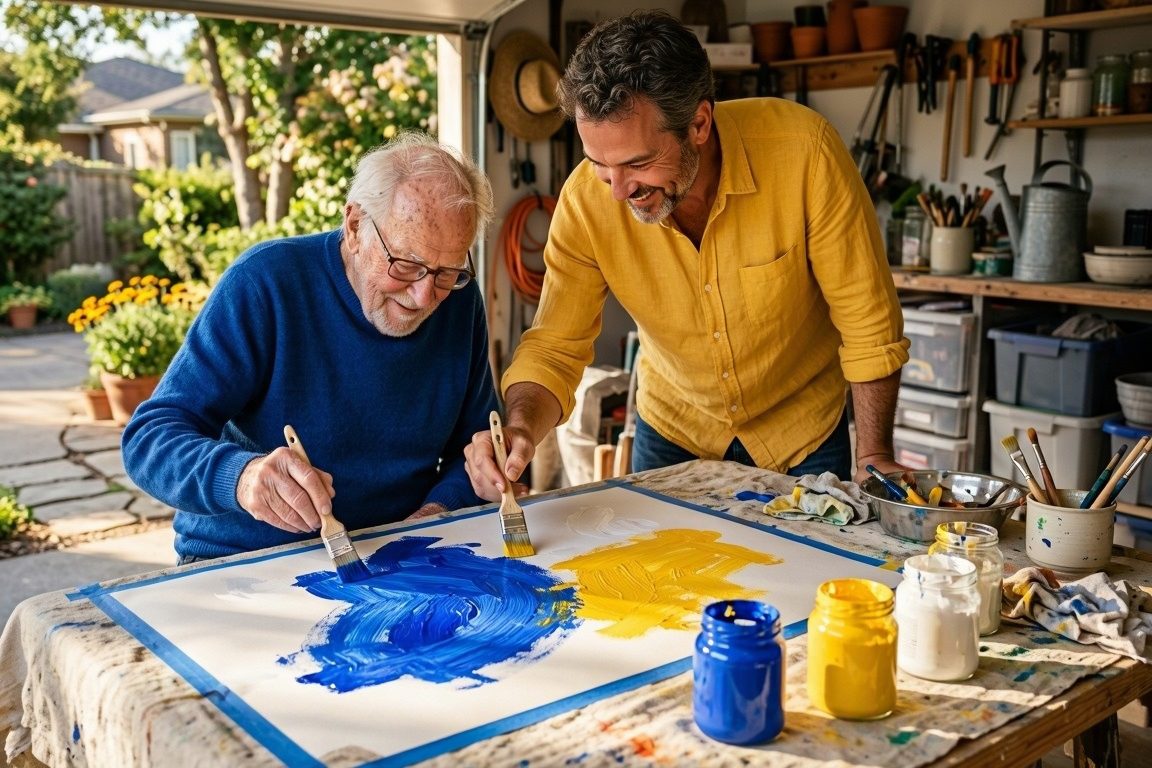
- Don't criticize or correct their work. Comment on the process instead (e.g., 'I love how you're using so much blue today').
- Don't overwhelm with too many choices. Limit options to two or three offered one at a time.
- Don't force participation. If they refuse, try later or offer a different activity. Sitting quietly together can also be the best engagement.
- Don't leave them unsupervised with small or hazardous objects (beads, buttons, puzzle pieces), these are choking risks. Use large items and safe materials.
- Don't measure the activity against what they once could do. The connection matters, not the finished product.
Key points
- Creative activities tap into preserved brain functions, music and art can reach a person when words fail.
- Focus on the process, not the product. The goal is connection, not a perfect painting or song.
- Personalize activities based on the person’s life history: a former golfer can sort tees, a baker can stir.
- Keep instructions simple, use one step at a time, and demonstrate before asking them to do it.
- Watch for signs of fatigue or frustration and stop before they become overwhelmed.
- Use music as a powerful, flexible tool, it can calm, energize, or evoke happy memories.
Videos
 How to keep a dementia patient busyThis video offers practical, low-prep activity ideas that can be done at home, with tips for adapting to different ability levels.
 Top 5 Indoor Activities for Seniors with Dementia (For Free)Focuses on free, accessible activities that use items you already have at home, perfect for caregivers on a budget.
 Dementia friendly activities someone would actually enjoy!Explains how to choose activities that match the person’s interests and current abilities, increasing the chance they will engage willingly.
 Why Meal Refusal Happens with Dementia (And How to Tackle It Without a Fight)While not directly about arts, this video teaches communication techniques that apply to any activity refusal, helping you avoid power struggles.
2 more videos
 How Do You Promote Safety In Patients With Dementia?Covers essential safety considerations for any activity, including art and music, so you can engage without worry.
 Grandpa, Do you know who I am? (Dementia Tips)Provides emotional support and practical tips for family caregivers, reinforcing the importance of connection over cognition.
Background
Why Creative Activities Work So Well
When dementia affects language and memory, the brain’s creative and emotional centers often remain accessible longer. Music, for example, is processed across the entire brain and is one of the last abilities to fade, familiar songs can unlock memories and emotions that words cannot reach. Similarly, art projects tap into self-expression without requiring perfect speech or recall. This is why a person who struggles to find the right word might still hum along to a childhood tune or smile while smearing paint on paper. The goal is not to create a masterpiece but to share a moment of connection, accomplishment, and joy.
The Power of Process Over Product
Many caregivers worry that an activity must be completed correctly or look good to be worthwhile. In dementia care, the opposite is true. Engagement is about the process, the feel of clay in the hands, the rhythm of a brush, the shared laughter over a funny face. When you focus on the doing rather than the outcome, you reduce pressure on both of you. This approach also respects the person’s remaining abilities: a person who once baked can still stir, a former golfer can sort tees by color. The activity becomes a vehicle for dignity, purpose, and positive interaction, not a test of skill.
How Engagement Reduces Challenging Behaviors
Boredom and under-stimulation are common triggers for restlessness, agitation, and sundowning. When a person with dementia has too much unstructured time, they may pace, call out, or become irritable. Structured creative activities fill that time with meaningful, calming engagement. Art and music can also serve as a redirection tool: if your loved one is anxious or upset, putting on a favorite song or offering a simple craft can shift their focus and mood. This is not about keeping them busy for busyness’s sake, it’s about meeting their need for purpose, connection, and sensory input in a way that feels safe and familiar.
Practical tools
4
Two-Step Invitation Script
A phrase pattern: 'I'm going to [activity]. Would you like to help me?' This gives genuine choice and frames the activity as shared rather than imposed.
Stage-Matched Activity Menu
Quick-reference list: Early, adult coloring, simple watercolors, flower arranging. Middle, sorting by color/size, large-bead stringing, clay. Late, squeezing a soft ball, tearing paper, shaking rhythm instruments, listening to music.
Music Playbook
Build playlists from their youth (big band, folk, oldies) with matching tempo to mood. Keep volume moderate. Their favorite era's music is a reliable mood-lifter even in late stages.
Activity Journal Template
Log the activity, time, mood, energy, and what sparked joy or frustration. Review weekly to spot patterns (e.g., sorting works best mid-morning; music calms sundowning).
Different situations
Early-stage Alzheimer’s (mild cognitive decline)
The person can still follow multi-step instructions and may enjoy more complex projects like painting a landscape, doing a jigsaw puzzle with 50–100 pieces, or learning a new simple craft like origami. They may also appreciate going to a museum or art class together. Focus on activities that maintain their sense of identity and competence. Encourage them to choose the activity themselves, and let them lead as much as possible.
Middle-stage Alzheimer’s (moderate decline)
Simplify activities to one or two steps. Use large, easy-to-grip tools (e.g., thick-handled brushes, chunky crayons). Avoid anything that requires reading or complex sequencing. Sorting objects by color or size, finger painting, and listening to music with rhythm instruments work well. Be prepared to demonstrate repeatedly and use hand-over-hand guidance. Keep sessions short (10–15 minutes) and watch for signs of fatigue.
Late-stage Alzheimer’s (severe decline)
Focus entirely on sensory engagement: soft fabrics to touch, gentle music, aromatherapy (lavender or vanilla), and simple hand massage with lotion. Offer a soft ball to squeeze or a textured blanket to stroke. Speak in a calm, low voice and use slow, gentle movements. The goal is comfort and connection, not task completion. Even if they cannot respond verbally, they may show pleasure through a relaxed posture or a slight smile.
Lewy body dementia or Parkinson’s dementia
Be mindful of visual hallucinations and motor fluctuations. Avoid complex visual patterns that might be misinterpreted. Use high-contrast materials (e.g., black paper with white chalk). Keep activities short and flexible, if they have a 'good' hour, do a simple craft; if they are stiff or tremulous, offer a seated music activity instead. Always prioritize safety: avoid small objects that could be swallowed or dropped.
Frontotemporal dementia (behavioral variant)
This type often affects behavior and personality more than memory. The person may be impulsive or have lost interest in previous hobbies. Try novel, hands-on activities that provide immediate sensory feedback, like pounding clay, tearing paper, or playing a drum. Avoid activities that require sustained attention or social rules. Be flexible and ready to switch activities quickly if they lose interest.
Common questions
3
How can a life history tool help visitors, especially teenagers, interact with a person with dementia?
A life history tool gives teenagers a quick, concrete way to connect, share one or two favorite photos or facts, like 'she used to bake cookies every Saturday,' so they can ask a simple, meaningful question or sit down to look at pictures together.
What is a virtual music engagement program for dementia and how can I use it?
A virtual music engagement program like 'Music & Memory' streams personalized playlists of songs from their youth right to a tablet or phone; you just play a familiar tune during a restless moment or at mealtime to spark calm or a smile without needing any special equipment.
What can care partners do to reduce loneliness and its harmful effects?
Invite the person to join you in a simple, shared activity like sorting a small pile of colorful socks or stirring a bowl of cookie dough, this focused, side-by-side time builds connection and fights loneliness better than words ever could.
For the doctor
5
- If the person has a history of choking or swallowing difficulties, ask their doctor or speech therapist which art materials (e.g., clay, beads, small objects) are safe to use.
- If the person is on blood thinners or has fragile skin, check with their doctor before using any activity that involves pressure or repetitive hand movements (e.g., clay molding, hand massage).
- If the person has a history of seizures, ask whether flashing lights or certain music tempos could trigger a seizure.
- If the person has a latex allergy, ensure all art supplies (gloves, balloons, some modeling clays) are latex-free.
- If the person is prone to wandering or agitation, ask the care team about the best time of day to introduce stimulating activities versus calming ones.