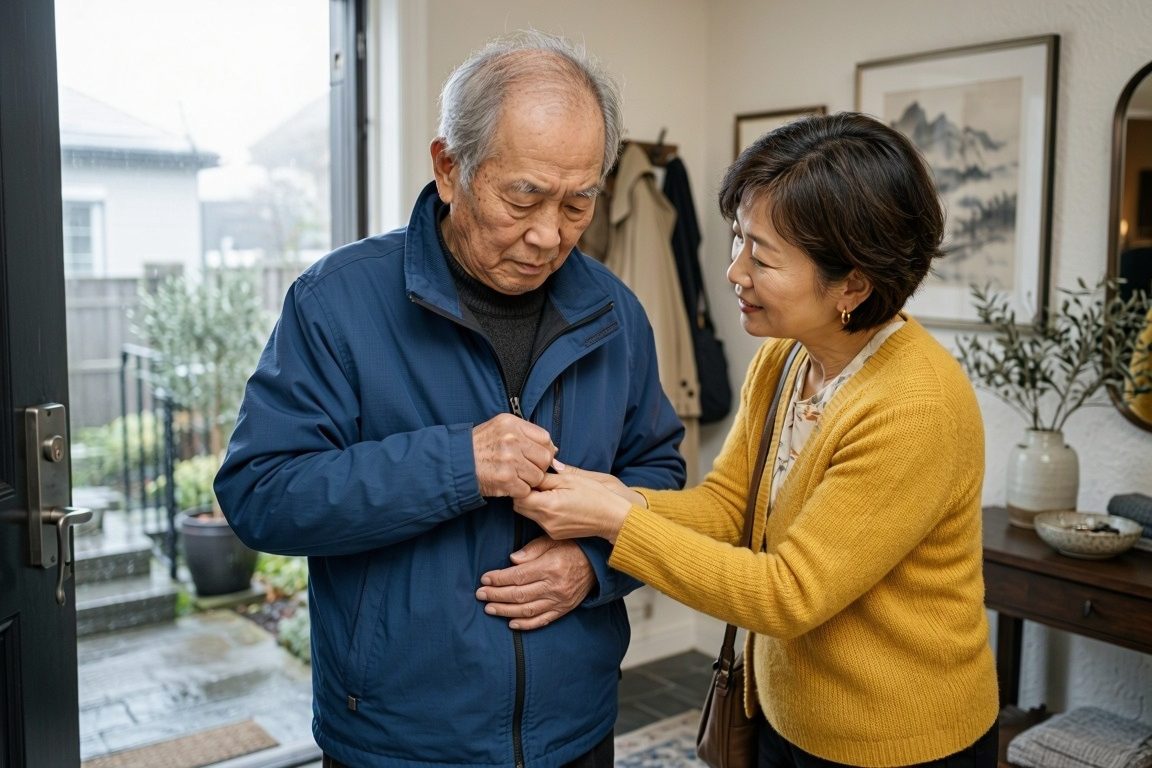
Step by step
What not to do
- Do not approach from behind or the side, this can startle and trigger defensiveness.
- Do not rush into a task without a warning or asking permission, this can feel invasive and provoke agitation.
- Do not grab the person's hand from above or pull them, this signals control, not support.
- Do not ignore the person's refusal or non-response, pushing through without consent escalates distress.
Key points
- Approach slowly from the front, at eye level, and use a warm greeting to set a safe tone.
- Give a timely warning before care and ask for permission to reduce surprise and distress.
- Use hand-under-hand touch to guide gently and build trust without control.
- The Six Pieces of the Puzzle helps you assess and adjust the environment, health, task, approach, timing, and background.
- The GROW card is a quick, portable reminder to Greet, Relate, Offer choice, and Wait.
- Minimize distractions and maintain calm body language to help the person feel safe and focused.
Videos
 Time with Teepa - In This Situation What Do You NeedTeepa Snow demonstrates the Six Pieces of the Puzzle framework in real time, showing how to assess and adjust your approach.
 SUP! Immediate Impacts on the Care Partner Relationship after PAC TrainingThis video shows how Positive Approach to Care training (including hand-under-hand and GROW) improves caregiver relationships immediately.
 Time with Teepa – Why Do We Call It Aggression in Dementia?Teepa explains why defensiveness is not aggression and how to reframe your understanding to respond with compassion.
 COMMUNICATION TECHNIQUES FOR DEMENTIA CAREGIVERSThis video covers practical communication techniques, including the importance of timely warnings and reducing distractions.
2 more videos
 Assisting with Activities of Daily Living in Dementia CareDemonstrates hand-under-hand and other gentle assistance techniques during personal care tasks.
 Eoin Walker Paramedic and Host of the Pre-Hospital PodcastDiscusses communication awareness and closed-loop communication in care settings, relevant for facility staff.
Background
Why Defensiveness Happens in Dementia
Brain changes in dementia mean the person no longer processes information the same way they used to. They may be more easily startled, and their brain can trigger a fight-or-flight response to ordinary care tasks, like being helped with bathing, dressing, or eating. This is not intentional resistance; it is a protective reflex. Research shows that giving a timely warning before care (rather than surprising them) and then asking for permission can prevent both verbal and physical expressions of distress. The initial approach sets the tone for the whole interaction, so how you begin matters enormously.
The Power of Nonverbal Connection
Communication is far more than words. Gestures, touch, and eye contact often carry more meaning than what you say. A gentle touch on the hand or shoulder can relax and calm a person, encouraging cooperation. Laughter and shared enjoyment are also powerful connectors, humor remains one of the best ways to communicate with anyone, anytime. When you focus on the human-to-human connection first, the person is far more likely to accept your care now and in the future. The less you correct or argue, the more positive your interactions become.
Practical tools
1
GROW Card
A small pocket or lanyard card listing the acronym: Greet warmly, Relax and respect space, Observe and offer choice, Wait for a response. Used as a quick in-the-moment reminder to maintain a connecting, non-defensive approach.
Different situations
Lewy body dementia
People with Lewy body dementia may have visual hallucinations and extreme sensitivity to touch. Use hand-under-hand very gently, and avoid sudden movements. The GROW card's 'Relate to their reality' step is crucial, validate their experience even if it seems unreal to you. Minimize visual clutter in the environment.
Late-stage dementia
In late stages, the person may not understand words. Focus on nonverbal cues: gentle touch, soft tone, and slow movements. The hand-under-hand technique is especially effective. Use the GROW card's 'Greet' and 'Wait' steps, but skip complex choices, offer only one option at a time. Keep the environment very quiet and calm.
Spouse vs. adult child caregiver
A spouse may have a longer history of shared routines and can use familiar phrases ('Remember how we always did this?'). An adult child may need to build trust first, use the GROW card's 'Relate' step to connect on a personal level. Both should avoid correcting or arguing, but a spouse may need extra support to not take defensiveness personally.
In a care facility
Facility staff may have limited time, but the Six Pieces of the Puzzle framework can be used quickly. Use the GROW card as a quick reference on a lanyard. Coordinate with other staff to ensure consistency in approach. The timely warning script is especially important in a facility where multiple caregivers interact with the person.
Medicaid or low-resource setting
These techniques require no expensive equipment, just your presence and intention. Use the hand-under-hand touch and GROW card (which can be handwritten on an index card). The Six Pieces of the Puzzle can be done mentally. Focus on the environment: even a quiet corner of a shared room can be a 'distraction-free zone.'
For the doctor
4
- If the person's defensiveness is accompanied by new or worsening pain, discuss pain management options with their doctor.
- If the person is on medications that may cause agitation or confusion, ask the clinician about possible side effects or adjustments.
- If the person has a history of falls, discuss safe ways to use hand-under-hand guidance without pulling or straining.
- If the person has a skin condition or sensitivity, ask about safe touch techniques before using hand-under-hand.