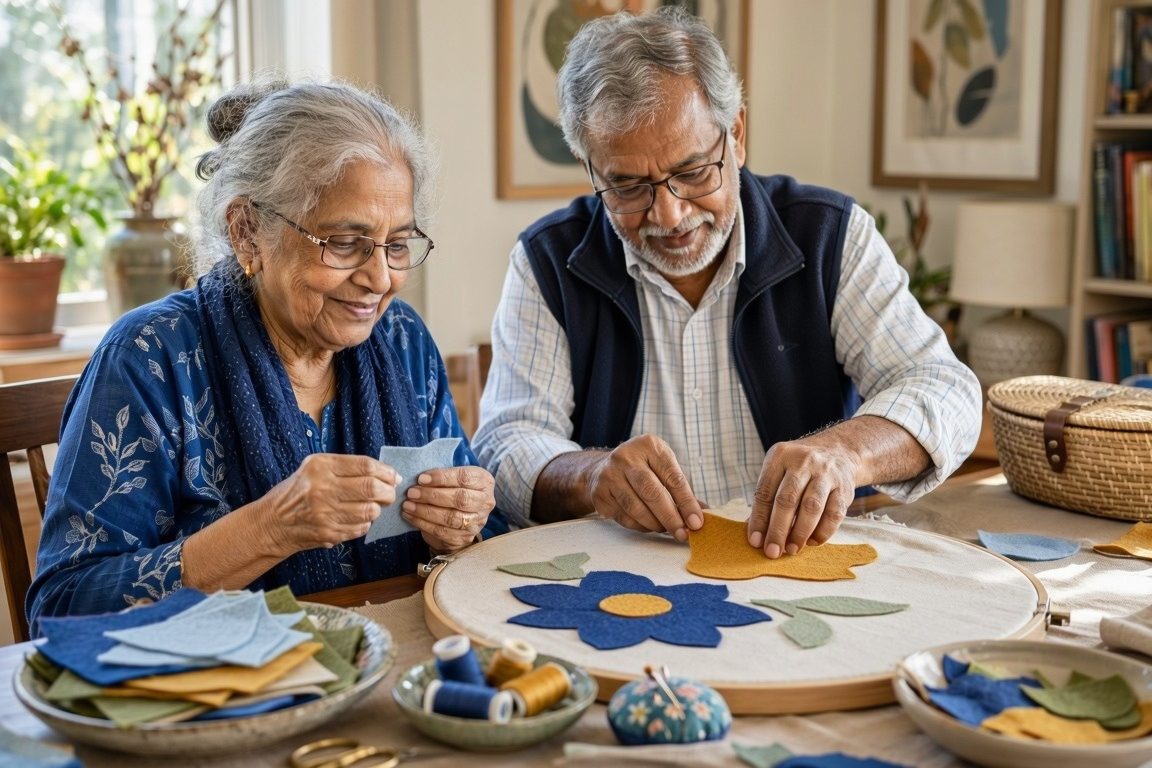
Step by step
What not to do
- Do not give a craft with many small pieces or complicated instructions. This can overwhelm the person and lead to frustration or refusal.Instead, pre-sort materials and present only what is needed for the current step. For example, if you are doing a beading project, put just a few beads on the tray, not the whole container.
- Do not correct or criticize how they do the craft. If they glue a piece upside down or paint outside the lines, let it be. The goal is engagement, not a perfect product. Criticism can cause shame and make them less willing to try again.Instead, praise the effort: 'You are doing a great job with that color.'
- Do not leave them alone with sharp tools or toxic materials. In mid-stage dementia, judgment and impulse control can be impaired. Even if they were once skilled with scissors or glue, they may now put things in their mouth or accidentally cut themselves. Always supervise and use safety-modified tools like plastic needles, blunt scissors, and non-toxic glue. The source material specifically warns about needles in later stages and recommends plastic alternatives.
- Do not force the activity if they are not in the mood. Apathy is common in mid-stage dementia, and pushing can lead to agitation.Instead, try again later or offer a different activity. The source material notes that sometimes the person just needs a break or a change of scenery. You can also try inviting them to help you with a 'job', like sorting screws or folding napkins, which may feel less like a craft and more like a meaningful task.
- Do not use crafts that are too childish or patronizing. An adult with dementia may feel insulted by a project clearly designed for a toddler. Modify kids' crafts to make them age-appropriate: use real tools (with safety adaptations), quality materials, and themes that connect to their adult life. For example, instead of a paper plate mask, try a simple woodworking project like sanding a block of wood.
Key points
- Focus on the process, not the product. The goal is engagement and comfort, not a finished craft.
- Break every craft into single, visible steps. Use a tray to limit visual clutter and keep materials within the person's 12-inch field of view.
- Adapt tools for safety and ease: plastic needles, blunt scissors, chunky yarn, and non-toxic materials.
- Personalize the activity to the person's past interests. A former fisherman may enjoy sorting lures; a former baker may enjoy stirring dry ingredients.
- Watch for signs of frustration and stop gracefully. A short, positive experience is better than a long, frustrating one.
- Use side-by-side modeling: do the craft yourself and let them imitate you. Offer choices between two options, not open-ended questions.
Videos
 How to keep a dementia patient busyThis video offers practical, low-prep activity ideas that can be adapted for mid-stage dementia, including crafts that use household items.
 4 Easy Activity Ideas For Middle Stage DementiaSpecifically focused on middle-stage dementia, this video provides four ready-to-use activity ideas that require minimal setup and can be modified for crafting.
 How to increase activity for someone with dementiaThis video helps troubleshoot why a person might refuse activities and offers strategies to increase engagement, which is crucial when adapting crafts.
 How To Distract Someone With Alzheimer's? Episode 1Covers redirection techniques that can be used when a craft activity is not working, helping you pivot without causing frustration.
2 more videos
 Dementia Friendly Activities at Home: Part 1 of 3Part of a series that shows how to set up activities at home, including crafts, with a focus on safety and simplicity for mid-stage dementia.
 What Activities Are Good For Dementia Patients? Module 1Provides a foundational overview of activity types that work for dementia, helping you choose the right craft approach for your loved one's current abilities.
Background
Why Crafts Can Feel Overwhelming in Mid-Stage Dementia
In mid-stage dementia, a person's ability to plan, sequence steps, and sustain attention narrows significantly. Their world shrinks to about the space between their hands, roughly twelve inches, and they may struggle to scan a table or follow a multi-step instruction. A typical craft project that requires reading a pattern, counting stitches, or using sharp tools can trigger anxiety, frustration, or refusal. This isn't a lack of interest; it's a mismatch between the activity's demands and the person's current cognitive capacity. The key is to adapt the craft so it fits within their reduced attention span and motor abilities, turning a potential failure into a moment of connection and accomplishment.
The Shift from Product to Process
For someone with mid-stage dementia, the value of a craft lies in the doing, not the finished item. They may not remember what they made five minutes after finishing, but the sensory experience, the feel of yarn, the smell of paint, the rhythm of sorting, can provide comfort and a sense of purpose. Occupational therapists and dementia care specialists emphasize that activities should be broken into single, repetitive steps that feel familiar and safe. For example, instead of knitting a scarf, you might offer a pre-started row of large stitches on a chunky needle and simply let them continue the motion. The goal is engagement, not mastery. When you let go of the outcome, you free both of you to enjoy the moment.
The Role of Personal History and Montessori Principles
Crafts that connect to a person's past interests are far more likely to succeed. A former fisherman might enjoy sorting lures into a tackle box (with sharp hooks removed), while someone who loved baking might find meaning in mixing dry ingredients or decorating a simple cookie. This is rooted in the Montessori approach for dementia, which uses familiar, hands-on tasks to maintain skills and provide a sense of competence. The activity should be self-directed as much as possible, with you setting up a station and then stepping back to let them explore. Even if they only participate for a few minutes, that's a win. You can always invite them to rejoin later.
Practical tools
6
The 'Just One Step' Tray
This reduces visual clutter and helps the person focus on the single action in front of them.
Adaptive Craft Kits (DIY or Store-Bought)
You can purchase craft kits designed for dementia, such as 'Busy Minds' boxes, which contain activities like sorting, lacing, and simple assembly. Alternatively, make your own kit based on the person's interests. For a former knitter, include a large plastic needle and a pre-started row of chunky yarn. For a former baker, include a bowl, a wooden spoon, and a bag of dry beans to 'stir.' The source material notes that even store-bought kits may need further modification, for example, removing small parts or simplifying instructions.
The 'Side-by-Side' Setup
Set up two identical workspaces, one for you and one for your loved one. Sit next to them, not across from them. This allows you to model the activity without giving verbal instructions. For example, if you are doing a simple weaving project, start weaving on your own loom, and they will often imitate you. The source material emphasizes that side-by-side engagement reduces pressure and makes the activity feel like a shared experience rather than a task.
The 'Sort and Soothe' Box
Fill a small box with items that can be sorted by color, size, or type. Examples:
Use a muffin tin or an egg carton as sorting compartments. This activity is calming, repetitive, and requires no instructions. It works well for someone who is restless or apathetic. The source material highlights sorting as a terrific activity for individuals who enjoyed organizing or fishing.
The 'Sensory Station'
Create a station that engages multiple senses. For example, a 'gardening' station could include a tray of potting soil, a small trowel, and a few plastic flowers to 'plant.' Or a 'baking' station could include a bowl of flour, a measuring cup, and a whisk. The person can stir, scoop, and touch without needing to follow a recipe. The source material notes that activities involving familiar smells and textures can evoke positive memories and reduce agitation.
The 'One Choice' Prompt
When offering a craft, give only two clear options. For example, 'Would you like to paint or sort buttons?' Hold up the two items so they can see them. Avoid open-ended questions like 'What do you want to do?' which can cause confusion. The source material advises that offering a choice between two options gives the person a sense of control without overwhelming them.
Different situations
Lewy Body Dementia (LBD)
People with LBD often have fluctuating attention and may experience visual hallucinations. Choose crafts that are very simple and avoid patterns or images that could be misinterpreted. Use high-contrast materials (e.g., bright yarn on a dark background) to help with visual processing. Be prepared to switch activities quickly if they become confused or frightened. Avoid crafts that require fine motor control during periods of rigidity or tremor.
Frontotemporal Dementia (FTD)
FTD often affects behavior and social judgment more than memory in early stages. Crafts that involve repetitive, soothing motions (like sorting or sanding) can be calming. However, the person may become fixated on a particular action (e.g., endlessly gluing pieces). Gently redirect them to a new step or end the activity. Avoid crafts that require abstract thinking or following social rules (e.g., taking turns). Focus on sensory, hands-on tasks.
Late Mid-Stage (approaching severe)
As the person loses the ability to initiate or follow even simple steps, move to purely sensory activities. For example, offer a basket of fabric squares to feel, or a tray of sand to run their fingers through. You may need to do hand-over-hand guidance for any craft. The goal shifts from engagement to comfort and sensory stimulation. The source material notes that in severe stages, the person may only be able to participate by watching or touching briefly.
Spouse vs. Adult Child Caregiver
A spouse may have a deeper emotional history with the person and may find it harder to 'let go' of the product. It can help to remind yourself that the craft is about connection, not a finished item. An adult child may feel pressure to 'fix' the situation with activities. Instead, focus on being present and patient. Both roles benefit from setting up the activity in advance and then sitting side by side, doing the craft together.
In a Facility vs. At Home
In a facility, you may have access to activity therapists who can provide adapted crafts. You can also bring in personal items (e.g., a favorite sewing basket) to make the activity more meaningful. At home, you have more control over the environment but may feel isolated. Consider joining a caregiver support group to share craft ideas. The source material notes that facilities often split the contents of activity boxes among residents based on skill level, so you can do the same at home.
For the doctor
4
- If the person has a history of swallowing non-food items (pica), ask the occupational therapist for safe craft materials that cannot be ingested.
- If the person becomes agitated or aggressive during crafts, discuss with the doctor whether this is a sign of unmet needs (pain, hunger, boredom) or a medication side effect.
- If the person has arthritis or other physical limitations, ask a physical therapist for adaptive tools that reduce joint strain (e.g., built-up handles on paintbrushes).
- If the person is on blood thinners, avoid crafts that could cause even minor cuts (e.g., using scissors or paper edges). Discuss safe alternatives with the clinician.