Step by step
What not to do
- Do not grab or pull their arm to stop them from moving. This triggers a fight-or-flight response and can cause them to pull away harder, leading to a fall or injury.Instead, use a gentle touch on their elbow or back and guide them with words.
- Do not argue or correct them when they say they want to go home or that they are lost. This increases their distress and makes them more determined to leave.Instead, validate the feeling and redirect to a comforting activity or memory.
- Do not try to physically block their path or stand in front of them with arms crossed. This feels like a threat and can escalate to aggression.Instead, step to the side and offer a distraction or a safe alternative path.
- Do not leave them alone in a car or in an unfamiliar place, even for a minute. Their impulse to move can override any memory of being told to stay put. Always have a plan for supervision, especially in new environments.
- Do not lock doors or use physical restraints without a plan for emergency exit. This can cause panic and injury.Instead, use alarms, decoy signs, or childproof locks that you can open quickly.
- Do not ignore your own stress. If you are tense, your body language will signal threat. Take a break, practice deep breathing, or ask for help. Your calm is their calm.
Key points
- Risky movement is driven by the brain's survival wiring: either a perceived threat or an unmet need. It's not intentional defiance.
- Your calm presence and slow approach reduce the threat response and make redirection possible.
- Encourage safe movement (bending, walking) with support, it builds strength and reduces fall risk over time.
- Use simple scripts like 'What do you need?' and 'Tell me about your home' to uncover the real need without arguing.
- Create a safe environment: clear paths, door alarms, and a sundowning toolkit can prevent many risky situations.
- Take care of yourself, your stress affects their behavior. Use deep breathing, coping statements, and ask for help when needed.
Videos
 Providing Support When Mobility Rules Are Not Regarded | Teepa's ClipsTeepa Snow explains the two core reasons for movement (threat and unmet need) and demonstrates how to support safe movement rather than restrict it.
 What Do You Do When A Dementia Patient Starts Wandering?This video offers practical strategies for redirecting wandering behavior and creating a safe environment, including the use of alarms and decoy signs.
 Why Do Dementia Patients Keep Saying They Want To Go Home?Understand the emotional need behind 'I want to go home' and learn how to respond without arguing, using validation and redirection.
 Manage dementia caregiver stress: 4 tips to cope with difficult dementia behaviorsCaregiver stress directly affects the person's behavior. This video gives coping statements and breathing techniques to help you stay calm during risky moments.
2 more videos
 What Are Common Safety Risks For Dementia Patients? - Dementia Help HubCovers fire safety, wandering, and other risks, with tips on alarms and environmental modifications to prevent unsafe movement.
 4 Tips to Avoid Difficult Dementia BehaviorsOffers proactive strategies to reduce triggers for risky movement, including creating a calm environment and meeting needs before they escalate.
Background
The Brain's Survival Drive: Threat or Need
At the core of the brain, two tiny structures are wired for survival. When a person with mid-to-late stage dementia senses a threat, like a shadow, a loud noise, or even a caregiver approaching too quickly, their primitive brain kicks in. The first response is to freeze, then to flee, and finally to fight if cornered. This is not a choice; it's a reflex. So when your loved one suddenly tries to get up from a chair or head for the door, they may be reacting to something that feels dangerous to them, even if you see no danger at all. The second reason for risky movement is an unmet need: they are thirsty, need the bathroom, feel bored, or are in pain. Their brain says 'I need something' and they move to get it, but without the ability to plan or communicate clearly, the movement can be clumsy or dangerous.
Why Risky Movement Increases in Mid-to-Late Stage
As dementia progresses, the front part of the brain, which normally puts the brakes on impulsive actions, shrinks. This means your loved one loses the ability to think, 'It's midnight and cold outside, maybe I shouldn't go out.' Instead, the impulse to move just happens. They may also experience visual-spatial problems: shadows look like holes, a dark rug looks like a drop-off, or a familiar room suddenly seems foreign. This disorientation triggers the 'I need to find familiar' drive, leading to exit-seeking or wandering. Sundowning, or increased confusion and agitation in the late afternoon and evening, can also spark these movements. The body is moving faster than the brain can process, which is why falls and unsafe actions become more common.
Your Behavior Affects Their Movement
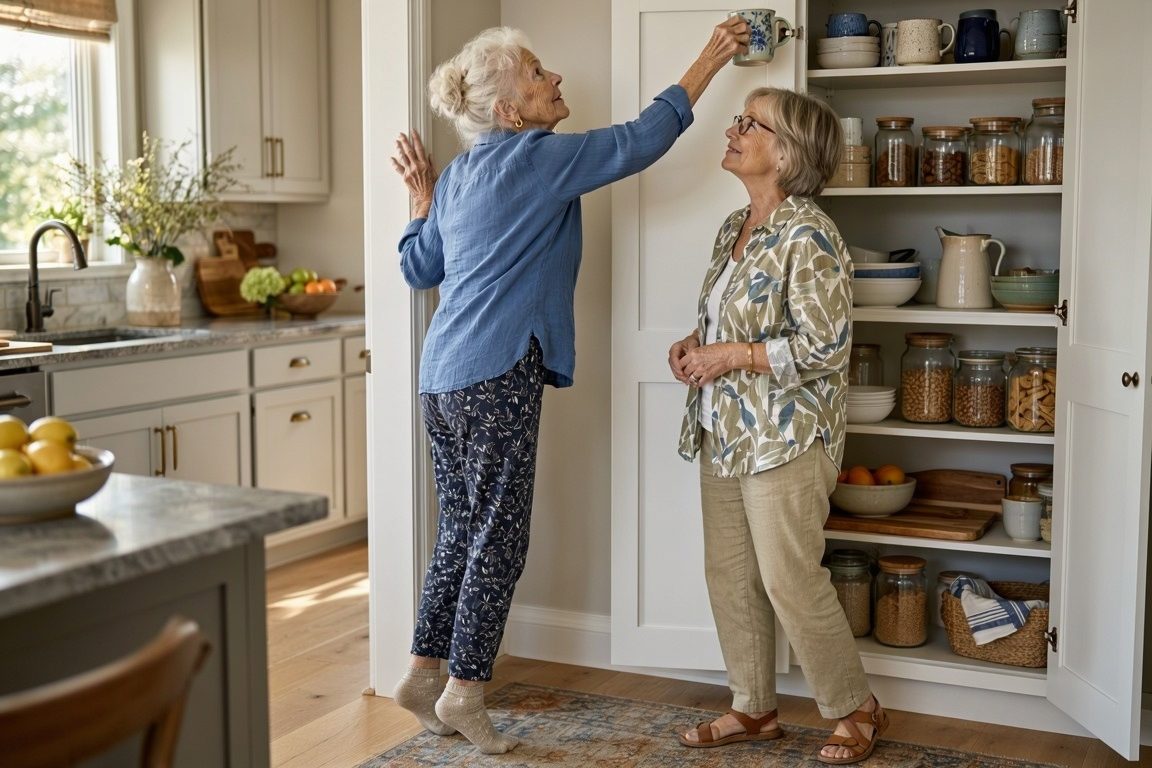
Here's a crucial insight: your own stress, frustration, or hurried movements can make things worse. If you are flustered, your body language and tone signal threat to their already sensitive brain. They may freeze, pull away, or try to escape from you. On the other hand, if you can stay calm, slow down, and approach from the front with a gentle smile, you reduce the perceived threat. You also have the power to turn risky movement into healthy movement. By encouraging safe bending, stooping, and reaching, with you nearby to support, you actually build their strength and coordination, buying them more time before a fall-related injury happens. Letting go of old habits like grabbing or pulling them back is the first step to helping them move safely.
Practical tools
6
The 'What Do You Need?' Script
A simple set of phrases to use when you see risky movement. Say: 'I see you're moving. What do you need?' If they can't answer, offer choices: 'Are you thirsty? Do you need the bathroom? Are you looking for something?' If they say 'I want to go home,' respond: 'Tell me about your home. What do you miss?' This script addresses the unmet need without confrontation.
Safe Walking Path Setup
The 'Bend and Reach' Exercise
Door Alarm or Pressure Mat
Sundowning Toolkit
Prepare a basket with calming items:
When sundowning starts (usually late afternoon), dim the lights, offer the basket, and say, 'Let's sit together and look at these.' This reduces the urge to wander or pace.
The 'I'm Here' Approach
When they are agitated and moving, stand at a 45-degree angle to them, not directly in front. Keep your hands visible and relaxed at your sides. Say their name softly, then 'I'm here. You're safe.' Wait for their eyes to meet yours before moving closer. This reduces the threat response.
Different situations
Lewy Body Dementia (LBD)
People with LBD often have visual hallucinations and severe sensitivity to medications. Risky movement may be triggered by seeing something that isn't there (e.g., a person in the corner). Do not argue about what they see. Instead, say, 'I see you're worried. Let's move to the other room together.' Also, be aware that they may have sudden changes in alertness, movement may be more risky during 'off' periods. Discuss any new movement issues with their clinician, as medication adjustments may be needed.
Late Stage (Severe Dementia)
In late stage, the person may be bedbound or use a wheelchair, but still make risky movements like trying to get up without help. Use a bed alarm or a low bed with padding on the floor. Never leave them unattended on a toilet or commode. For wheelchair users, use a seatbelt or a lap tray to prevent sliding out, but ensure it can be released quickly. Focus on comfort and pain management, unmet needs like pain or thirst are common triggers.
Spouse vs. Adult Child Caregiver
Spouses may feel more emotional distress when the person tries to 'go home' or seems lost, it feels like a rejection. Remind yourself: 'This is the disease, not a choice.' Use the 'Tell me about your home' script to connect emotionally. Adult children may be more likely to correct or argue. Practice saying, 'You're right, let's figure this out together.' Both roles benefit from taking breaks and asking for help from other family members or respite care.
In a Facility (Memory Care or Nursing Home)
Staff should be trained in the Positive Approach to Care. Risky movement in a facility is often due to under-stimulation or over-stimulation. Advocate for a consistent daily routine and safe walking areas. If the person is trying to leave, staff should use redirection, not restraint. Ask about door alarms and secure outdoor gardens. If the person is falling frequently, request a physical therapy evaluation for mobility aids.
Medicaid or Low-Income Settings
You can create low-cost safety tools at home. Use a baby monitor or a cheap door alarm from a hardware store. Clear a walking path by moving furniture yourself. Use a cardboard box as a decoy 'exit' sign. Contact your local Area Agency on Aging for free or low-cost safety assessments and equipment loans. Many communities offer free respite care or caregiver support groups.
For the doctor
5
- If risky movements lead to frequent falls or injuries, ask: 'Could a physical therapy evaluation help with balance and strength training?'
- If the person is aggressive during movement (hitting, biting), ask: 'Could there be an underlying infection, pain, or medication side effect causing this?'
- If sundowning is severe and not responding to environmental changes, ask: 'Are there any non-drug approaches or medications that might help reduce agitation?'
- If the person is trying to leave the house repeatedly and you cannot keep up, ask: 'Is a referral to a memory care facility or adult day program appropriate at this stage?'
- If the person has a history of falls with injury, ask: 'Should we consider a hip protector or a helmet to reduce injury risk?'