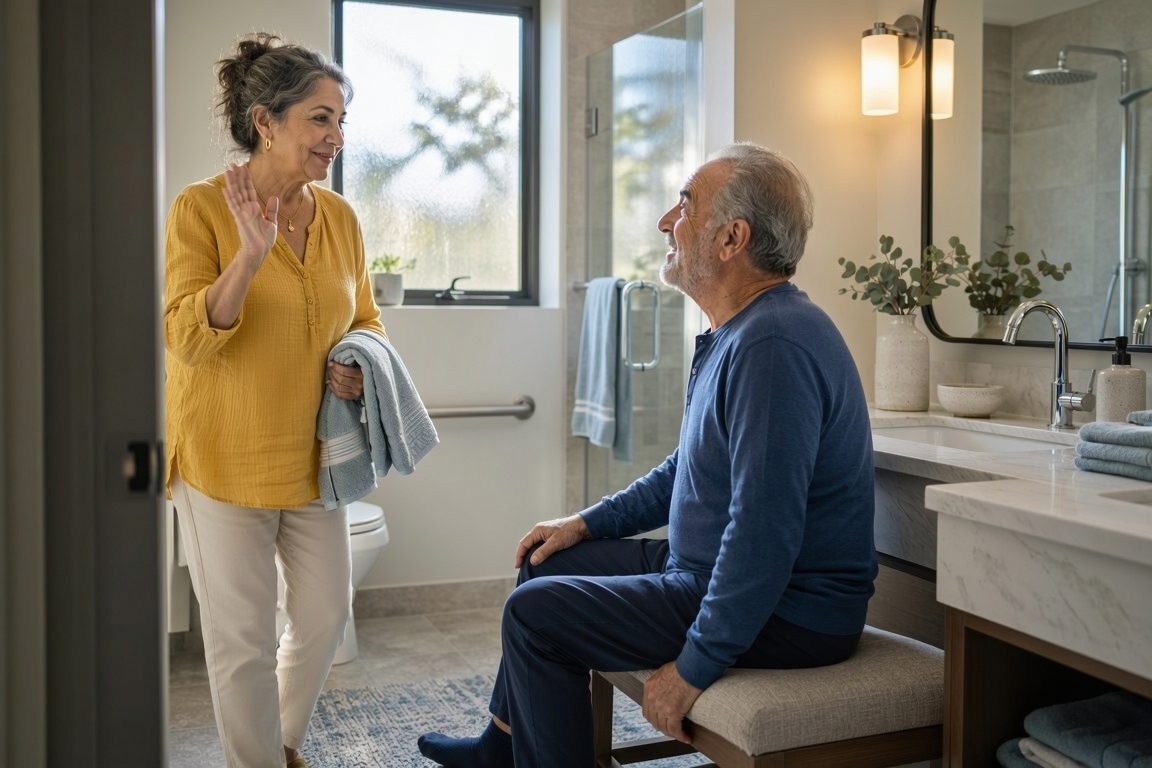
Step by step
What not to do
- Do not approach from behind or startle them.
- Do not stand or hover over them, match their eye level.
- Do not force touch or enter personal space without warning.
- Do not use loud or high-pitched voice; speak slowly and warmly.
- Do not quiz, test, or correct their memory.
Key points
- Always approach from the front, at the same eye level, with a warm smile and open body language.
- Pause at a close but respectful distance (about 8–12 inches) before moving into their personal space.
- Use gentle, sustained eye contact and a soft, calm voice. Avoid questions, use positive statements instead.
- Mirror the person’s body language and energy to build rapport, then gradually shift to guide the interaction.
- Offer a gentle touch on the arm or hand only if the person is calm and receptive. Respect their boundaries.
- Keep your language short, simple, and positive. Use one-step commands and plenty of encouragement.
Videos
 How to Use a Positive Physical Approach to Assess Abilities with Someone Living with DementiaThis video from Teepa Snow demonstrates the exact steps of the Positive Physical Approach in real time. You will see how to approach, pause, mirror, and connect.
 How to Help Someone With Dementia Accept HelpThis video explains why many people with dementia resist care and how using a warm, respectful approach can make them more receptive. It reinforces the importance of building trust first.
 Connecting with Various GEMS States Using Cues That Match | Teepa's ClipsTeepa Snow explains how to adapt your approach based on the person's current cognitive state (the GEMS model). This helps you match your cues to their abilities.
 Grandpa, Do you Know who I am? (Dementia Tips)This video offers practical tips for family caregivers on how to connect with a loved one who may not recognize them. It emphasizes patience, love, and using the Positive Physical Approach.
2 more videos
 Jill Couch DAWN Dementia SpecialistJill Couch demonstrates the DAWN method, which includes many of the same principles as the Positive Physical Approach. This video is especially helpful for family caregivers who want a step-by-step, compassionate framework.
 Multimodal Comprehensive Care Communication Skills in Dementia CareThis video covers the importance of non-verbal communication, including eye contact, touch, and body language. It reinforces the idea that your approach sets the stage for everything else.
Background
Why the Start of an Interaction Matters So Much
When you walk into a room, the person with dementia is already reading you, your facial expression, your posture, your pace, your energy. Their brain is constantly scanning for cues, trying to make sense of what’s happening. If you rush in, look stressed, or start talking too fast, their brain may interpret that as a threat or confusion. That’s not because they’re being difficult, it’s because their brain is working with different wiring now. As Teepa Snow explains, you can never assume what worked five minutes ago will work again; the person is using what’s available to them in that moment. So your job as a care partner is to use your own abilities to pick up on what they are showing you, and to adjust your approach accordingly. The first few seconds are your best chance to create a sense of safety and connection.
The Brain is Processing Non-Verbals First
A person with dementia often mirrors back your non-verbal cues and body language. If you are tense, frustrated, or in a hurry, they will feel that, even if you don’t say a word. That’s why it’s so important to center yourself before you even enter the room. Take a deep breath. Let go of the stress of your day. Put a genuine smile on your face. As one expert puts it, you need to act like you have been waiting your entire lifetime to spend time with them. This isn’t about being fake, it’s about intentionally setting a positive emotional stage. The person’s brain will pick up on your calm, warm presence and begin to relax. This is the foundation for everything that follows.
The Goal: Connection, Not Just Task Completion
Many caregivers jump straight to the action, trying to get the person to eat, bathe, or dress. But if the last six months have been filled with frustration and tension around that very task, your chance of success is low. The person may not trust you or may associate you with negative experiences. The Positive Physical Approach is about laying the groundwork first: building trust, showing respect, and letting the person know you are there for them, not just to get something done. When you take the time to connect, the person becomes more receptive to your help. As one care expert notes, when someone knows you have their back, they feel better and are more likely to cooperate. This approach is not slower, it’s actually more efficient in the long run.
Practical tools
3
Side-by-Side Positioning
Position yourself beside the person, facing the same direction, for tasks like walking or puzzles. Use hand-over-hand guidance to help start a motion like stirring.
One-Step Invitations
Use single-action commands: 'Let's sit down,' 'Here is your cup.' Avoid multi-step instructions like 'First we'll go to the bathroom, then brush your teeth', that is overwhelming.
Familiar Object Anchor
Bring
to spark connection and offer comfort when words are hard.
Different situations
Early-stage dementia (e.g., mild cognitive impairment or early Alzheimer's)
In early stages, the person may still be very aware of their diagnosis and may feel embarrassed or defensive. Use the Positive Physical Approach gently, but be careful not to be patronizing. You can still use eye contact and a warm smile, but you might also say something like, 'I know things feel different lately. I’m here to help however I can.' Avoid treating them like a child. They are still an adult with feelings and dignity.
Late-stage dementia (e.g., severe Alzheimer's, non-verbal, bedbound)
In late stages, the person may not respond verbally, but they can still feel your presence and your touch. The Positive Physical Approach becomes even more important. Approach slowly, speak softly, and use gentle touch on the hand or shoulder. Even if they do not open their eyes, talk to them as if they can hear you. Use their name. Play soft music they loved. Your calm, loving energy can still reach them.
Lewy body dementia or Parkinson's dementia
People with Lewy body dementia may have visual hallucinations, fluctuations in alertness, and sensitivity to medications. They may startle easily. Approach even more slowly and from the front. Avoid sudden movements. If they seem to be looking at something that isn’t there, do not argue, just gently redirect to something real in the room. Use a calm, low voice. Be prepared for their energy to shift from moment to moment.
Spouse vs. adult child caregiver
If you are a spouse, the person may have a long history with you and may feel more comfortable, or they may be more likely to resist your help because of role changes. Use the Positive Physical Approach to re-establish connection as a partner, not a parent. If you are an adult child, you may need to be extra careful not to slip into a 'parenting' tone. Approach as a loving friend. Use their name. Let them feel your respect.
In a facility (nursing home, assisted living, or adult day center)
In a facility, the environment can be distracting, noise, other people, unfamiliar staff. Before you approach, scan the room. Is it too loud? Can you move to a quieter corner? Use the Positive Physical Approach to create a small bubble of calm. If staff are rushing, you can model a slower, more respectful approach. You can also ask staff to join you in using the same techniques for consistency.
Common questions
11
What is the 'Six Pieces of the Puzzle' approach for Alzheimer's care?
The 'Six Pieces of the Puzzle' approach isn't detailed here, but for Alzheimer's care, focus on what is: always approach from the front at eye level with a warm smile, pausing at 8–12 inches before entering their space.
What is the Positive Action Starter step in PPA and how do I use it?
The Positive Action Starter is beginning every interaction with warmth and respect: approach from the front, pause at a close distance, and use a soft voice with a positive statement instead of a question.
How should I physically approach and pace a person to do a task without upsetting them?
Approach slowly from the front at the same eye level, pause at about 8–12 inches away, then offer a gentle touch on the arm only if they seem calm and receptive, this reduces startle and builds trust.
How should I position myself to reduce threat and improve cooperation during care?
Position yourself directly in front of them at their eye level with open body language and a warm smile; this reduces threat and makes cooperation more likely because they can see you coming and read your calm energy.
How do I use PPA to assess a person with dementia's current abilities and adapt my care?
Use PPA by pausing at 8–12 inches to observe their body language and energy; mirror their pace and mood, then offer a simple one-step command like 'Let's sit' to gently guide them while respecting their current abilities.
How can I use visual cues and observation to improve communication with my loved one?
After approaching from the front, pause and watch their face and posture for cues, if they lean away, give more space; if they relax, offer a gentle touch and use short positive statements to match their visual understanding.
How do I use a handshake-based approach to establish connection before care tasks?
Extend your hand slowly with your palm up, smile warmly, and wait for them to take it; use gentle sustained eye contact and a soft voice to say something positive like 'Hello, I'm here with you' before moving into care tasks.
How should I approach a person to avoid startling them and gain cooperation?
Approach from the front at a slow, predictable pace, stop about 8–12 inches away at their eye level, and use a calm, warm voice with a positive statement, this avoids startling them and invites cooperation.
How do I use the visual-verbal-touch handshake to establish connection before care?
Use the visual-verbal-touch handshake by first making eye contact and smiling, then saying a simple positive phrase, and finally offering your hand palm up for a gentle touch, this builds connection before any care task.
What physical technique helps someone stand or move without resistance?
Stand in front of them at their eye level, gently place your hand on their arm or back, and use a calm one-step command like 'Stand with me now' while matching their rhythm, this reduces resistance by making the movement feel guided, not forced.
1 more question
What is the Positive Physical Approach and how does it improve care interactions?
The Positive Physical Approach is a step-by-step way to start every interaction by approaching from the front at eye level, pausing at 8–12 inches, and using warm body language and short positive statements, it improves care by reducing confusion and building trust.
For the doctor
4
- If the person has a history of aggressive or violent behavior, ask your doctor or a dementia care specialist about safe ways to approach and de-escalate. Do not attempt physical touch if there is a risk of hitting or biting.
- If the person is on medications that affect their balance or alertness (e.g., antipsychotics, sedatives), ask the clinician how these might affect their response to your approach. They may need extra time to process.
- If the person has a condition that makes touch painful or uncomfortable (e.g., arthritis, neuropathy, skin sensitivity), ask the clinician for guidance on safe, comfortable touch techniques.
- If you are unsure whether the person has hearing or vision loss that might affect their ability to see your facial expressions or hear your voice, ask the clinician for a screening or recommendations for adaptive communication.