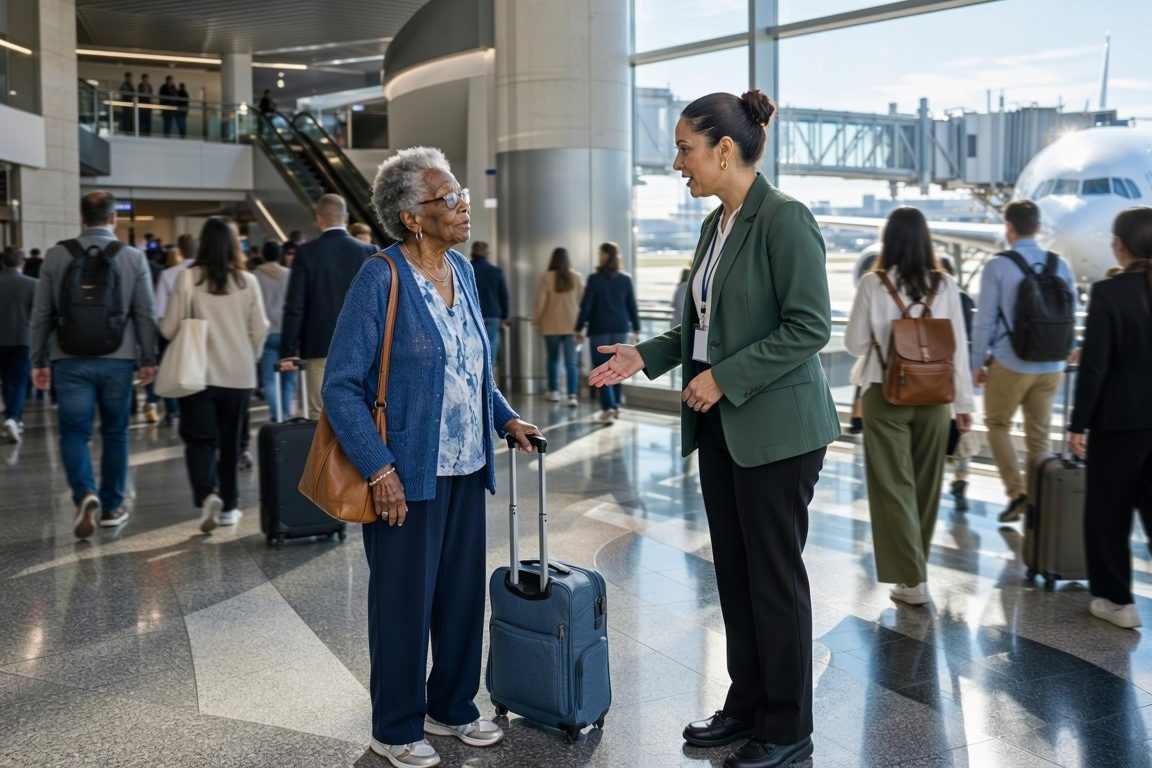
Step by step
What not to do
- Do not ask rapid questions like 'What is your name? Where do you live?', use one-step requests such as 'Let us sit down' instead.
- Do not grab their arm or steer them physically, offer your arm and let them choose to take it.
- Do not assume they are drunk or mentally ill; treat them with the same dignity you would want for a family member.
- Do not leave them alone to 'go find help', stay with them or hand off directly to a specific person who agrees to stay.
- Do not argue if they say something untrue like 'I am waiting for my mother'; acknowledge the feeling and redirect gently.
Key points
- Approach slowly, from the front, with a warm smile and simple words. Do not startle or overwhelm the person.
- Look for a medical ID, phone, or any identification. If you find a contact number, call it immediately.
- If you cannot find a contact, stay with the person and ask airport staff to page for a lost care partner or call security.
- Do not argue, grab, or leave the person alone. Your calm presence is the most powerful tool you have.
- Use simple, reassuring phrases like 'You are safe' and 'I am here to help.' Avoid questions that require complex answers.
- If the person is pacing, walk with them instead of trying to stop them. Gently steer them to a safe area.
Videos
 How to get someone with dementia to accept help from others: 5 tips (plus bonus)This video gives practical tips for helping a person with dementia feel comfortable accepting help from strangers, which is exactly what a helper in an airport needs.
 10 Tips for Dementia Caregivers - Caring for Loved Ones with Memory Loss (and avoid burnout)Care partners will find tips on building a support network and asking for help, which can prevent separation in the first place.
 Dementia Care Partner Talk Show Podcast Ep. 61: Is It Distress or Attention Seeking?This podcast helps helpers understand that what looks like attention-seeking is often genuine distress, guiding a more compassionate response.
 Tip for handling embarrassment if your loved one with dementia is rude in publicCare partners may feel embarrassed if their person says something odd in public; this video offers strategies to handle it gracefully.
2 more videos
 Caregiver Support Session: Caregiving Throughout the Stages of DementiaThis session covers how care needs change across stages, helping care partners plan for safe outings at each stage.
 Teepa for Ten | People Living With Dementia: What Should I Do After a Diagnosis?Teepa Snow offers foundational advice for care partners, including how to prepare for public situations and build a care team.
Background
What is happening for the person with dementia
In a busy airport terminal, a person with dementia may become overwhelmed by noise, crowds, and unfamiliar signs. Their brain is struggling to process all this information, and they may feel lost, scared, or confused even if they look calm. They might not recognize that they are separated from their care partner, or they may be desperately trying to find them but unable to ask for help clearly. The person may be wandering aimlessly, repeating the same question, or appearing agitated. This is not intentional misbehavior; it is a symptom of their condition. Their ability to reason, remember, and communicate is impaired, so they cannot simply 'figure it out' or 'calm down' on their own.
Why the person might be distressed or attention-seeking
Humans naturally seek other humans when they need something or feel unsafe. For a person with dementia, this need is even stronger because they cannot always identify what they need or how to get it. They may call out, pace, or try to follow strangers because their brain is telling them they need connection and safety. This is not attention-seeking in a manipulative sense; it is a genuine expression of distress. As one expert notes, 'humans seek other humans when what they want, like, or need isn't immediately available.' So if you see someone who seems lost or upset, they are likely in real distress and need your help.
Why helpers often hesitate and why that is a mistake
Many people hesitate to approach someone with dementia in public because they are afraid of doing the wrong thing or intruding. But doing nothing is the wrong thing. Experts emphasize that 'by doing something is the right thing... doing nothing is the wrong thing.' The person with dementia may be at risk of wandering onto a tarmac, falling, or becoming more frightened. Your calm presence and simple words can be the lifeline they need. You do not need to be a professional; you just need to be kind, patient, and follow a few simple steps.
Practical tools
3
Emergency contact card or medical ID
Have the person carry a laminated card or wear a medical ID bracelet reading: 'I have dementia. If alone, call [care partner name] at [phone number].' Include a photo of the care partner for easy recognition.
Airport paging protocol
GPS tracker or live location sharing
Equip the person with a GPS wearable (e.g., AngelSense), an AirTag in their bag, or enable live location sharing on their smartphone before the trip to reduce search time if separation occurs.
Different situations
If the person has Lewy body dementia
People with Lewy body dementia may have visual hallucinations or sudden changes in alertness. If they seem to be staring at something that is not there, do not argue. Instead, say, 'I see you are looking at something. Let us walk this way.' They may also have more trouble with balance, so offer your arm and move slowly.
If the person is in late-stage dementia
In late stages, the person may not speak or may only repeat sounds. Use gentle touch on the arm or shoulder, and speak in a soft, rhythmic voice. They may respond to a familiar song or a simple pat. Do not expect them to understand your words; your calm presence is what matters most.
If you are a helper who is also a stranger
As a stranger, you may be met with suspicion or fear. Start with a warm smile and a slow approach. If they pull away, give them space and say, 'I am just here to help. I will wait here.' If they become aggressive, step back and call security. Your safety matters too.
If the care partner is an adult child vs. a spouse
An adult child may feel guilty or embarrassed about the separation. Reassure them: 'This happens to many families. You are doing a great job.' A spouse may be more distressed and grateful. Offer practical help, like sitting with the person while the spouse uses the restroom or gets food.
If the person is in a facility or group setting
In a facility, staff are trained to handle wandering. If you find a resident alone, alert a staff member immediately. Do not try to return them to their room yourself, as you may not know the correct protocol. Stay with them until staff arrive.
For the doctor
3
- If the person with dementia has a history of aggressive behavior or falls, discuss with their doctor whether a medical ID bracelet with a fall risk alert is appropriate.
- If the person is on medications that affect balance or cognition (e.g., sedatives, antipsychotics), ask the clinician how these might affect their behavior in public and what to watch for.
- If the care partner is considering a GPS tracking device for the person, discuss with the clinician whether this is appropriate for the person's stage and cognitive abilities.