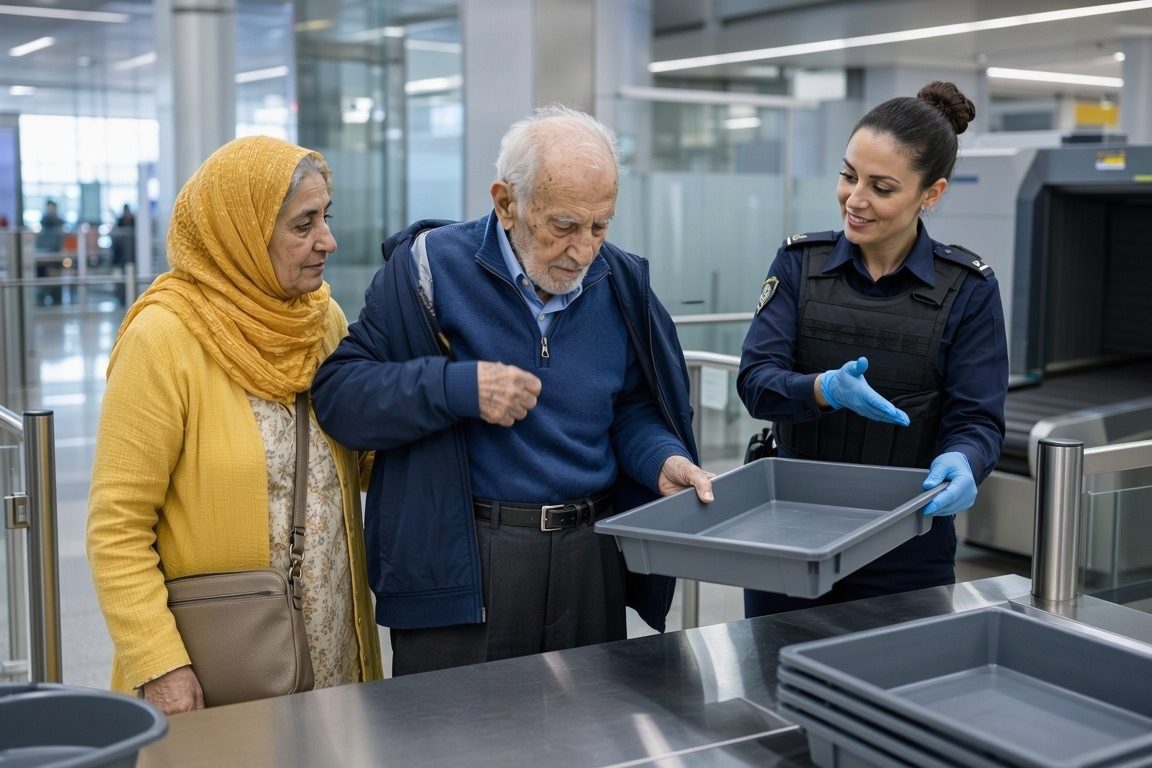
Step by step
What not to do
- Do not assume the check-in agent will automatically know your companion has dementia. Many people with dementia look perfectly healthy. If you don’t speak up, the agent may treat them as fully capable, leading to confusion and frustration.Instead, calmly disclose the diagnosis at the start of the interaction.
- Do not ask your companion open-ended questions like 'Which seat do you want?' or 'How do you want to pay?' This forces them to make a choice they may not be able to process, which can trigger anxiety or a meltdown.Instead, offer only two clear options: 'Window or aisle? Point to the one you like.'
- Do not rush through the check-in process. If you try to speed things up, you may miss cues that your companion is overwhelmed, like fidgeting, looking away, or repeating the same question. Slow down, take a breath, and match your pace to theirs.
- Do not argue with your companion if they insist on doing something a certain way (e.g., wanting to hold their own passport). This can escalate into a power struggle.Instead, say, 'Great, you hold it. I’ll keep mine. Let’s hand them together to the nice lady.'
- Do not skip the step of using earplugs and sunglasses. Even if your companion doesn’t seem bothered by noise or light, these tools prevent sensory overload before it starts. It’s much easier to prevent agitation than to calm it once it begins.
Key points
- Disclose the dementia diagnosis to airport staff early, it unlocks help and patience.
- Use earplugs and sunglasses before entering the terminal to prevent sensory overload.
- Pre-arrange a wheelchair or meet-and-greet service to get a dedicated escort through check-in and security.
- At the counter, speak for your companion using simple, closed-ended questions and guided actions.
- Carry a printed disclosure card and companion cards to ease communication in noisy environments.
- Stay with your companion at all times, never leave them alone, even for a moment.
Videos
 Travel with Dementia - How to Assist at the Airport Check-in CounterThis video directly demonstrates the step-by-step process of assisting someone with dementia at the check-in counter, including how to guide their hand and simplify payment.
 Travel with Dementia - How to Help with Making a Selection in a Retail StoreAlthough focused on retail, the same principles of reducing choices and using clear visual cues apply directly to the check-in counter environment.
 Conscious Caregiving with L & L 'Seniors and Travel'Covers broader travel tips including airport navigation, disclosure strategies, and how to handle unexpected challenges with a calm mindset.
 Curious Conversations about Brain Change with Teepa Snow and the PAC™ TeamTeepa Snow explains the 'positive approach to care' and how to create dementia-friendly systems in any setting, including airports.

Practical tools
6
The 'Hidden Disability' Disclosure Card
Create a small card (business-card size) that says: 'My companion has dementia. Please speak slowly, use simple words, and direct all questions to me. Thank you for your patience.' Hand this to the check-in agent as you approach. This avoids having to explain verbally in a loud environment.
The 'Two-Step' Payment Script
When paying at the counter, use this exact phrase: 'We’re going to tap the card right here. I’ll put my hand over yours and guide you. Ready? One, two, three, tap.' This turns a confusing action into a simple, shared movement. Practice it at home before the trip.
Sensory Toolkit: Earplugs and Sunglasses
Pack high-fidelity earplugs (like Loop or Eargasm) that reduce noise but still let you hear speech. Bring wraparound sunglasses that block peripheral flashing lights. Put them on your companion before entering the terminal. Say: 'These help your brain stay calm. Let’s put them on together.'
The 'Quiet Corner' Strategy
Before check-in, locate a quiet seating area away from the main flow. Use this as a 'reset zone' if your companion becomes overwhelmed. Sit for 2-3 minutes, offer a sip of water, and say: 'We’re doing great. Let’s take a little break before we go to the counter.'
Printed Companion Cards
Print a set of cards from the Alzheimer’s Association website (or make your own) that say things like: 'I have dementia. Please be patient.' or 'I need help finding my gate.' Keep these in your companion’s pocket or your own, and hand one to the check-in agent if verbal communication is difficult.
The 'Meet-and-Greet' Service Request
When booking your flight, ask: 'Do you offer a meet-and-greet service for passengers with disabilities?' Many airlines do, and it includes a staff member who meets you at the curb, helps with check-in, and escorts you through security to the gate. This service is often free and can be arranged by calling the airline’s special assistance line.
Different situations
Early-stage dementia (mild cognitive impairment)
Your companion may still be able to handle some steps independently, like handing over their ID or tapping a card. Let them do what they can, but stay close to step in if they hesitate. Use the 'Two-Step' script to guide rather than take over. Avoid treating them like a child, say, 'I’ll help you with this part' instead of 'Let me do it.'
Middle-stage dementia (moderate impairment)
Your companion will likely need full assistance at the counter. Use the disclosure card and speak for them from the start. Keep them physically close, hold their hand or keep a hand on their shoulder. The wheelchair escort is highly recommended here, as it provides a structured path through the entire airport.
Lewy body dementia (with visual hallucinations or movement issues)
The flashing lights and moving screens at check-in can trigger hallucinations or confusion. Use sunglasses and earplugs without fail. If your companion becomes frightened by something they see, don’t argue, say, 'I see something too. Let’s look away together.' Ask the agent to turn off the screen or point you to a less stimulating area.
Spouse caregiver vs. adult child caregiver
A spouse may be more attuned to subtle mood changes but may also feel embarrassed about asking for help. Remind yourself: asking for assistance is not a failure, it’s a tool. An adult child may feel more comfortable being assertive with staff but should avoid sounding bossy. Both roles benefit from rehearsing the disclosure phrase: 'My husband/wife/mom/dad has dementia, and we need a little extra help.'
Traveling alone (early stage, independent traveler)
If the person with dementia is traveling alone, they should call the airline ahead to arrange a meet-and-greet service. At check-in, they can hand the agent a pre-printed card: 'I have early-stage dementia. Please help me check in and direct me to the gate.' They should also wear a medical ID bracelet and carry a phone with emergency contacts pre-programmed.
For the doctor
3
- Ask your doctor if your companion’s current medications might cause drowsiness or confusion during travel, and whether a temporary adjustment is safe.
- Discuss whether a sedative or anti-anxiety medication is appropriate for the flight itself, and if so, how to time it so it takes effect after check-in is complete.
- If your companion has a history of agitation or aggression in stressful situations, ask your clinician for a behavior management plan that includes de-escalation techniques you can use at the airport.