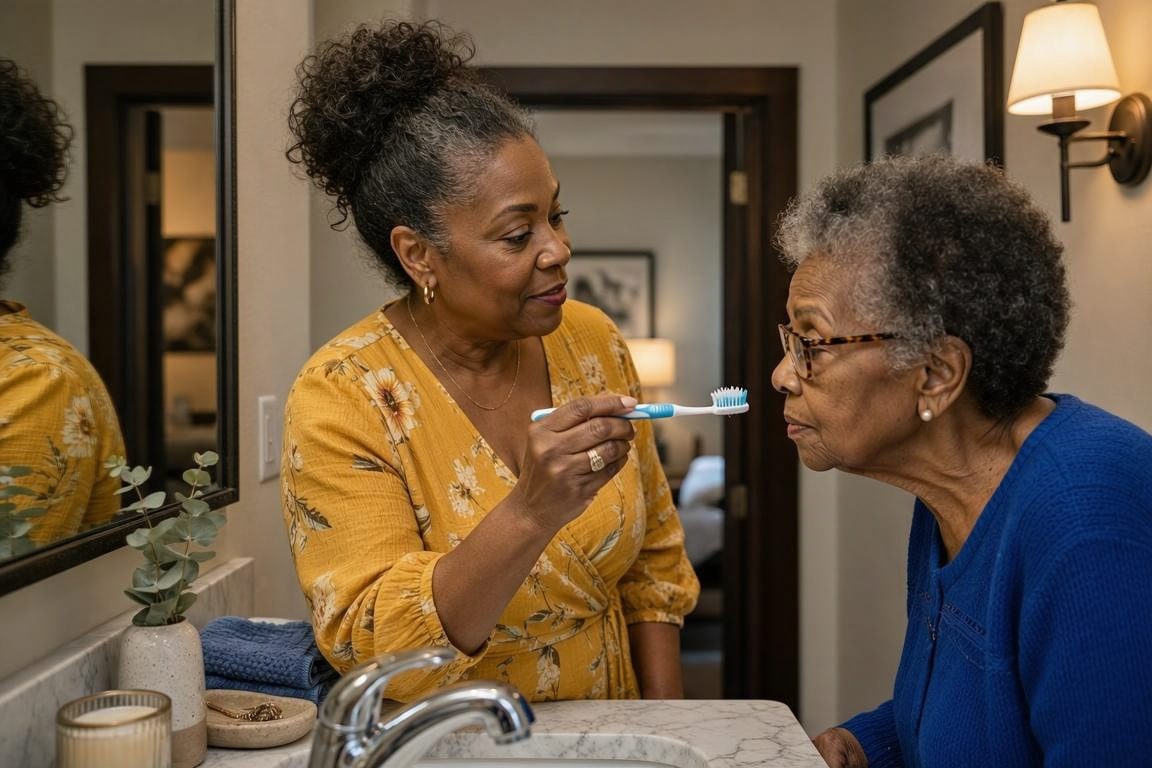
What not to do
- Do not force the mouth open or restrain the person.
- Do not use upward or sawing motions that can feel invasive or cause gagging.
- Do not argue or insist on a full cleaning if the person resists, stop and try again later.
- Do not use standard angled brushes that require specific positioning and can confuse the person.
- Do not skip mouth care because of resistance; partial cleaning reduces infection risk.
Key points
- The Collis Curve toothbrush has curved bristles that clean all tooth surfaces at once, reducing the need for multiple motions and making mouth care faster and less invasive.
- Approach from the side, stand on their dominant side, and use single-step instructions to reduce anxiety and resistance.
- If your loved one swallows toothpaste, use baking soda toothpaste or just water. Avoid mouthwash unless cleared by a doctor.
- Do not force the brush into their mouth. Stop if they resist and try again later. Even a partial cleaning is beneficial.
- Consistency and a calm, positive tone are more important than perfect technique. Praise them for any cooperation.
- Poor oral health is linked to a higher risk of dementia progression, so maintaining mouth care is a key part of overall brain health.
Videos
 Oral Care Tips for Loved Ones with DementiaThis video demonstrates practical techniques for approaching mouth care with a person who has dementia, including positioning and communication tips.
 Collis Curve for Assisted Mouth Care with DementiaThis video shows exactly how to use the Collis Curve toothbrush in a real caregiving situation, including how to hold it and what motions to use.
 Ask Teepa Anything! Live on YouTubeTeepa Snow answers caregiver questions about mouth care and offers insights into why people with dementia resist and how to work with their brain changes.
 Oral Hygiene Concerns and Options for GEMS States | Teepa's ClipsThis clip explains how to adapt mouth care for different stages of dementia, including the use of the Collis Curve and other tools.
2 more videos
 What Is A Good Gift To Give For Someone With Dementia?While not directly about mouth care, this video discusses comfort items that can help soothe anxiety, which may make mouth care easier.
 Dementia Caregiving: How to Get Them to EatThis video covers strategies for encouraging cooperation during daily care tasks, which can be adapted for mouth care.
Background
Why mouth care becomes difficult in dementia
As dementia progresses, the brain struggles to process familiar routines. Brushing teeth involves many steps: recognizing the need, finding the bathroom, picking up the toothbrush, applying toothpaste, moving the brush in a specific pattern, spitting, and rinsing. For someone with dementia, this sequence can feel overwhelming or even threatening. They may forget why they are holding a brush, feel confused by the sensation of bristles in their mouth, or become anxious about the caregiver's hand coming toward their face. This is not willful resistance; it is a neurological response to a task that no longer makes sense to them.
How the Collis Curve toothbrush helps
The Collis Curve toothbrush has a unique design: its bristles are curved so that when you place the brush on the chewing surface of the teeth, the bristles automatically reach both the outer and inner surfaces at the same time. This means you do not need to angle the brush or ask the person to open wide for separate strokes. The brush was originally developed for children, but its design works well for people with dementia because it reduces the number of movements and the amount of time the brush is in the mouth. It also requires less cooperation from the person, which can lower anxiety and resistance.
The bigger picture: oral health and brain health
Research has shown that poor oral health is linked to a higher risk of cognitive decline. One large study found that people with gum disease have a greater chance of developing Alzheimer's disease, and each missing tooth is associated with about a 1.1% increased risk of dementia. Overall, poor oral health is linked to a 21% increase in dementia risk. While the Collis Curve is not a cure, it is a practical tool that helps you maintain your loved one's oral hygiene, which may support their overall brain health and prevent painful mouth infections that can worsen confusion or behavior.
Practical tools
3
Collis Curve toothbrush
Curved bristles that simultaneously clean outer, inner, and chewing surfaces with a simple back-and-forth motion on the chewing surface, reducing the need for complex brushing patterns.
Soft-bristled toothbrush (optional)
For gentle tongue and palate brushing if the Collis Curve is not tolerated for those areas.
Sponge swab or moistened mouth swab
For moisturizing the mouth and removing debris when spitting or rinsing is not possible.
Different situations
Lewy body dementia (LBD)
People with LBD often have sensitivity to touch and may recoil when you approach their face. Use a very light touch and approach from the side. They may also have swallowing problems, so use only a pea-sized amount of toothpaste or just water. Be prepared for sudden changes in cooperation from day to day.
Late-stage dementia
In late stages, the person may be unable to open their mouth or follow any verbal cues. Focus on wiping the front teeth and gums with a wet cloth or using a finger brush. Use a mouth prop only if you are trained. Prioritize comfort and dignity over thorough cleaning. A quick wipe twice a day is sufficient.
Spouse vs. adult child caregiver
A spouse may have an easier time with physical closeness and may be able to use hand-under-hand more naturally. An adult child may need to build trust first. If the person with dementia is confused about who you are, introduce yourself calmly: 'Hi Mom, it's me, Sarah. I'm going to help you clean your teeth.'
In a facility or with home care aides
If you are not the primary caregiver, share this article with the care team. Ask them to use the Collis Curve toothbrush and to follow the same step-by-step approach. Consistency across caregivers reduces confusion. You can also request that mouth care be done at the same time each day.
Medicaid or limited budget
The Collis Curve toothbrush is relatively inexpensive (around $10-15) and can be reused for months. If cost is a barrier, a soft-bristled child's toothbrush can be a substitute, though it will require more angling. Baking soda toothpaste is very cheap. You can also ask a dentist if they have samples or low-cost options.
For the doctor
4
- If your loved one has a history of swallowing problems or choking, ask their doctor or speech therapist whether it is safe to use toothpaste or mouthwash, and whether a mouth prop is appropriate.
- If your loved one has bleeding gums, loose teeth, or mouth pain, consult a dentist before continuing with any brushing routine. They may need a professional cleaning or treatment for gum disease.
- If you are considering using an anti-plaque rinse or mouthwash, ask the doctor or dentist if it is safe given the risk of swallowing. Some rinses contain alcohol or other ingredients that can be harmful if ingested.
- If your loved one has dentures and you notice sores or irritation in their mouth, see a dentist. Ill-fitting dentures can cause infections and pain that may worsen behavioral symptoms.