Step by step
What not to do
- Do not use large, sudden hand gestures that startle the person. This can trigger a fight-or-flight response.Instead, keep your movements slow, predictable, and within their line of sight.
- Do not grab the person's hand without warning. This can feel invasive and cause resistance. Always offer your hand first and wait for a response. If they pull away, respect that and try again later.
- Do not use complex or unfamiliar hand signals. Stick to gestures that are universal or that you have used consistently. Avoid finger-pointing in a way that could be seen as accusatory.
- Do not speak louder or repeat yourself when gestures are not working. This often increases confusion.Instead, try a different gesture, slow down, or use a gentle touch on the arm to redirect attention.
- Do not ignore the person's hand movements. If they are fidgeting, tapping, or reaching, this is communication. They may be anxious, in pain, or seeking comfort. Respond to the hand movement with a gentle touch or a calming object.
- Do not use hand gestures that are too fast or too many at once. The brain cannot process rapid visual input. One gesture at a time, held steady, is most effective.
Key points
- Words are only 7% of communication; gestures and touch carry the rest.
- Always offer your hand first, before speaking, to set a calm tone.
- Use slow, simple, and consistent hand gestures that are easy to see and understand.
- Model actions with your own hands to show what you want the person to do.
- Hand-under-hand technique gives the person a sense of control and reduces resistance.
- Pay attention to the person's hand movements; they are a form of communication.
- Adapt your hand use to the person's stage of dementia and personal history.
Videos
 Alzheimer's Answers About AgingThis video explains why gestures are so effective when words fail, using everyday examples like 'eat' and 'stop' to show how hand signals can bridge communication gaps.
 Live Webinar with Teepa Snow and the Elizabeth Kubler-Ross FoundationTeepa Snow demonstrates the 'hand offer' technique and explains how to read a person's response to your hand, including what it means when they are curious or avoidant.
 Time with Teepa - Seeking Sensory Input, or Is It About Sexual Touch? Section 3This video addresses how to respond when a person reaches out to touch you, and how to use deep pressure hugs and hand-under-hand to meet their need for connection.
 Dementia Care Podcast #37: How to Provide Support When Physical Resistance PresentsLearn how hand gestures and hand-under-hand techniques can reduce physical resistance during care tasks, with practical examples from real caregivers.
2 more videos
 Understanding the signs of paranoia, hallucinations and delusional behaviors w/ Lucy Barylak Sept 12This video shows how gentle hand use and touch can redirect a person from hallucinations or delusions, and how to use hand gestures to acknowledge their feelings without arguing.
 Multimodal Comprehensive Care Communication Skills in Dementia CareThis video covers the importance of touch interaction in communication, including how to use hand gestures to build trust and reduce confusion during care.
Background
Why Words Fail and Hands Succeed
As dementia progresses, the brain's ability to process spoken language declines significantly. Research shows that only about seven percent of communication is carried by words, even for people without cognitive challenges. For someone with neurodegeneration, that percentage drops even further. This means that when you rely only on what you say, you are asking the person to decode a signal their brain can no longer easily interpret. Gestures, on the other hand, tap into more primitive, visual, and motor pathways that often remain intact longer. A simple hand motion for 'come here' or 'eat' can be understood instantly, even when the spoken version is confusing.
The Brain's Shift to Visual and Tactile Processing
The person's brain is changing how it takes in information. They may become easily startled or have a heightened fight-or-flight response because they can no longer filter and process sensory input the way they used to. Hand gestures provide a slower, more predictable, and less threatening form of input. When you pair a gentle hand movement with a few simple words, you give the brain two channels to work with. If the verbal channel fails, the visual and tactile channels can still carry the message. This is why offering your hand first, before speaking, can set a positive tone for the whole interaction. The person sees your open hand and knows you are approaching with kindness, not demands.
Hand Use as a Tool for Connection and Calm
Touch is a fundamental human need, and for someone with dementia, it can be even more important. When the person reaches out to touch your hand or an object you offer, they are signaling a willingness to engage. This is not just about communication; it is about building trust and reducing distress. A gentle hand-on-hand or hand-under-hand approach can soothe agitation, redirect attention away from hallucinations or delusions, and create a sense of safety. The act of touching something familiar, like a soft fabric or a familiar object, can ground the person in the present moment and reduce anxiety. Even a simple handshake can be a familiar, non-threatening way to start an interaction.
Practical tools
6
The 'Hand Offer' Script
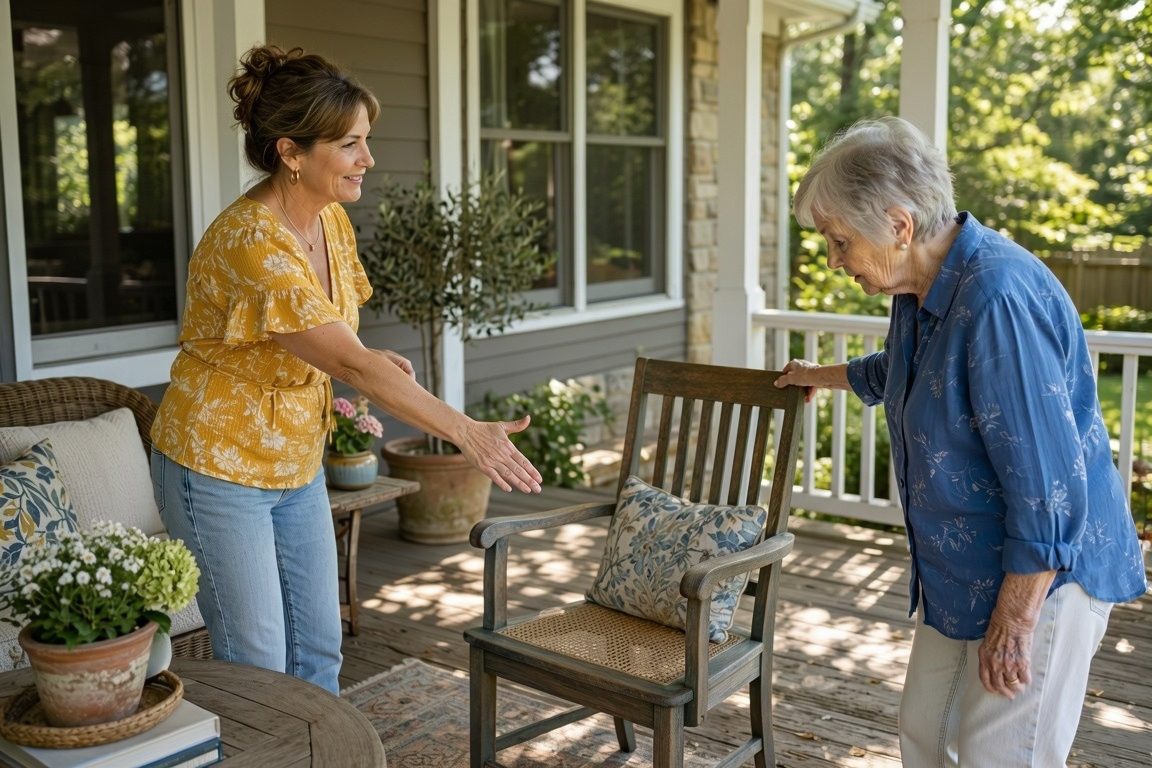
Exact words to say while offering your hand: 'Hi [name], it's me. I'm going to help you with [task]. Would you like to hold my hand?' Hold your hand out, palm up, at a comfortable distance. Wait at least 10 seconds for a response. If they reach out, you have a green light. If they do not, try a different approach or come back later.
The 'Modeling' Technique
When you want the person to do something (like eat, drink, or brush hair), first do the action yourself with your own hands, slowly and exaggeratedly. For example, pick up a spoon, bring it to your mouth, and say 'Mmm, good.' Then offer the spoon to them. This uses their visual system to understand the task.
The 'Two-Object Choice' Method
Hold up two objects (e.g., a red cup and a blue cup) in your open hands. Say, 'Which one would you like?' Let them touch or point to their choice. This reduces verbal demands and gives them a sense of control. Works well for food, clothing, or activity choices.
The 'Deep Pressure Hug'
If the person is seeking touch or seems anxious, offer a gentle, firm hug with deep pressure. Say, 'I am so glad to be with you.' Apply steady pressure for a few seconds, then release. This can provide proprioceptive input that calms the nervous system. Only do this if you have an established trusting relationship.
The 'Timely Warning' Gesture
Before any care task (like bathing or dressing), use a hand gesture to warn the person. For example, hold up your hand and say, 'In a moment, I'm going to help you get cleaned up.' Then wait. This gives their brain time to process the upcoming change, reducing distress. Follow with an open hand to ask for permission.
The 'Texture Touch' Object
Keep a small, soft object (like a fleece square, a smooth stone, or a textured ball) in your pocket. If the person is fidgeting or reaching for you, offer the object for them to hold and manipulate. This can redirect their need for tactile input and provide comfort. Washable items are best.
Different situations
Lewy Body Dementia (LBD)
People with LBD often have visual hallucinations and fluctuating attention. Use hand gestures even more slowly and deliberately. Avoid sudden movements that could be misinterpreted as part of a hallucination. Offer your hand and wait for them to initiate touch. If they seem frightened, use a calm, open palm gesture and speak in a low, soothing tone. The 'two-object choice' method can be very helpful here, as it grounds them in reality.
Late Stage Dementia
In late stages, the person may have limited ability to use their hands voluntarily. Focus on gentle, passive hand use. Place your hand under theirs and guide them through a simple motion, like bringing a spoon to their mouth. Use hand-under-hand for all care tasks. Even if they cannot respond, the warmth of your hand can provide comfort. Avoid any gestures that require them to initiate movement.
Spouse vs. Adult Child Caregiver
A spouse may have a long history of physical intimacy, so hand gestures can feel natural and comforting. However, be careful not to assume the person still recognizes you as a partner. Use the same 'hand offer' technique to check for willingness. An adult child may need to be more formal initially. Use hand gestures that are respectful and not overly familiar. For both, consistency in hand signals builds trust over time.
In a Facility Setting
In a facility, the person may be overstimulated by noise and activity. Use hand gestures that are slow and within their personal space. Avoid waving your hands in front of their face. Use the 'hand offer' to establish connection before any care task. If the person is resistant, a gentle hand-on-shoulder can be a non-threatening way to redirect. Coordinate with staff to use the same hand signals for consistency.
Medicaid or Low-Resource Settings
You may not have access to many specialized products, but your hands are free and always available. Focus on the 'hand offer' and 'modeling' techniques, which require no tools. Use everyday objects like a cup, a spoon, or a piece of clothing to demonstrate tasks. The 'deep pressure hug' costs nothing and can be very effective. Prioritize building a calm, predictable routine with consistent hand gestures.
For the doctor
4
- If the person becomes aggressive or frightened when you use hand gestures, discuss with a clinician whether there may be undiagnosed pain, vision problems, or a medication side effect contributing to their response.
- If the person has a history of stroke or paralysis affecting their hands, ask a clinician or occupational therapist for adapted hand gestures or alternative communication methods.
- If the person is on medications that affect motor control (like antipsychotics or Parkinson's drugs), discuss how to safely use hand-under-hand techniques without causing discomfort or injury.
- If you notice the person's hand movements are new, repetitive, or seem to indicate distress (like constant rubbing or picking), consult a clinician to rule out pain, infection, or a neurological change.