Step by step
What not to do
- Do not hand them supplies and walk away. This can cause confusion, frustration, or even agitation because their brain cannot initiate the activity.Instead, sit down and start the activity yourself, then invite them to join you.
- Do not correct or 'fix' their work. If they paint a tree purple, do not say, 'Trees are green.' This can feel like criticism and may make them feel ashamed or defensive.Instead, say, 'That purple is so vibrant. I love how you chose that color.'
- Do not insist on the original form of the hobby. If they used to paint detailed landscapes but now can only make broad strokes, do not push them to go back to detail. Let the activity evolve naturally. As one expert says, if painting becomes too hard, try making a salad together, still creative, still hands-on, but different.
- Do not assume they cannot do something because of the diagnosis. Many families assume a person with dementia cannot create anymore, so they stop offering opportunities. But as one care specialist notes, people with dementia can still do creative work if you adapt the activity. Always try first, with support.
- Do not use the activity as a way to keep them 'out of your hair.' If you treat it as busywork, they will sense it. The activity must feel meaningful to them. If you are just trying to occupy them, they may become bored or resistant.Instead, find a way to make it feel like a genuine contribution or shared experience.
- Do not force it if they are not in the mood. Some days they will not be interested, and that is okay. Respect their 'no.' Say, 'That's fine, maybe another time.' Then try a different activity or just sit quietly together. Forcing creativity can create negative associations that make future attempts harder.
Key points
- Creative work is still possible and valuable throughout Alzheimer's, but it must be adapted to the person's current ability level, not their past one.
- Always give the activity a purpose, even a small one, to make it feel meaningful and reduce the pressure to 'perform.'
- Set up the environment and materials before inviting them to join, and start the activity yourself to model what to do.
- Use positive, encouraging language: 'You're doing great,' 'I love how you chose that color,' 'Take your time.'
- End the activity before frustration sets in, and celebrate the process, not the product.
- Keep a few simple, ready-to-go creative kits on hand for moments when you need to redirect or fill time.
Videos
 How to keep a dementia patient busyShows practical, low-prep activities that can be adapted for creative work, including using household items.
 3 Activities for Dementia Patients to Do AloneDemonstrates simple, self-directed tasks that can be set up for independent creative play, useful for when you need a few minutes.
 How To Stop A 'Frustrating' Dementia BehaviorExplains how to redirect frustration into a positive activity, which is key when creative work becomes overwhelming.
 Online Dementia Journal | Conversations with PAC Core Team Members: NiaOffers insight into adapting hobbies like sketching and cooking for someone with dementia, with a focus on maintaining dignity.
2 more videos
 Ep. 150: Adult Day Center Care vs Respite CareHelps you consider whether a day center with structured creative activities might be a good option for your loved one.
 How to increase activity for someone with dementiaProvides a framework for gradually increasing engagement in creative and physical activities as ability changes.
Background
Why creative work still matters
Creative activities tap into parts of the brain that remain strong longer in Alzheimer's. The ability to feel emotion, to enjoy color and texture, and to experience a sense of accomplishment often persists even when memory and language fade. When a person with dementia engages in art, music, or hands-on making, they are not just 'keeping busy', they are expressing themselves, maintaining a sense of identity, and connecting with you in a way that words cannot. As one dementia care specialist explains, creative endeavors allow the person to express themselves, whether through painting, sculpting, or arranging flowers. This is not about producing a masterpiece; it is about the process of creating, the feeling of doing something meaningful.
What changes as Alzheimer's progresses
In early stages, the person may still be able to follow complex steps and use tools safely. They might paint, write, or play an instrument with only minor adjustments, like having a simpler pattern or a larger brush. As the disease moves into middle stages, the ability to plan and initiate becomes harder. They may stare at a blank page and feel frustrated because they cannot start. This is not a lack of interest; it is a brain that has lost the 'go' signal. In later stages, the focus shifts to sensory experience and simple repetitive motions, like squeezing clay, tearing paper, or stirring a bowl. The key is to match the activity to the current ability level, not to what they used to do. As one expert notes, the activity must not be beyond their capabilities, and it must be interesting and purposeful enough to hold their attention.
The problem with 'just handing them supplies'
A common mistake is to set out art materials and expect the person to start creating on their own. But Alzheimer's affects the brain's ability to initiate an activity. If you simply put a brush and paper in front of them, they may feel confused or overwhelmed. They might even become agitated because they know they should be able to do something but cannot figure out how. Instead, you need to provide a clear, simple invitation, and often a reason. One strategy that works well is to give the activity a purpose. For example, you might say, 'The kids at the school are struggling with an art project and need some examples. Could you make a few for them?' This gives the person a role, a reason, and a sense of contribution. It also sets them up for success because you are not asking them to invent something from scratch.
Practical tools
6
The 'Purposeful Invitation' Script
Exact words to say when inviting them to create: 'I need your help with something. The kids at the school need examples of flowers for their art project. Could you make a few with these markers? I'll do one too.' Or: 'I'm making a card for your sister. I can't decide on the colors. Can you help me pick?' This script gives a reason, a role, and a low-pressure start.
The 'Rummage Box' for Creative Play
A box filled with safe, interesting objects:
Let them explore and arrange items however they like. This works well for people who like to take things apart or sort. As one expert suggests, if they were always 'Mr. Fix-It,' give them plastic pipes or Legos to assemble and disassemble.
Adapted Art Supplies Checklist
Keep these on hand:
For cooking, use a salad spinner, a plastic knife for soft fruits, or a hand mixer with a large bowl.
The 'Shared Making' Setup
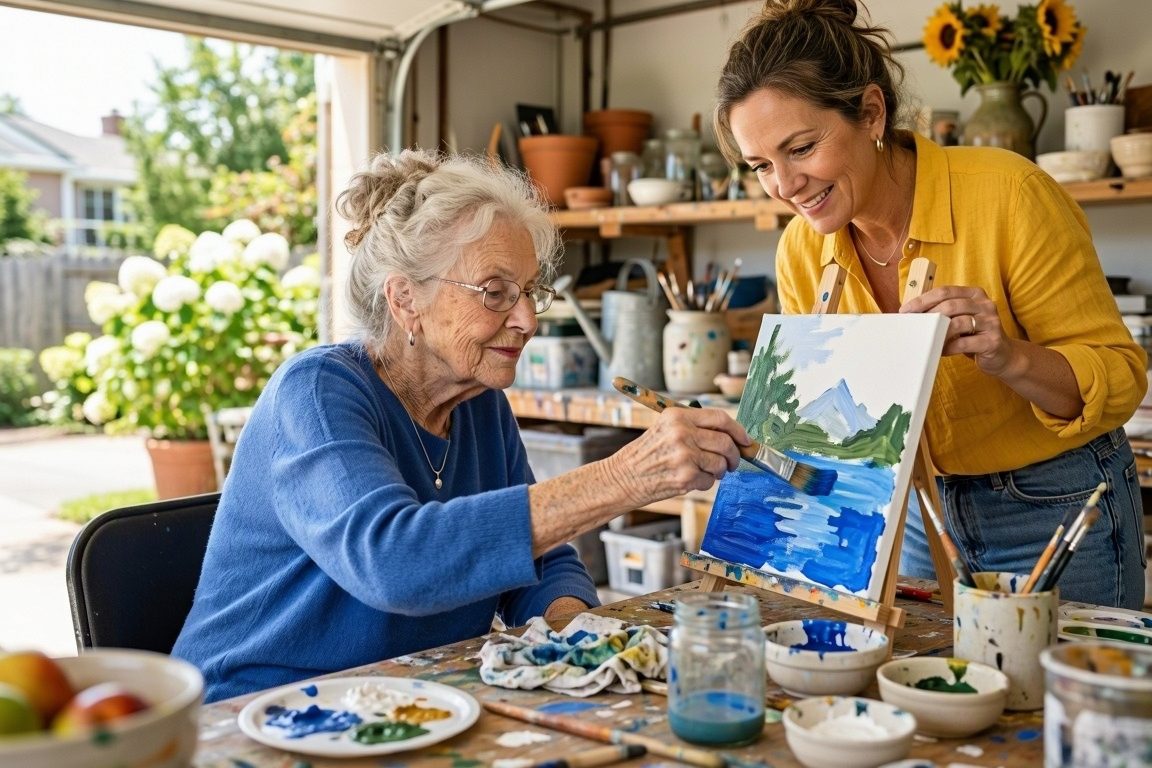
Set up two workstations side by side. You each have the same materials. Say, 'Let's make something together.' You start your own project, narrating what you do: 'I'm going to draw a big circle. Now I'm adding some lines.' This models the activity and gives them a template to follow without pressure. It also turns the activity into a social, shared experience.
The 'Sensory Art' Kit for Later Stages
For someone who can no longer hold a brush or follow directions, focus on sensory input. Fill a shallow tray with sand, rice, or shaving cream. Let them run their fingers through it. Or provide a basket of fabric squares in different textures (velvet, silk, corduroy, wool). Or give them a lump of clay to squeeze and pat. The goal is not to make something, but to feel something.
The 'Music + Art' Combo
Before starting any creative work, play a song from their youth that they loved. Let them listen, clap, or hum along. Then, while the music is still playing, introduce the art activity. The music can help regulate mood and reduce anxiety, making them more open to the creative task. Keep the volume low enough that it does not compete with your voice.
Different situations
Early-stage Alzheimer's (still independent with some memory loss)
They can likely still do most of their original hobby with minor adjustments. For example, if they painted, provide a pre-sketched outline or a photograph to copy. If they cooked, let them plan a simple meal with you, but handle the hot stove yourself. They may still enjoy reading or writing; try large-print books or a journal with prompts. The key is to offer support without taking over. Let them lead as much as possible, and only step in when they show frustration.
Middle-stage Alzheimer's (needs help with planning and initiation)
This is when you need to break activities into very small steps. Do not expect them to start on their own. Instead, set everything up and invite them to join you in the middle of the process. For example, if they used to knit, cast on the stitches yourself and then hand them the needles and say, 'Can you do a few rows?' If they used to garden, bring a pot of soil and a few seedlings to the table and say, 'Let's plant these together.' Use the 'purposeful invitation' script heavily. Offer choices between two options, not open-ended questions.
Late-stage Alzheimer's (limited verbal ability, needs full assistance)
Focus on sensory and repetitive activities. They may enjoy feeling different textures, watching colors mix, or hearing the sound of paper tearing. Do not expect a finished product. Instead, value the process. For example, give them a soft cloth to fold and unfold, or a bowl of warm water with floating flowers. Play music they loved and gently move their hands to the rhythm. The goal is comfort, connection, and gentle stimulation. Always watch for signs of overstimulation (turning away, tensing up) and stop immediately.
Spouse vs. adult child caregiver
If you are the spouse, you may have decades of shared history to draw from. Use that: 'Remember how we used to paint together on Sundays? Let's try that again.' You can also use inside jokes or references that only you two share. If you are an adult child, you may need to be more creative in finding activities that feel natural. You might say, 'Mom, I found your old knitting needles. Will you teach me?' This reverses the role and gives them a sense of expertise. Avoid treating them like a child; instead, treat them as a collaborator.
In a facility or adult day center
Coordinate with the activities staff. Share what your loved one used to enjoy and what adaptations work at home. Many facilities have art therapy programs, but they may not know the person's history. You can also bring in familiar supplies from home. If the person is in a group setting, ask if they can have a quiet corner to work alone if they get overwhelmed by noise. Some people with Alzheimer's do better in a one-on-one setting than in a group.
For the doctor
5
- Ask the doctor or occupational therapist: 'Is my loved one cleared for light physical activity like chair yoga or tai chi, which can be combined with creative movement?'
- If the person has a history of falls or uses a wheelchair, ask: 'What modifications do I need to make to the work surface height and chair stability to keep them safe while doing art?'
- If the person has vision or hearing loss, ask: 'How can I adapt art materials (e.g., high-contrast colors, tactile markers) to accommodate these sensory changes?'
- If the person is on medications that cause drowsiness or tremors, ask: 'Are there times of day when they are most alert and steady for creative activities?'
- If the person has a history of putting non-food items in their mouth, ask: 'What materials are safe to use (e.g., non-toxic, large enough not to swallow) for sensory art activities?'