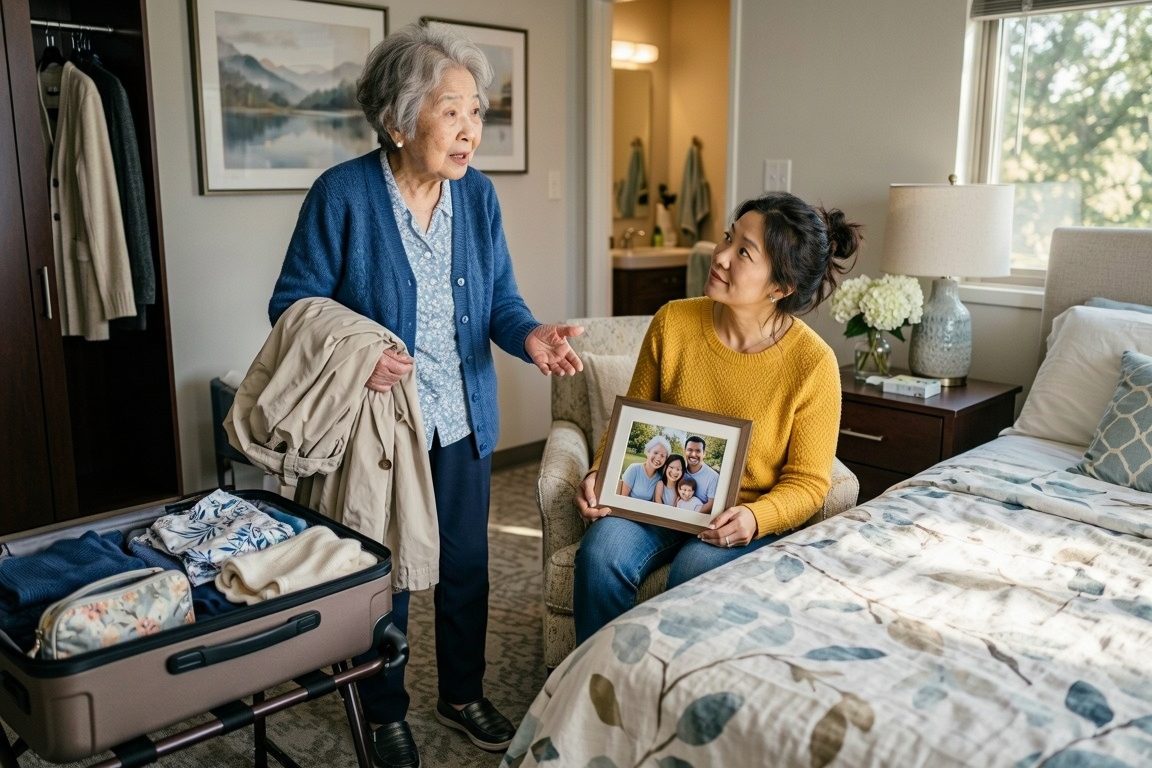
Step by step
What not to do
- Do NOT say 'You are home now, remember?' This forces them to try to remember something their brain cannot access, leading to frustration and arguments.Instead, validate the feeling: 'You're missing home: I get that.'
- Do NOT argue or try to reason with them about the move. Saying 'We moved you here for your safety' or 'You've been here for two weeks' will only escalate their distress. Their brain cannot process that logic.Instead, focus on the present moment and what they need right now.
- Do NOT take it personally. When they say 'I want to go home,' it is not a rejection of you or the care you've arranged. It is a symptom of their disease. Remind yourself: this is the dementia talking, not your loved one.
- Do NOT use a harsh or exasperated tone. Even if you've heard it a hundred times, your tone matters. A sigh or a sharp 'We've been through this' can trigger more anxiety. Use a soft, curious voice: 'Oh, you want to go home? Tell me about home.'
- Do NOT try to 'fix' it by showing them photos of their old house or reminding them it's sold. This can be deeply confusing and painful.Instead, let them talk about the home they remember, even if it no longer exists.
- Do NOT leave them alone in distress. If they are agitated and asking to go home, stay with them or ensure a staff member is nearby. Isolation can worsen their fear. Use your presence as a calming anchor.
Key points
- Never argue or correct, validation is your first and most powerful tool.
- The 'go home' request is about emotional safety, not a physical address.
- Transition trauma can last 2-8 weeks; have a consistent, compassionate plan.
- Use sensory anchors (familiar objects, routines, scents) to make the new environment feel safer.
- Your tone and presence matter more than your words, stay calm and curious.
- Involve staff in the same approach for consistency and better outcomes.
Videos
 I WANT TO GO HOME! dementia challengeThis video shows a real-life demonstration of how to handle the 'go home' request without arguing, using validation and redirection.
 How To Respond When Someone With Dementia Constantly Asks To Go HomeProvides clear, step-by-step phrases to use when the request is repetitive, especially useful for new placements.
 3 Activities for Dementia Patients that Stop 'I Want to Go Home'Offers three concrete activities that can redirect the person's focus and reduce the frequency of the request.
 Why Do Dementia Patients Want To Go Home?Explains the neurological reasons behind the request, helping caregivers understand it's not personal.
2 more videos
 What to Do When Someone with Dementia says 'I Want to Go Home' (The BIG Mistake You're Making)Highlights the common mistake of correcting the person and offers alternative approaches.
 Dementia Care Partner Talk Show Podcast: Ep. 86 - 'I Want to Go Home!'In-depth discussion with Teepa Snow on the emotional meaning of 'home' and how to respond with empathy.
Background
What's Really Happening: The Emotional Cry Behind 'Home'
When a person with dementia says 'I want to go home' after moving into a memory care facility, they are not making a logical request about a physical address. Their brain has lost the ability to form new memories of the new environment, so the facility feels foreign and unsafe. The word 'home' has become a symbol for safety, comfort, and the familiar, often tied to a childhood home or a time when they felt in control. As dementia progresses, recent memories (including the move itself) are erased, leaving only older, more deeply embedded memories of a home that may no longer exist. This is not a rejection of you or the care you've arranged; it's a neurological symptom of disorientation and fear.
Why 'You Are Home' Makes It Worse
Telling someone with dementia that they are already home, especially in a new facility, almost always backfires. Their brain cannot reconcile what you're saying with what they feel. They may become more anxious, start packing bags, or try to leave. This is because their reality is not the same as yours. They are living in a past decade, perhaps their 30s or 40s, and the facility looks nothing like that home. Correcting them forces them to defend their reality, leading to arguments, agitation, and a deeper sense of being lost. Instead, the goal is to validate the emotion behind the request and redirect to a comforting activity or memory.
The Transition Trauma Window: What to Expect
Moving someone with dementia into a facility can trigger what experts call 'transfer trauma', a period of heightened confusion, anxiety, and behavioral challenges that can last anywhere from two weeks to eight weeks. During this time, the person may repeatedly ask to go home, wander, or refuse care. This is not a sign that the placement was wrong; it's a normal reaction to an overwhelming change. The key is to have a consistent, compassionate plan that doesn't try to reason them out of their feelings but instead meets their emotional need for safety. With patience and the right techniques, most people eventually settle, though some may never fully recognize the facility as 'home' in a cognitive sense.
Practical tools
6
The Validation Script
A short set of phrases to use when they say 'I want to go home': 'You're missing home, aren't you?' / 'Tell me about your home, what did it look like?' / 'I bet it was beautiful.' / 'Do you miss your family there?' Keep your voice warm and slow. This script avoids correction and opens a door to connection.
The 'Why Not Stay' Checklist
When they want to leave, quickly check:
Often, the 'go home' request is a signal of an unmet physical need. Address that need first, and the request often fades.
Familiar Object Kit
Pack a small bag with items from their previous home:
Place these in their room within sight. These objects provide sensory anchors that can reduce the feeling of being in a strange place.
The 'Walk and Redirect' Technique
If they are determined to leave, don't block the door. Instead, say: 'Okay, let's go together. Which way?' Walk a few steps with them, then gently guide them toward a pleasant area (garden, common room with a view). Say: 'Oh, let's just sit here for a minute first: I'm tired.' This turns a potential crisis into a calming stroll.
Daily Routine Card
Create a simple, visual schedule of their day (e.g., 8 a.m. breakfast, 10 a.m. walk, 12 p.m. lunch, 2 p.m. music). Post it in their room. While they may not remember the schedule, the visual cues and staff consistency help their brain feel more secure. Predictability reduces the urge to 'go home.'
Comforting Sensory Activity Kit
Have a small basket with items that engage the senses:
When they say 'I want to go home,' offer one of these items and say: 'Let's do this together while we talk about home.' This redirects their focus to a calming activity.
Different situations
Late-stage dementia (moderately severe to severe)
In later stages, the person may not be able to engage in conversation about home. Focus entirely on non-verbal comfort: gentle touch, soft music, a familiar scent. Use simple, one-step redirections like 'Let's sit here' or 'Here's your blanket.' Avoid asking questions, they may not be able to answer. Your calm presence is the most powerful tool.
Lewy body dementia or Parkinson's dementia
These types often involve visual hallucinations and fluctuating cognition. The 'go home' request may be triggered by seeing something frightening in the environment. First, check if they are hallucinating. If so, do not argue about what they see. Instead, say: 'I see you're scared. Let's move to a quieter room.' Use validation and redirection, but be extra gentle, they may be more sensitive to your tone.
Spouse vs. adult child as caregiver
If you are the spouse, the request to go home may feel like a personal rejection, 'you are not enough.' Remember: it's the disease. As a spouse, you can lean into shared memories: 'Remember our first home? Tell me about it.' If you are an adult child, you may feel guilt about the placement. Remind yourself that the facility provides safety you cannot offer at home. Use the same validation techniques, but also give yourself permission to have a separate support system for your own emotions.
In a memory care facility vs. at home with a new caregiver
In a facility, the 'go home' request is often about the new environment feeling foreign. Use the comfort corner and daily routine tools heavily. Involve staff in the plan. If the person has moved into your home (e.g., from their own house), the request may be about missing their old familiar space. Create a similar comfort corner in your home, and try to maintain some of their old routines (same meal times, same TV shows). In both settings, avoid saying 'This is your home now', it rarely works.
Medicaid-funded facility with limited resources
If the facility has fewer staff or less personalized care, you may need to be more proactive. Visit often during the transition period (first 2-8 weeks) to provide familiar presence. Bring in those familiar objects yourself. Advocate with the staff for a consistent routine. If possible, schedule visits at the same time each day to build predictability. Your consistent presence can compensate for a less personalized environment.
For the doctor
4
- If the 'go home' request is accompanied by severe agitation, aggression, or attempts to elope (leave the facility unsafely), discuss with the physician whether a short-term medication adjustment might help reduce distress during the transition period.
- If the person is not eating or drinking because they are so focused on leaving, ask the doctor about a referral to an occupational therapist or speech-language pathologist who can assess swallowing and recommend safe food/drink strategies.
- If the person has a history of falls and is trying to get up and leave frequently, discuss with the care team about the safest way to manage this, such as a low bed, floor mats, or a bed alarm, without using restraints.
- If the transition period lasts longer than 8 weeks with no improvement in the 'go home' distress, ask the clinician to evaluate for possible underlying depression, pain, or a urinary tract infection, which can worsen confusion.